
Power versus truth
This video illustrates the conflict between truth and power. The parody troupe called the "Yes Men" staged a "press conference" presenting themselves to be representatives of the U.S. Chamber of Commerce. As part of this conference, they took the position that "clean coal" was a myth and that the Obama Administration should be instead focusing upon proven effective technologies such as solar energy and conservation.
In the middle of these proceedings, in walks the the Executive Director of Communications of the Chamber of Commerce making clear that he, Eric Wohlschlegel, was the true representative of the U.S. Chamber of Commerce, further announcing that the event was a "fraud" and a "stunt." Wohlschlegel then twice announced, "If you have any questions, you are welcome to direct them to me."
After a rather testy yet amusing moment where the two purported representatives questioned each others' identities, a reporter took up the offer of Wohlschlegel, raising her hand and asking Wohlschlegel to comment on whether the Chamber of Commerce "acknowledges climate change." Wohlschlegel refused to answer this simple question and, instead, scurried away. His actions aren't surprising in light of the Chamber's failure to even admit that the climate is changing. The Chamber and its cheerleaders simply can't find the courage to admit that the climate is changing.
This stunt illustrates the interplay between truth and power. Scientists are virtually unanimous that climate change is happening as a result of increased greenhouse gases, and that this situation presents huge dangers to our civilization (and thus to our economy). Scientists don't have enough money to flood Congress with lobbyists, however. "Clean coal" is a joke, technologically and as a public policy (and see here); no such technology exists, and there is nothing feasible on the horizon. It is beyond debate that coal is a terribly dangerous basis for an energy policy, yet the Chamber is married to Coal. In the meantime, conservation, ignored by the Chamber, is a guaranteed way to address energy needs and to minimize risk of further climate change, yet the Chamber would rather promote profits than truth. Here is the kind of company the Chamber 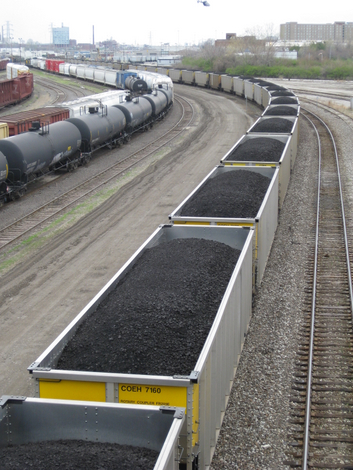 keeps and the kinds of tactics it uses to prevent honest dialogue regarding the causes of climate change and meaningful steps that should be taken to address it. Here's a lot more information from the website of the "Yes Men." And here's Rachel Maddow's report.
If we've learned anything in the past 10 years, we've learned that you can "swiftboat" any person and any Truth, if you have a lot of money. In modern society, truth, all by itself, doesn't have legs. A 2009 poll by Pew Research Center found that "[w]hile 84% of scientists say the earth is getting warmer because of human activity such as burning fossil fuels, just 49% of the public agrees."
According to the March/April edition of Public Citizen News (I have the print edition only), the Chamber's reactionary position has driven away numerous corporate giants such as Nike, General Electric and Apple. Public Citizen has presented a brochure of various legitimate ways of dealing with climate change. Ironically and sadly, the Chamber is wearing narrow blinders that needlessly drive it into the arms of the fossil fuel industries. Those with open minds know that "protecting the climate is not costly but profitable."
Wohlschlegel barged into the fake conference to announce that the fake speaker was not "legitimate." In reality, Wohlschlegel's (and the Chamber's) failure to deal with the issue of climate change honestly shows that they are not legitimate. Nonetheless, the Chamber has lots of money, and thus lots of power to load up the halls of Congress and media airwaves with falsehoods. And if you fill up enough airwaves with false statements, it will confuse the public, meaning that nothing gets done on these two critically important issues of energy supply and climate change. But that is exactly the plan of the Chamber.
keeps and the kinds of tactics it uses to prevent honest dialogue regarding the causes of climate change and meaningful steps that should be taken to address it. Here's a lot more information from the website of the "Yes Men." And here's Rachel Maddow's report.
If we've learned anything in the past 10 years, we've learned that you can "swiftboat" any person and any Truth, if you have a lot of money. In modern society, truth, all by itself, doesn't have legs. A 2009 poll by Pew Research Center found that "[w]hile 84% of scientists say the earth is getting warmer because of human activity such as burning fossil fuels, just 49% of the public agrees."
According to the March/April edition of Public Citizen News (I have the print edition only), the Chamber's reactionary position has driven away numerous corporate giants such as Nike, General Electric and Apple. Public Citizen has presented a brochure of various legitimate ways of dealing with climate change. Ironically and sadly, the Chamber is wearing narrow blinders that needlessly drive it into the arms of the fossil fuel industries. Those with open minds know that "protecting the climate is not costly but profitable."
Wohlschlegel barged into the fake conference to announce that the fake speaker was not "legitimate." In reality, Wohlschlegel's (and the Chamber's) failure to deal with the issue of climate change honestly shows that they are not legitimate. Nonetheless, the Chamber has lots of money, and thus lots of power to load up the halls of Congress and media airwaves with falsehoods. And if you fill up enough airwaves with false statements, it will confuse the public, meaning that nothing gets done on these two critically important issues of energy supply and climate change. But that is exactly the plan of the Chamber.