
Priorities

I spotted this quote by Tom Friedman on Daily Dish:

China is doing moon shots. Yes, that’s plural. When I say “moon shots” I mean big, multibillion-dollar, 25-year-horizon, game-changing investments. China has at least four going now: one is building a network of ultramodern airports; another is building a web of high-speed trains connecting major cities; a third is in bioscience...; and, finally, Beijing just announced that it was providing $15 billion in seed money for the country’s leading auto and battery companies to create an electric car industry... Not to worry. America today also has its own multibillion-dollar, 25-year-horizon, game-changing moon shot: fixing Afghanistan.
The story doesn't end with this helpful and insightful quote. Perhaps, the above quote is an attempt by Friedman to attempt to redeem himself for his pro-war rhetoric from prior years. He has himself to thank for the fact that the U.S. warmongering mentality has caused us to fall so far behind China. And we continue to fall behind China because we can't wake up from our nightmare in which relatively few people armed with unsophisticated weapons such as box-cutters are deemed more dangerous than the Soviet Union at its height, armed with thousands of nuclear warheads. Thus, we will continue to spend more than half of our federal tax revenue on military pursuits. Our exuberant and delusional warmongering is killing our economy and our future.

Continue ReadingPriorities

On tipping points and feedback loops

Malcolm Gladwell popularized the concept of tipping points with his book The Tipping Point: How Little Things Can Make a Big Difference. Although his book was mainly dealing with pop-psychology, the utility of the term has led to its spread throughout several disciplines. But the arena where it has really come into its own is the environmental movement. Scientists have struggled to find a way to explain complex environmental changes in ways that will make them comprehensible to the layperson. The concept of tipping points is just such an explanation. Wikipedia gives us an example of how tipping points can simplify the understanding of climate changes:

A climate tipping point is a point when global climate changes from one stable state to another stable state, in a similar manner to a wine glass tipping over. After the tipping point has been passed, a transition to a new state occurs. The tipping event may be irreversible, comparable to wine spilling from the glass—standing up the glass will not put the wine back.
In much the same way as you can gradually tip a wineglass to the side, climactic or ecological changes can accumulate slowly. Once the tipping point is reached however, gravity or some analogous force takes control and the situation can change rapidly.

Continue ReadingOn tipping points and feedback loops

Is USDA Organic Certifiably Insane?

I saw a very brief and hurried post from ERV on ScienceBlogs. In it, she noted that organic farmers let their animals die from treatable diseases, because to do otherwise would deny them the valuable 'organic' label. WTF? In Europe, organic livestock MUST be treated humanely, and may receive therapeutic medication (including antibiotics) - to do otherwise is a complete denial of everything science and medicine has learned in the past three hundred years. But, apparently, that's what Organic means in the US! As ERV says

'Organic' farmers? All concerned about their free-range, cage-free, at harmony with the Mother Goddess animals? They let their fucking animals die from treatable diseases, because if they treat them with even one dose of antibiotics, the animals are no longer 'organic'.
She quotes Ronnie Cummins, National Director of the Organic Consumers Association
Allowing one-time therapeutic antibiotics is "a slippery slope", and would "undermine consumer confidence in organics. It's the same position [I have] as on human vaccines. They are dangerous, and that's why I didn't vaccinate my kid."
Never mind the epic FAIL in Ronnie Cummin's statement about the dangers of vaccines - that woo is worthy of a post all by itself! The issue is that animals are allowed to die, often painfully, from completely preventable and treatable diseases. Why is this so? ERV linked to her source (this article at the blog "In These Times"). According to that article,
Department of Agriculture (USDA) regulations defining organic standards mandate that if [a] calf had gotten one dose of antibiotics, even to save her life, she could never give organic milk—even after the two years it takes for her to become a milker, and even though neither she nor her milk would retain any trace of antibiotics.
So why would the USDA have such nonsensical standards for 'organic'?

Continue ReadingIs USDA Organic Certifiably Insane?

9,236 gallons of oil

I recently visited the website of Rocky Mountain Institute, where I learned that the United States consumes nearly 19 million barrels of oil per day. That sounds like a lot of oil, but how can I put it into a number that I can understand? Consider, that there are 42 gallons per barrel. I decided to calculate how many gallons American consume each second. The answer? Americans consume 9,236 gallons of oil each second. Consider that an Olympic sized swimming pool holds about 660,000 gallons. Thus, Americans use oil at such a high rate that we could almost fill up an Olympic sized swimming pool every minute, day and night, 365 days a year. Much of that oil is burned for transportation. What can we do in the transportation sector to use oil more efficiently? As individuals, we can use less by walking, biking, using public transportation, carpooling, combining trips and making sure that your engine is tuned and your tires are fully inflated. No Impact Man Colin Beavan offers a free manual full of ideas (register here). Here are 365 more suggestions. RMI suggests an additional way to cut back our use of oil: by using "feebates."

The basic idea of a feebate is simple. Buyers of inefficient vehicles are levied a surcharge (the “fee”), while buyers of efficient vehicles are awarded a rebate (the “bate”). By affecting the purchase cost up front, feebates speed the production and adoption of more efficient vehicles, saving oil, insecurity, cost, and carbon.

One form of a feebate program has been in use in France, where vehicles now have the lowest carbon emissions in the European Union. To read more about feebates, see "Feebates: A Key to Breaking U.S. Oil Addiction."

Continue Reading9,236 gallons of oil

How to get from here to there regarding renewable energy

According to a recent article by Richard Kerr in the August 13, 2010 issue of Science ("Do We Have the Energy for the Next Transition?") it's going to be extremely difficult to move the world away from power-packed fossil fuels to more diffuse and less useful renewable energy:

Never has the world so self-consciously tried to move toward new sources of energy. But the history of past major energy transitions-from wood to coal, and from coal to oil and gas-suggests that it will be a long, tough road to scaling up alternatives to fossil fuels that don't stoke greenhouse warming. The big problem is that, for the first time, the world is moving to tap new energy sources that are, in many ways, less useful and convenient than the currently dominant sources: fossil fuels.

[For instance] oil is densely packed with energy, easily transported and stored, and efficient at releasing its energy in modern engines. Renewables are another matter.

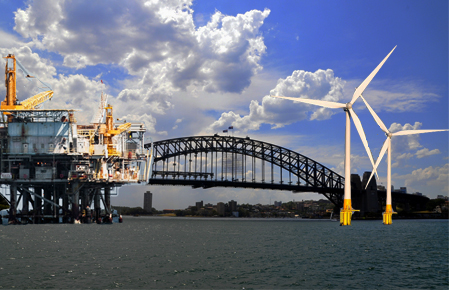
[caption id="attachment_14020" align="alignright" width="300" caption="Image by Erich Vieth (using creative commons images)"][/caption] How much energy do we need to replace? The number is staggering. "Replacing even half of the coal, oil, and gas consumed today would require 6 terawatts of renewable energy . . . In contrast, renewables today produce just 0.5 terawatts." Kerr suggests that oil production might peak at around 2030 and natural gas section might keep pace with demand only until 2050. What then? He suggests the the "sobering reality" that only one renewable, solar energy, could meet future energy demands by itself (although wind power could make significant contributions). All of the other types of renewables "would provide just 1/10 to 1/10000 of today's energy output from fossil fuels." How should we attempt such a daunting transition to cleaner fuels that are otherwise much less desirable? Kerr argues that the best way to approach this transition is to "reduce consumption," and, fortunately, we have the technology for reducing consumption drastically. I previously posted that modest conservation measures with regard to transportation could save enough oil to retire all of the 4000 oil drilling rigs in the Gulf of Mexico. Based on our long and unimpressive track record, Americans will readily express interest in reducing consumption but they lack the political will to actually do so. One huge approach to saving energy would be to immediately implement strict requirements for building highly energy-efficient residences and office buildings. There are many substantial things we could be doing to save energy, if only we cared enough about our future to do so. Kerr closes his article with this less than cheerful conclusion: "Conservation would buy time for meagerly attractive renewables to make some inroads before fossil fuels begin to bow out." (Note: Kerr's article is available online only to subscribers)

Continue ReadingHow to get from here to there regarding renewable energy