About the Climate Emergency . . .

Where are all of those people who, in recent years, insisted that climate change was the most urgent issue, all the while doing NOTHING regarding their personal lifestyle to lower their own impact on the alleged situation?

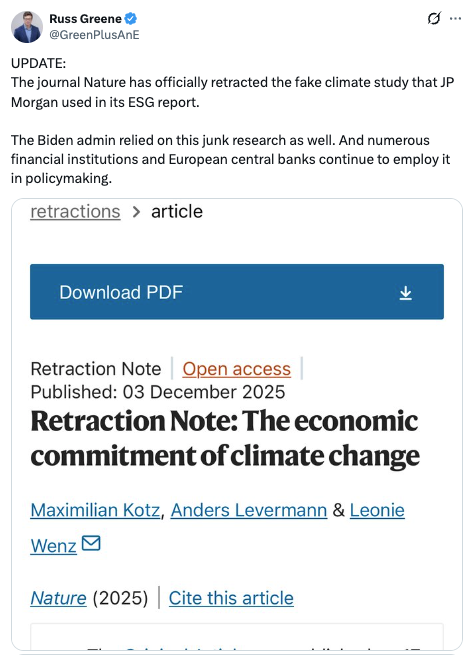
UPDATE: The journal Nature has officially retracted the fake climate study that JP Morgan used in its ESG report.

The Biden admin relied on this junk research as well. And numerous financial institutions and European central banks continue to employ it in policymaking.

Continue ReadingAbout the Climate Emergency . . .

Luxury Beliefs in Chicago

Rob Henderson coined the term "Luxury Beliefs" as follows:

Luxury beliefs are ideas and opinions that confer status on the upper class while inflicting costs on the lower classes.

Here, Rob offers a more expansive discussion:
In addition to my own experiences with social mobility, my luxury beliefs idea stems from Thorstein Veblen’s work, particularly his 1899 book, The Theory of the Leisure Class. Veblen, a sociologist and economist, described how the elites of his era displayed their status through conspicuous consumption, such as wearing delicate, expensive clothing, carrying pocket watches, or attending lavish ballroom events. While material possessions still play a role in signaling status today, I argue that they have become a noisier indicator of wealth. A century ago, one could easily distinguish the rich from the poor based on appearance alone. However, in our wealthier modern society, where access to goods is more widespread, it’s harder to gauge someone’s wealth at a glance.

Instead, status is increasingly expressed through what I call luxury beliefs, which have largely replaced luxury goods. These beliefs reflect what sociologist Pierre Bourdieu termed cultural capital. Elites invest in attending prestigious schools and universities, where they adopt the mannerisms, vocabulary, habits, and fashionable opinions of the upper class. This process enculturates them into the elite and sets them apart from the broader population. For example, while the conventional view might support law enforcement, someone seeking to signal their elite status might advocate for abolishing the police or reimagining law enforcement with ideas like hiring “violence interrupters.” Such unconventional or avant-garde views serve as a way to distinguish oneself from the masses and signal a superior social position.

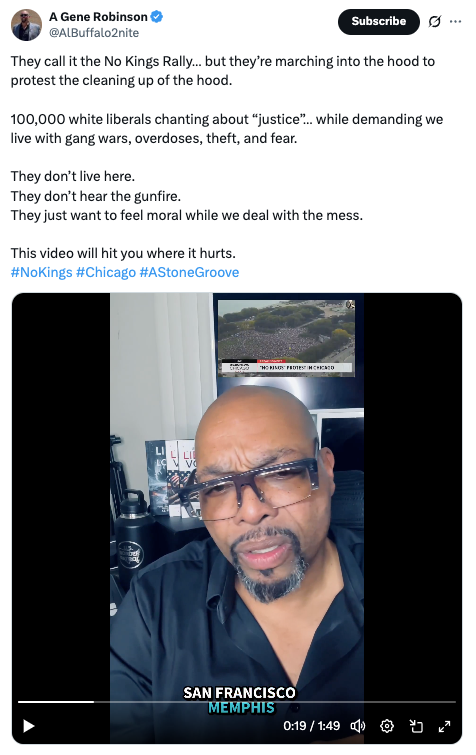
Today, I noticed this post by A Gene Robinson, who doesn't use the term "luxury beliefs," but is angry about non-stop high crime in Chicago contrasted with what he considered the detached cheap signaling of those who participated in the Chicago No Kings Rally:

I asked Grok to compare the economic circumstances of those in Chicago's crime ridden neighborhoods to the circumstances of people who work for corporate media:

Corporate media workers earn 2–5 times more than residents in these Chicago neighborhoods ($60,000+ vs. $25,000–$50,000), enabling comfortable lifestyles with savings, travel, and leisure. They benefit from employer perks like health insurance and flexible time off, contrasting with reliance on public aid in high-crime areas, where poverty rates are 2–3 times higher (40%+ vs. national 12%). Media lifestyles involve professional growth and urban amenities, while these neighborhoods face survival challenges, unemployment-driven desperation, and violence that perpetuates economic stagnation. This disparity highlights broader urban inequalities, where media professionals might even report on these communities from a position of relative privilege.

Then I asked Grok to compare the economic circumstances of those in Chicago's crime-ridden neighborhoods to those who marched in the Chicago no-kings rally:

The economic divide between residents of Chicago's crime-ridden neighborhoods and No Kings rally marchers is stark, highlighting urban inequalities in race, class, and opportunity. Neighborhood residents endure entrenched poverty, with incomes 2–4 times lower than the implied stability of rally participants, who benefit from assets like homes and retirement funds accumulated over decades.

While the former face unemployment, reliance on aid, and violence-linked economic stagnation, marchers—often older, white, and from more affluent backgrounds—enjoy financial security enabling activism without personal economic risk.

This contrast underscores how protests like No Kings may draw from privileged demographics, potentially overlooking the direct economic hardships in the city's most vulnerable areas.

Continue ReadingLuxury Beliefs in Chicago

Our Dependence on Petroleum-Based Fuel

How many gallons does of petroleum based products (gasoline, diesel, jet fuel and many other uses) does the entire world use every second?

First of all, I asked Grok (follow this link for a deeper dive):

Global oil demand (including both fuel and non-fuel uses) is currently around 104.6 million barrels per day.

Approximately 84% of this demand is for fuel uses (energy consumption), while the remaining 16% is for non-energy purposes like petrochemical feedstocks, lubricants, and asphalt. This ratio is derived from comparing IEA's reported energy consumption from oil (193 EJ in 2024, equivalent to ~86.4 million barrels per day) against total oil demand (102.8 million barrels per day in 2024), and scaling proportionally to current levels.

Fuel demand = 104.6 million barrels/day × 0.84 ≈ 87.9 million barrels/day. Convert to gallons per day: 87.9 million barrels/day × 42 gallons/barrel ≈ 3.69 billion gallons/day.

Convert to gallons per second: 3.69 billion gallons/day ÷ 86,400 seconds/day ≈ 42,732 gallons/second.

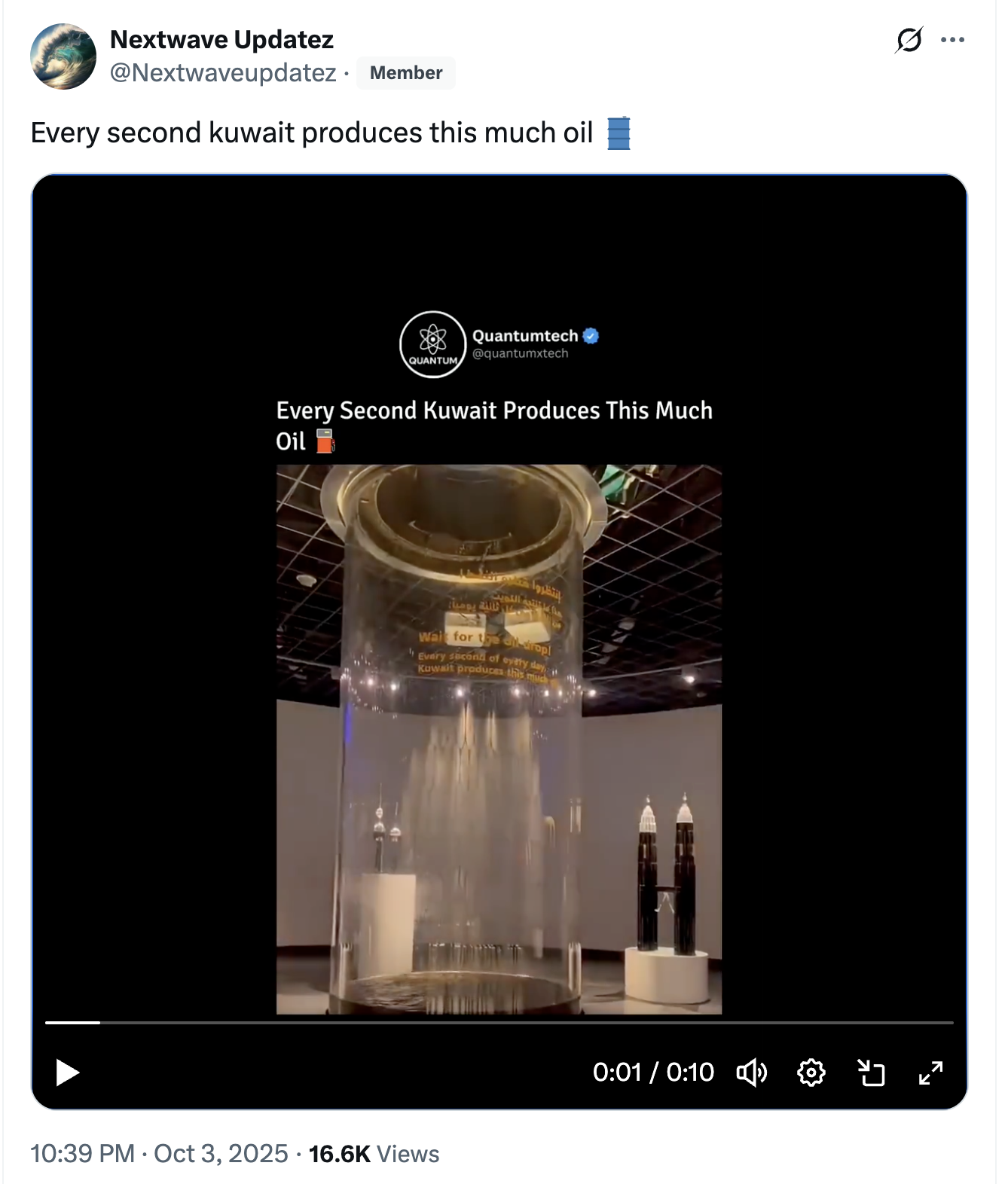
Next, I'll leave you with this shocking visual that pertains to the oil produced only by Kuwait every second:

I'm reminded of a comment made to me by an engineer who worked in the field of petroleum. He said it is perhaps the greatest achievement of human beings to be able to extract as much petroleum for use by human beings at such a moderate cost per gallon.

I'm also reminded of the many people who claim that we can replace all of this oil usage with wind and solar. I am skeptical of that claim when I read of the immense volume of oil we use.

Continue ReadingOur Dependence on Petroleum-Based Fuel

Coleman Hughes Contemplates the End of Life

Coleman Hughes has written a personal account of the excruciating death of his mother. What follows is an excerpt from "My Mom—and the Case for Assisted Death: My dying mother chose to end terrible suffering. I want others to have that choice, too."

Instead of a slippery slope, what has emerged over the past three decades are two distinct policies: one restricted to people on their deathbed and exemplified by Oregon, Australia, and New Zealand; and the other open to anyone who is “suffering” and exemplified by the Benelux nations and Canada, without any slippage between the two. It is not a coincidence that all the horror stories come from the latter. The lesson for the rest of the world is not to throw out assisted dying altogether, but to copy the policy that works, and avoid the policy that doesn’t.

Aside from the major objections, critics have leveled many practical objections: Do doctors always know when someone has six months to live? Are fatal drugs always painless? What if relatives pressure someone to commit suicide? I may go through these one by one some other time, but here I will simply say this: Once you understand how much suffering is on the other side of this moral equation—that is, once you understand just how bad “bad deaths” are—then you must view these practical objections as problems to be addressed, rather than as reasons to jettison the whole policy.

It is commonly said that a huge percentage of our healthcare spending comes in the last year of life. But the far more important corollary is rarely said: In many cases, a huge portion—perhaps a majority—of our lifetime suffering comes not just in the last year, but in the last few months. Assisted dying therefore represents an opportunity to prevent an immense amount of needless suffering in the world. If my mother’s story can help even one person come around to this view, then I can say that she did not suffer completely in vain.

I think of these issues every so often. And I often think back to my college days when I volunteered as a counselor and trainer for Suicide Prevention in St. Louis. After doing my best for several years I left. I had had several cases where I did my best to encourage people to live another day, but where I privately wondered whether that was the kind of advice I would want were I in a situation that was truly (not merely apparently) hopeless. I'm referring to people who were terminally ill, jobless, in constant pain, who had no longer had family or friends to look out for them. People who had worked hard for months to find reasons to keep on living but no longer could. People for whom the things that once brought them great joy were no longer interesting to them.

I hope that humane people will step up to help me in my moment of need, people who have the courage to show mercy rather than to obsess about the "rules."

Continue ReadingColeman Hughes Contemplates the End of Life

Our Incredible Shrinking Attention Span

Gloria Mark is a professor of informatics at the University of California, Irvine. She has documented an overall shrinking of the attention span of Americans. This is not a good thing for various reasons, including switching costs. Here is an excerpt from her interview by Kim Mills:

Mills: . . . How much have our attention spans shrunk?

Mark: So we started measuring this back in 2004, and at the time the measures that we used were stopwatches because that was the most precise thing we had at the time. We would shadow people with stopwatches for every single activity they did. We would record the start time and the stop time. So you're on a screen where you're working in a Word doc, as soon as you get to that screen, we clicked start time, soon as they turned away and checked email, we clicked stop time for the Word document, start time for the email. But fortunately, sophisticated computer logging methods were developed, and so of course we switched to those. So back in 2004, we found the average attention span on any screen to be two and a half minutes on average. Throughout the years it became shorter. So around 2012 we found it to be 75 seconds.

This is with logging techniques. This is an average. And then in the last five, six years, we found it to average about 47 seconds, and others have replicated this result within a few seconds. So it seems to be quite robust. Now, another way to think about this result is the median. The median means the midpoint of observations. The median is 40 seconds. And what this means is that half of all the measurements that we found were 40 seconds or less of people's attention spans. Now obviously because we're talking about averages and medians, sometimes people do spend longer, but quite a good bit of the time, their attention spans are much shorter and with an average coming to 47 seconds.

Mills: So why is this a problem? Since it seems to be happening almost universally at this point, is this just the new normal?

Mark: It seems to be the new normal because we seem to have reached a steady state over the last five or six years where these are the measures that we're seeing. Is this a good thing? I would argue it's not a good thing for the following reasons. First of all, we find in our research a correlation between frequency of attention switching and stress. So the faster the attention switching occurs, stress is measured by people wearing heart rate monitors. We show that stress goes up. We know from decades of research in the laboratory that when people multitask, they experience stress, blood pressure rises. There's a physiological marker in the body that indicates people are stressed. And in our studies, we've also simply asked people with well valid instruments to report their stress, their perceived stress, and it's reported to be higher the faster that we measure attention shifting.

So all of these measures seem to be consistent. I'll also measure that when people shift their attention so fast, and this is multitasking, when you keep switching your attention among different activities, people make more errors. And that's been shown in studies in the real world with physicians, nurses, pilots. We also know that performance slows. Why? Because there's something called a switch cost. So every time you switch your attention, you have to reorient to that new activity, that new thing you're paying attention to, and it takes a little bit of time.

An article by Jac Mullen of The Nation indicates that this is hurting students:

By many measures, our powers of attention appear to be rapidly deteriorating. The average attention span of the individual has seemingly contracted almost 70 percent in the last 20 years, for instance, and our collective attention span is reported to be shrinking as well. Overwhelmingly, people report that their capacity for sustained focus is declining, along with their ability to engage in deep thought. There is growing evidence that many of the methods devised to continually reengage an already depleted attention, or to seize a developing capacity for focus, pose special dangers to children: A recent spate of publications, for instance, highlight evidence linking“chronic sensory overstimulation (i.e., excessive screen time)” during brain development to cognitive impairment and substantially increased risks of early-onset dementia in adulthood.

According to Cal Newport, in his 2021 book, Deep Work: Rules for Focused Success in a Distracted World. What we need is less of the above and more "deep work":

Deep Work: Professional activities performed in a state of distraction-free concentration that push your cognitive capabilities to their limit. These efforts create new value, improve your skill, and are hard to replicate. Deep work is necessary to wring every last drop of value out of your current intellectual capacity. We now know from decades of research in both psychology and neuroscience that the state of mental strain that accompanies deep work is also necessary to improve your abilities. . . Indeed, if you study the lives of other influential figures from both distant and recent history, you’ll find that a commitment to deep work is a common theme. . . .

A 2012 McKinsey study found that the average knowledge worker now spends more than 60 percent of the workweek engaged in electronic communication and Internet searching, with close to 30 percent of a worker’s time dedicated to reading and answering e-mail alone.

This state of fragmented attention cannot accommodate deep work, which requires long periods of uninterrupted thinking. At the same time, however, modern knowledge workers are not loafing. In fact, they report that they are as busy as ever. What explains the discrepancy? A lot can be explained by another type of effort, which provides a counterpart to the idea of deep work:

Shallow Work: Noncognitively demanding, logistical-style tasks, often performed while distracted. These efforts tend to not create much new value in the world and are easy to replicate.

In an age of network tools, in other words, knowledge workers increasingly replace deep work with the shallow alternative— constantly sending and receiving e-mail messages like human network routers, with frequent breaks for quick hits of distraction. Larger efforts that would be well served by deep thinking, such as forming a new business strategy or writing an important grant application, get fragmented into distracted dashes that produce muted quality.

To make matters worse for depth, there’s increasing evidence that this shift toward the shallow is not a choice that can be easily reversed. Spend enough time in a state of frenetic shallowness and you permanently reduce your capacity to perform deep work.

Continue ReadingOur Incredible Shrinking Attention Span