
Jonathan Haidt Discusses Two Versions of Identity Politics: “Common Enemy Politics” and “Common Humanity”

I've followed Social Psychologist Jonathan Haidt closely for many years (as you can see by searching for his name at DI). He is the author of several excellent books, including The Happiness Hypothesis, The Righteous Mind: Why Good People Are Divided by Politics and Religion and The Coddling of the American Mind. Haidt's thought process crosscuts the prevailing two wings of political thought in the United States. In this extended interview with Joe Rogan, Haidt dissects many topics, including identity politics. He urges that this phrase encompasses two separate approaches, "Common Enemy Politics" and "Common Humanity."

Haidt also distinguishes between two prevalent types of conversations, two types of "games" being played that often make conversations frustrating. Many of us insist upon playing the "truth seeking game," while others play a game that assumes a Manichean battle where A) no one gains except at the expense of someone else, B) where people are not seen as individuals but a members of groups, and C) you can tell who someone is merely by their appearance. Much of the fruitless dialogue on social media and elsewhere makes a lot more sense once we realize that these two approaches have virtually nothing in common--they serve entirely different purposes. Just because we exchange words does not mean we are, in any meaningful way, communicating.

I'm strongly in agreement with Haidt's analysis.

Haid's distinction parallels David Sloan Wilson's distinction between science-oriented "factual realism" and group-survival-oriented "practical realism."

In addition to embedding the video of the interview, I invested some time to create a transcript of several sections of this interview, from about Min. 33 - 55. I have cleaned up the wording to omit throat-clearings and false starts, but I have worked hard to be true to the substance of the conversation.

--

Haidt – Rogan Interview

33:18 JH: You have to look at different games being played. Yale was a place that taught me to think in lots of different ways and it was constantly blowing my mind when I took my first economics course. It was like wow, here's a new pair of spectacles that I can put on and suddenly I see all these prices and supply. I never learned to think that way, where I learned about Freud in psychology or sociology. A good education is one that lets you look at our complicated world through multiple perspectives. That makes you smart. That's what a liberal arts education should do. But what I see increasingly happening, especially at elite schools, is the dominance of a single story, and that single story is life is a battle between good people and evil people, or rather good groups and evil groups, and it's a zero-sum game. So if the bad groups have more, it's because they took it from the good groups, so the point of everything is to fight the bad groups. Bring them down create equality and this is a terrible way to think in a free society. That might have worked you know in biblical days when you got the Moabites killing the Jebusites or whatever, but you know we live in an era in which we've discovered that that the pie can be grown a million-fold. So to teach students to see society as a zero-sum competition between groups is primitive and destructive.

34:22 JR: In your book, you actually identify the moment where these micro aggressions made their appearance and they were initially a racist thing.

JH: Yeah. The idea of a micro aggression really becomes popular in a 2007 article by Derald Wing Sue at Teachers College. He talks about this concept of microaggressions. There are two things that are good about the concept, that are useful. One is that explicit racism has clearly gone down--by any measure explicit racism is plummeted in American across the West—but there could still be subtle or veiled a racism.

37:27 JR It's ultimately for everyone's sake, I mean, even for the sake of the people that are embroiled in all this controversy and chaos. It would be fantastic across the board if there was no more sexism, there was no more racism, there was no more any of these things. It would be wonderful. Then we could just start treating humans as just humans. Like this is just who you are you're just a person. No one cares. What a wonderful world we would live in if this was no longer an issue at all.

JH: Beautifully put.

JR: How does that get through?

38:01 JH: We were getting there, okay? That's what the twentieth century was. We were shaped by the late 20th century. The late 20th century was a time in America in which, you know, earlier on there was all kinds of prejudice. I mean, when I was born, just right before you were born, it was legal to say you can't eat here because you're Black and so that changed in 1964-65. But it used to be that we had legal differentiations by race and then those were knocked down. But we still had social [discrimination] and it used to be that if you were gay that was something humiliating. It had to be hidden. If you look at where we were in 1960 or ’63, when I was born and then you look at where we got by 2000, the progress is fantastic on every front, so that's all I mean when I say we were moving in that direction.
Continue ReadingJonathan Haidt Discusses Two Versions of Identity Politics: “Common Enemy Politics” and “Common Humanity”

Seattle Office of Civil Rights About to Be Sued for Unapologetic Racism

It's the year 2020 and Christopher Rufo is about to file a civil rights complaint against Seattle's Office of Civil Rights. No, you didn't misunderstand me.

Rufo is the director of the Discovery Institute’s Center on Wealth & Poverty. He’s directed four documentaries for PBS and is currently a contributing editor for City Journal, where he covers homelessness, addiction, mental illness, crime, and other afflictions.  He explains:

Seattle’s Office of Civil Rights has developed a “race and social justice” curriculum for all 10,000 city employees.

I’ve obtained new documents from the city’s segregated “whites-only” trainings, which induct white employees into the cult of critical race theory.

The trainers require white employees to examine their “relationships with white supremacy, racism, and whiteness” and explain how their “[families] benefit economically from the system of white supremacy even as it directly and violently harms Black people.”

Under the banner of “antiracism,” Seattle’s Office of Civil Rights is now explicitly endorsing principles of segregationism, group-based guilt, and race essentialism—ugly concepts that should have been left behind a century ago.

Rufo has posted the training documents used by the Office on his website.

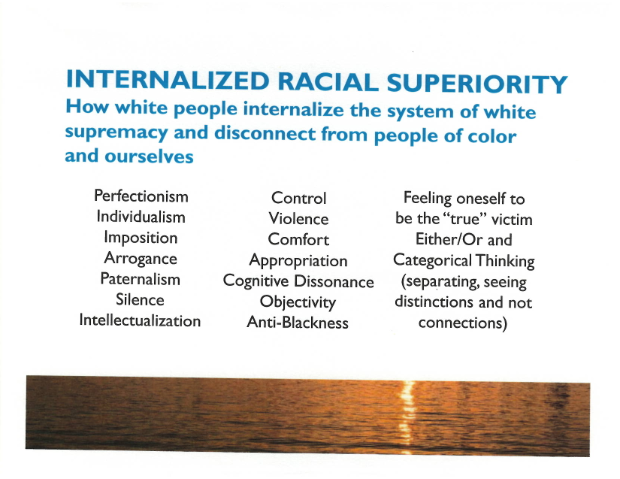
Here's a sample from the training material:

Continue ReadingSeattle Office of Civil Rights About to Be Sued for Unapologetic Racism

Senator Ted Cruz Invites Eric Weinstein to Diagnose the United States

It is critically important for you to watch this one-hour video, "The Verdict," Hosted by Senator Ted Cruz. If you are thinking "Why the fuck would I want to see any show hosted by Ted Cruz, you are a big part of the problem, because on this show (released July 23) Cruz has reached far from his comfort zone, inviting Eric Weinstein as a guest. If you are worried about the future of the United States, I guarantee that you have an hour for this.

I follow Eric Weinstein on Twitter and on the "Dark Web" because he is consistently brilliant. I found this video on Weinstein's Twitter feed. I didn't quite know what to expect if you put Eric in the same room as Ted Cruz, but it was riveting, and I respect Cruz for giving Weinstein lots of space to present ideas that are highly critical of both the left and the right. The resulting conversation was not out of any typical political playbook and it offers promising new ways to conceptualize intransigent national conundrums.

Topics included the abject failure of both political parties. The rise of the Maoists on the Left. The fact that the moderates of the two dominant parties need to jettison their extremes and come together. "WTF happened in 1971?" The fact that "rent-seeking" (the practice by which the source of one's wealth is non-productive) has destroyed national growth; the resulting economic stress is exposing social pathogens that have always been around, but they are now more visible. The modern media as Shakespeare's character of Iago, poisoning our national dialogue at every turn. "Russell Conjugations" (referencing Bertrand Russell). Our failure to practice "Critical Feelings" (as opposed to critical thinking) ("Most of our feelings are not OUR feelings, but feelings that we inherit through daily programming, convincing us that those people that think differently than us are evil." The failures of universities. The lies about immigration that are a cover-up to a scheme to exchange citizenship for free university labor. That a successful national response to COVID-19 should have been a "layup," and what this failure says about us (our entire leadership class of both parties is "unworkable").

[Ted Cruz]: How do we get from Othello to midsummer night's dream?

[Eric Weinstein]:

The key issue is that we have to start talking about our own failures. What I hope you've heard is that I'm willing to call out the Left, the right, and the libertarian. The libertarian problem is that it doesn't work to pretend that we're all atomistic. We see that with respect to contagion and masks and the like. Arnold Kling has this beautiful description. He says that you have three Groups: progressives conservatives and Libertarians. Libertarians are animated principally by hating coercion, progressives are animated principally by hating oppression, and conservatives are principally animated by needless loss of hard-won traditions and gains over past generations. The answer is that any sensible person should want to make sure that they're optimizing among the three, and not to become part of a simplistic situation whereby they so hate coercion or so hate oppression that they lose sight of the entire picture and therefore lose the plot of the American Project.

Continue ReadingSenator Ted Cruz Invites Eric Weinstein to Diagnose the United States

How to Become an Award-Winning Woke Researcher Overnight, and Why this is a Terrible Thing for Civil Rights in America.

How to become an award-winning Woke all-star author instantly, and why the success of this pranking-seeming project is a terrible thing for civil rights in America. Special Honor to physicist Alan Sokal for pioneering this approach to pouring sunshine on nonsense. James Lindsay, Peter Boghossian and Helen Pluckrose did the hard work to make this happen.

Continue ReadingHow to Become an Award-Winning Woke Researcher Overnight, and Why this is a Terrible Thing for Civil Rights in America.

A Giant Leap Backwards for Humankind: What the Smithsonian’s National Museum of African American History & Culture Thinks About White People

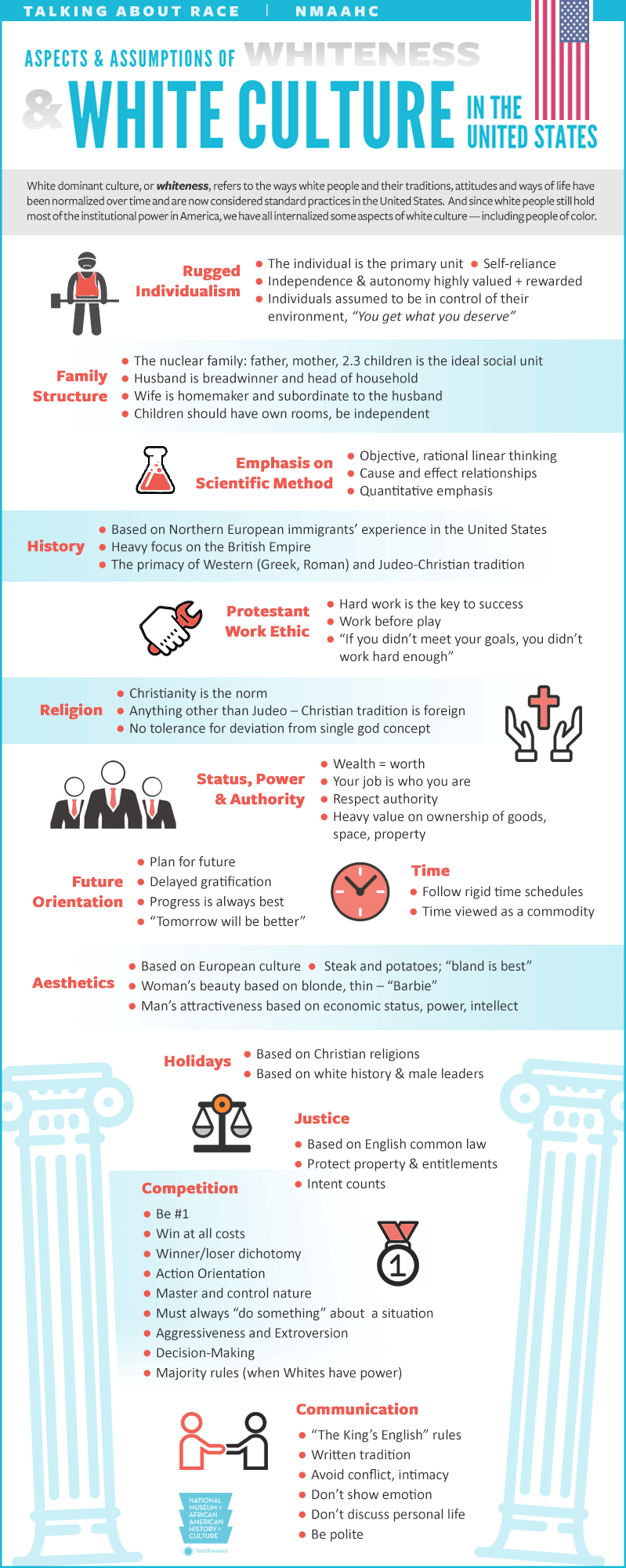
What would you think if a Fortune 500 Corporation Human Resources Director walked up to a podium and announced the following to a big crowd: "Whiteness and white racialized identity refer to the way that white people, their customs, culture, and beliefs operate as the standard by which all other groups of are compared.”

Say what?

Assume further that this HR Director then announced that the following are the “common characteristics of most U.S. White people most of the time”:

  • White people are self-reliant;
  • White people are independent and they highly value autonomy;
  • White people use the Scientific Method, with objective rational linear thinking, cause-and-effect relationship and quantitative emphasis;
  • White people delay gratification and follow rigid time schedules.
  • White people believe the ideal social unit is the nuclear family of father, mother and 2.3 children;
  • The children of white people have their own rooms and they are independent;
  • White people believe hard work is the key to their success and they believe “work before play”;
  • White people plan for the future by delaying gratification and they follow rigid time schedules.

Upon hearing this list, you would strongly suspect that you were listening to a white supremacist or that you had unwittingly stepped into a time warp that threw you back 200 years. Upon reminding yourself that this is actually the year 2020, you would conclude that this big corporation should be sued out of existence based on civil rights violations for creating a hostile work environment for its Black employees.

Unfortunately the source of these words and ideas is a webpage of the National Museum of African American History & Culture, a Smithsonian museum supported by U.S. taxpayers. Here is separate image of the “Whiteness” infographic. 

How does one even begin to articulate the many problems with these ideas?  How should concerned people respond when false information is being used to divide us. What is the solution when a public museum dedicated to African American history mocks the words of Martin Luther King?

I write this article fully acknowledges that racist conduct can still be found in many places in 2020 and that this bigotry should be dealt with aggressively through civil rights laws and social condemnation. We must condemn all real instances of racism, but we must simultaneously question the foundational concept of "race" from which the possibility or racism sprouts.  In short, anyone who wants to eviscerate racism needs to fight a two-front war. NMAAHC's "Whiteness" page doubly fails to fight this two-front war on racism.

Advocating that we should treat people differently based on skin color (as NMAAHC is enthusiastically doing) is throwing gasoline on our racial fires. The "Whiteness" page is stunningly divisive and it is factually unhinged. I would no more expect NMAAHC to be teaching us to be racist than I would expect the American Museum of Natural History to be teaching us that the earth was created 6,000 years ago and that modern humans co-habited our planet with the dinosaurs.

It is demonstrably false that people are born color-coded such that others can determine their personalities, habits and skills by noticing their skin color. That's because immutable traits of individuals, such as skin color, do not determine personality, resilience, aesthetics, capacity for empathy, intelligence, aspirations, parenting skills or any of the other human traits discussed on the NMAAHC "Whiteness" webpage. Skin color doesn't  dictate content of character any more than the many other things over which we have no control, things such as eye color, hair color, whether we have six toes, our birth date or the types of bumps we have on our heads. Constricting the way we evaluate people by using an Overton Window of black versus white  uses the exact same flawed approach used by astrology and phrenology, which also proclaim content of character by reference to equally irrelevant observations.

Many of the human traits listed on the museum’s website ("work before play" and "rational thinking") are demonstrably not true of many “white” people. Many of these same traits are compellingly true of (and embraced as valuable by) many successful Blacks.

NMAAHC's suggestion that we bifurcate people into "white" and "black" is based on an enormous falsehood. There is no meaningful way to distinguish who is white and who is black, because we are all varying degrees of brown, we are all from Africa (and see here) and we are all interrelated.Trying to determine who is more closely related to whom by physical appearance is often counter-intuitive:

By analyzing the genes of present-day Africans, researchers have concluded that the Khoe-San, who now live in southern Africa, represent one of the oldest branches of the human family tree. The Pygmies of central Africa also have a very long history as a distinct group. What this means is that the deepest splits in the human family aren’t between what are usually thought of as different races—whites, say, or blacks or Asians or Native Americans. They’re between African populations such as the Khoe-San and the Pygmies, who spent tens of thousands of years separated from one another even before humans left Africa.

Nor is there any meaningful basis for declaring that there is any unified "white culture" or a unified "Black culture." No people of any color all think the same. Not even close. No person has been authorized by all whites or all Blacks to speak on their behalf.  Not even close. "Race" is a stunningly unscientific concept.

There is more genetic diversity within a “race” than between "races.". Further, "there is no homogeneous African race" and "there is more diversity in Africa than on all the other continents combined" (see graphic under this title here) . As reported by National Geographic in an article titled, "There’s No Scientific Basis for Race—It's a Made-Up Label,"

[W]hen scientists set out to assemble the first complete human genome, which was a composite of several individuals, they deliberately gathered samples from people who self-identified as members of different races. In June 2000, when the results were announced at a White House ceremony, Craig Venter, a pioneer of DNA sequencing, observed, “The concept of race has no genetic or scientific basis.”

Continue ReadingA Giant Leap Backwards for Humankind: What the Smithsonian’s National Museum of African American History & Culture Thinks About White People