
Inoculation for Atheism

In the shadow of all the antivax buzz lately, I'd like to recommend a process of intellectual inoculation for children. This post is based on Best Practices 5: Encourage religious literacy from The Meming of Life. It illustrates the benefit of teaching your children about religion, to protect them from its excesses. McGowan argues that parents who want their kids to follow in their secular (agnostic/atheist/ignostic/etc) footsteps should not obsessively protect them from all exposure to the churchy crowd. Rather one needs to gradually expose them to doses of gentle strains of all the relevant faith memes. If not, they will be vulnerable to the first virulent strain to come along when they begin independent thought, and have a "teen epiphany". (Excerpt)

Struggles with identity, confidence, and countless other issues are a given part of the teen years. Sometimes these struggles generate a genuine personal crisis, at which point religious peers often pose a single question: "Don't you know about Jesus?" If your child says, "No," the peer will come back incredulously with, "YOU don't know JESUS? Omigosh, Jesus is The Answer!" Boom, we have an emotional hijacking. And such hijackings don't end up in moderate Methodism. This is the moment when nonreligious teens fly all the way across the spectrum to evangelical fundamentalism.

A little knowledge about religion allows the teen to say, "Yeah, I know about Jesus"-and to know that reliable answers to personal problems are better found elsewhere.

It is best to start early. Bedtime stories should have consistency for the comfort of the child, and variety to hold the interest of the child. Maybe do a month of "how we got here" stories from various cultures. Kipling, Torah, Norse, Navajo, Hindu, and so on. Show the richness of cultures and the similarities of ideas that underlie all the world religions. But parents need to be prepared. Learn about oral traditions and the power of mythos. Read Joseph Campbell , Homer , and The Arabian Nights . Know of Gilgamesh and Beowulf and Odin , the Ring of the Nibelungen and the Bhagavad Gita , and certainly know the current local favorite, the Torah .
Continue ReadingInoculation for Atheism

Color-coded history

Consider this description of a significant and tragic event in American history:

[Occurring in May and July 1917, this event] was an outbreak of labor and racially motivated violence against blacks that caused an estimated 100 deaths and extensive property damage in [an American industrial city]. It was the worst incident of labor-related violence in 20th century American history, and one of the worst race riots in U.S. history. It gained national attention. The local Chamber of Commerce called for the resignation of the Police Chief. At the end of the month, ten thousand people marched in silent protest in New York City over the riots, which contributed to the radicalization of many.

[paraphrased from Wikipedia]

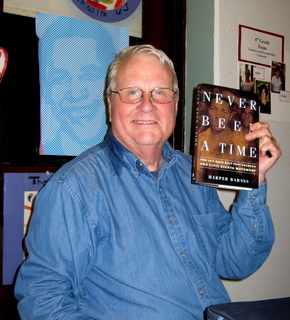
Do you know anything about the event described above? The above passage describes the East St. Louis race riot that occurred on Monday, July 2, 1917. I learned about this riot for the first time tonight when I had the opportunity to hear a talk by Harper Barnes, a St. Louis journalist who has recently written a book called Never Been a Time: The 1917 Race Riot That Sparked the Civil Rights Movement. [caption id="attachment_5419" align="alignright" width="150" caption="Harper Barnes - Photo by Erich Vieth"]Harper Barnes - Photo by Erich Vieth[/caption] In 1914, the first world war was heating up and so were the heavy industries. East St. Louis, Illinois, located right across the Mississippi River from St. Louis, Missouri, was the home of large aluminum and steel plants. To backtrack, through the 1910s, one-half million blacks who had resided in the rural South moved up to northern cities. Employers made use of these blacks as strikebreakers. The blacks certainly wouldn't have felt much loyalty toward the unions, because the white unions banned black workers.

Continue ReadingColor-coded history

Should science study race and IQ?

Should science study race and IQ? A recent article in Nature ("Should scientists study race and IQ") says yes, as long as the research is done carefully and kept free of outside influence and premature application by social scientists and politicians. Science did not give rise to bigotry. After all, scientific studies of race and IQ began in relatively modern times, only after long centuries of "pernicious folk-theories of racial and gender inferiority predated scientific studies." The authors believe that first-rate scientific research will, in the end, dispel much of the racial bigotry that still exists.

Some scientists hold more 'acceptable' views, ourselves included. We think racial and gender differences in IQ are not innate but instead reflect environmental challenges. Although we endorse this view, plenty of scholars remain unpersuaded. Whereas our 'politically correct' work garners us praise, speaking invitations and book contracts, challengers are demeaned, ostracized and occasionally threatened with tenure revocation.

Acts of censure edge close to Lysenkoism. They also do a disservice to science. When dissenters' positions are prevented exposure in high-impact journals and excluded from conferences, the dominant side goes unchallenged, and eventually its rationale is forgotten, forestalling the evolution of crucial ideas.

I am sympathetic to the need to for scientists to carefully examine everything, no exceptions. I'm concerned, though, that we need to look extra-closely at the concept of "race," which I consider to be virtually useless in daily matters. Nor should we allow the simplistic concept of "IQ" to serve as a variable, given much more expansive ways to measure intelligence (see, for example this post on Howard Gardner's work). For more on the dangers of misusing "IQ," see Steven J. Gould's 1996 book, "The Mismeasure of Man."

In sum, we should do good science and I believe that good science would suffocate bigotry. The article points out several examples of this. Good science should be done on only after kicking out the clumsy, pernicious concepts of "race" and "IQ," reframing the debate as the relationship between fine-grained genotypic variation and competence in each of the many ways in which humans display competence. Because genotypic variation within "races" is at least as wide as genotypic variation among "races," a meaningful scientific exploration would not amount to a simplistic survey of how people with different colors of skin do on standardized intelligence tests. That would not be good science. Good science will always take into account the convoluted ever-changing environment, and that is not easy to do when we are dealing with basic concepts that are vague.

I'm not convinced that we are prepared to begin the necessary research on this general topic, because too many of us, including many well-trained scientists, have not done their ontological homework (consider the incoherent and clumsy stumblings of DNA co-discoverer James Watson, described in the article). Are "race" and "IQ" useful constructs with which to do this sort of research? Time will tell if we are intelligent enough to sharpen our constructs before running off to demonstrate our "truths."

Continue ReadingShould science study race and IQ?

Who were the prisoners of Guantanamo?

Who were the prisoners of Guantanamo? Andy Worthington has compiled a four-part series telling us their stories. Here's the disturbing bottom line:

[A]t least 93 percent of the 779 men and boys imprisoned in total — were either completely innocent people, seized as a result of dubious intelligence or sold for bounty payments, or Taliban foot soldiers, recruited to fight an inter-Muslim civil war that began long before the terrorist attacks of September 11, 2001, and that had nothing to do with al-Qaeda, Osama bin Laden or international terrorism.

I don't pretend to know enough to know whether these accounts are totally accurate, but they are filled with details, personal anecdotes, statistics and reports regarding individual court cases. It has a strong ring of authenticity. Further, these individual accounts corroborate general accounts produced elsewhere. I have no reason to disbelieve any part of Andy Worthington's work. He is a well-reputed journalist who has published elsewhere, such as this post at Huffington Post. I am proud to be an American. America does much right in the world and has the potential to do much more that is admirable. This account by Andy Worthington, however, describes America at its shameful worst.

Continue ReadingWho were the prisoners of Guantanamo?