
The Relevant Divide is Mostly About Economic Class, not Race
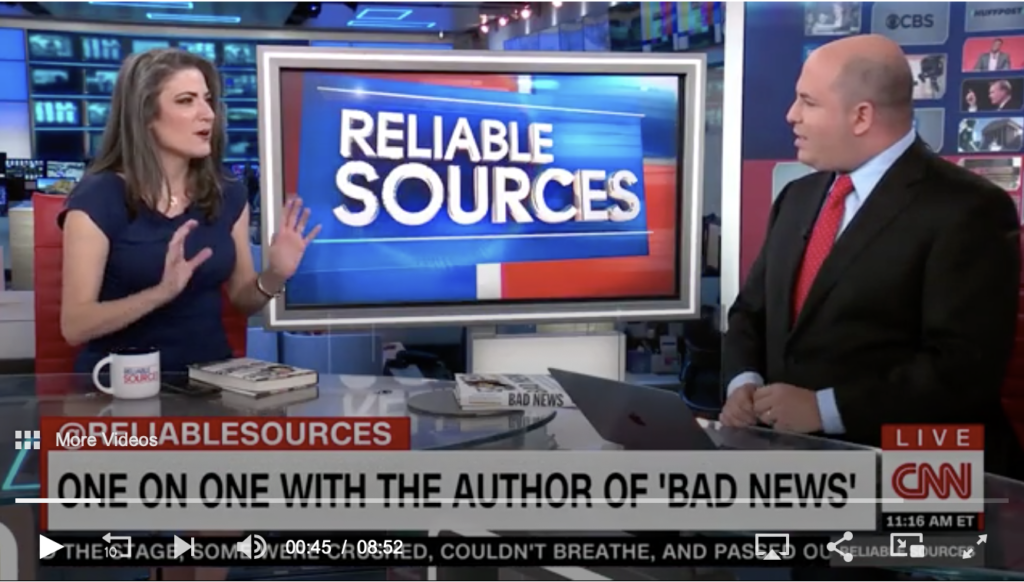
Newsweek's Batya Ungar-Sargon, author of Bad News: How Woke Media Is Undermining Democracy, speaks with CNN's "Reliable Sources" about how the media covered the Virginia gubernatorial election.

We are hiding a class divide in America," she said. "We are hiding disgusting levels of income inequality in America. We are hiding the total dispossession of the working class of all races by focusing on a very highly specialized academic language about race.

Louis Gates, writing at the NYT in 2016:

The Harvard sociologist William Julius Wilson calls the remarkable gains in black income “the most significant change” since Dr. King’s passing. When adjusted for inflation to 2014 dollars, the percentage of African-Americans making at least $75,000 more than doubled from 1970 to 2014, to 21 percent. Those making $100,000 or more nearly quadrupled, to 13 percent (in contrast, white Americans saw a less impressive increase, from 11 to 26 percent). Du Bois’s “talented 10th” has become the “prosperous 13 percent.”

But, Dr. Wilson is quick to note, the percentage of Black America with income below $15,000 declined by only four percentage points, to 22 percent.

In other words, there are really two nations within Black America. The problem of income inequality, Dr. Wilson concludes, is not between Black America and White America but between black haves and have-nots, something we don’t often discuss in public in an era dominated by a narrative of fear and failure and the claim that racism impacts 42 million people in all the same ways.

More statistics from a 2016 NYT article: "Class Is Now a Stronger Predictor of Well-Being Than Race"

Here’s a true statement: America’s historical mistreatment of blacks was uniquely evil and continues to depress the fortunes of African-Americans. Here’s another true statement: Class has become a stronger predictor of wellbeing than race. . . .

Social class “is the single factor with the most influence on how ready" a child is to learn when they start kindergarten, according to the liberal Economic Policy Institute. Low-income white kids score considerably lower in reading and math skills than middle-class white kids. Add race to the mix, and class still remains the Great Divide when it comes to school readiness.

America has hurt blacks grievously; their progress remains dismally slow. But working-class whites are in free fall. The educational achievement gap is now almost two times higher between lower and higher income students than it is between black and white students. That’s a big change from the past: In 1970, the race gap in achievement was more than one and a half times higher than the class gap. Since then, says Stanford University’s Sean Reardon, the class gap has grown by 30 to 40 percent, and become the most potent predictor of school success.

While single parent families are far more common among African-Americans than whites, less educated whites — who also tend to be lower income — are seeing an unprecedented dissolution of their families. Seventy percent of whites without a high school degree were part of an intact nuclear family in 1972; that number plummeted to 36 percent by 2008. (The comparable numbers for blacks were 54 percent and 21 percent.)

One more set of statistics regarding income of blacks (from Wikipedia).

27.3% of black households earned an income between $25,000 and $50,000, 15.2% earned between $50,000 and $75,000, 7.6% earned between $75,000 and $100,000, and 9.4% earned more than $100,000.
Continue ReadingThe Relevant Divide is Mostly About Economic Class, not Race

Sizing up Diversity Training: Is it Education or is it Indoctrination?

At Counterweight, Chuck Almdale has offered a thoughtful list of ten warning signs in his article at Counterweight: "Ten Signs your Diversity Training Session is CSJ Indoctrination."

Here are the titles to the ten warning signs:

1. It’s mandatory.

2. “Listen with curiosity, without judgment.”

3. “Check your privilege.”

4. “How do you identify?”

5. “What are your pronouns?”

6. Black Allyship.

7. No humor.

8. Shaming for disagreement or critical questions.

9. Diversity of race, gender and ethnicity but not of thought or speech.

10. New terms, rarely supported or defined.

Here's an excerpt on point 8:

Questions are permitted only to increase your shame and acquiescence to their program, as in “How do I stop behaving as a privileged white woman?” Critical questions about their statements or behavior are not permitted. They’ll say, “You’re pulling a power play”—trying to resist them, trying to influence others, subverting the training, and your disagreement proves your racism, that you are “on the wrong side of history”; the future belongs to the Woke. Want to belong? “Do the Work.”

Don’t believe them if they say that the “still, small voice” of your inner self is your White Fragility, panicking at vanishing. If they succeed at inhibiting that voice, your psychological recovery from Wokeness becomes very difficult, as some psychological therapists and others have discovered. Psychotherapist Seerut K. Chawla, practicing in London, dislikes Wokeness for the damage it has caused to many of her patients. Mike Brooks writes in Psychology Today about how Woke shaming destroys compassion. Also in Psychology Today Rupert W Nacoste writes that name-calling is bigotry, not social justice. The pressure to conform from facilitators and other trainees can be overwhelming. Your ounce of resistance is worth a pound of cure. Resist. Question. Tell a joke. Humor subverts Wokeness. One voice of resistance can unleash a chorus of support.

I would add the following. If you are forced to attend such an indoctrination session, go in knowing that you are going to make a lot of people irritated by committing the sin of being honest.  You will be called names and you will be shamed.  You will survive and live another day.  In the middle of the shamefest remember that Martin Luther King put up with abuse a thousand times worse for a period of decades.  Talk loud, hold your head high and know that there are a lot of quiet people in that room who are proud of you and relieved that you are speaking up.

Continue ReadingSizing up Diversity Training: Is it Education or is it Indoctrination?

What is Neoracism?

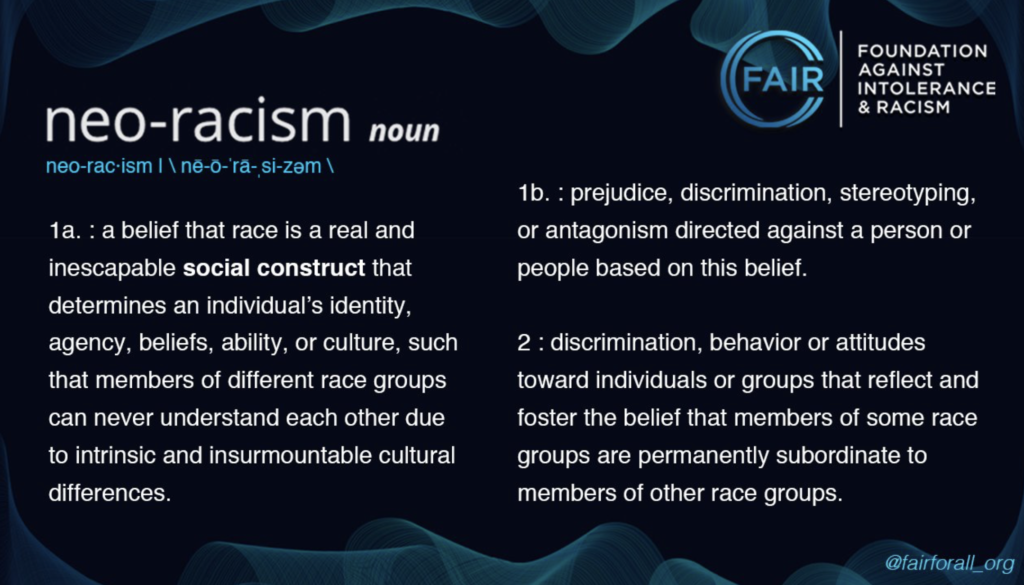
The Foundation Against Intolerance and Racism offers this definition of "neoracism":

neo-racism noun neo-rac·ism | \ nē-ō-ˈrā-ˌsi-zəm \

1a. : a belief that race is a real and inescapable social construct that determines an individual’s identity, agency, beliefs, ability, or culture, such that members of different race groups can never understand each other due to intrinsic and insurmountable cultural differences.

1b. : prejudice, discrimination, stereotyping, or antagonism directed against a person or people based on this belief.

2 : discrimination, behavior or attitudes toward individuals or groups that reflect and foster the belief that members of some race groups are permanently subordinate to members of other race groups.

In other words, "neoracism" is a modern reenactment of racism.

Continue ReadingWhat is Neoracism?

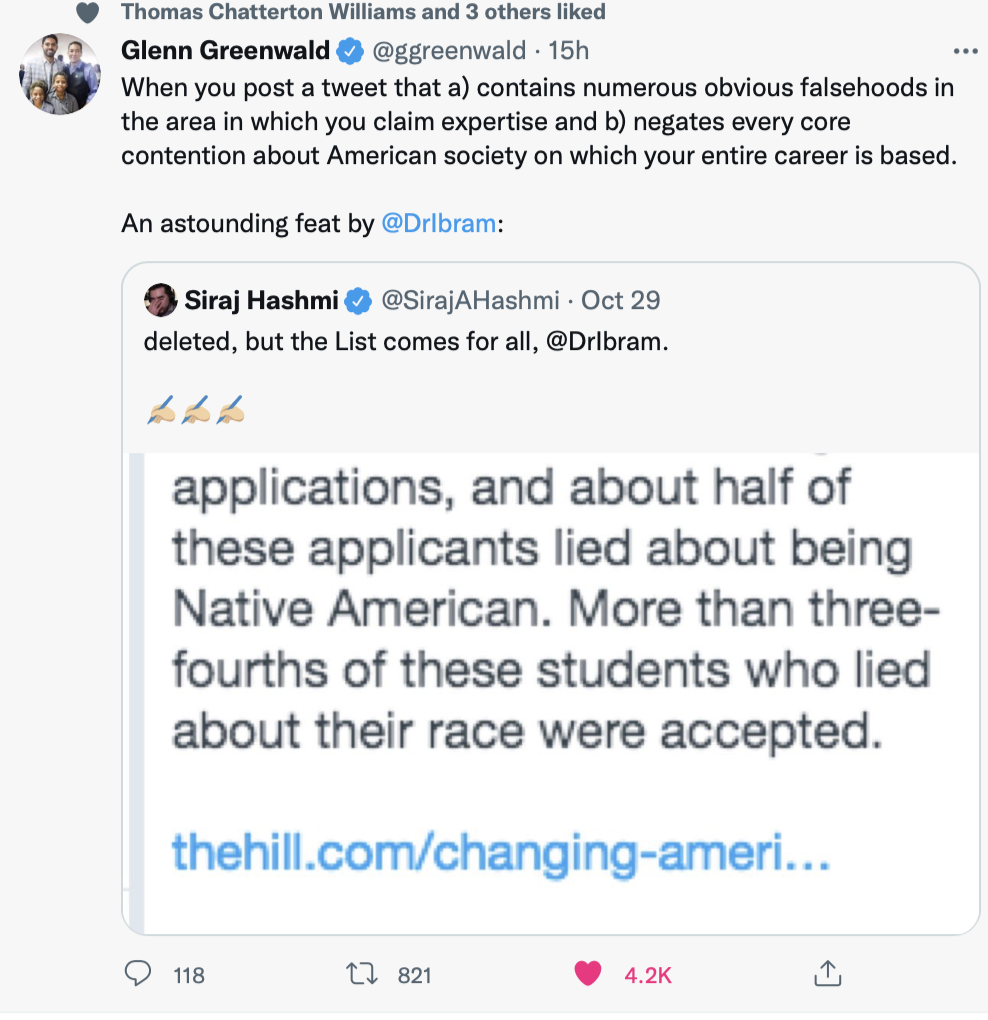
In Deleted Tweet, Ibram Kendi Claims Minority Status Paves the Way for Successful Admissions

Stunning admission:

This is the same man who talks in circles on the concept of "racism," a concept upon which all of his writings depend: At the Aspen Ideas Festival in 2019, when asked to define racism, Kendi earnestly answered: “[It is] a collection of racist policies that lead to racial inequity, that are substantiated by racist ideas.”

Continue ReadingIn Deleted Tweet, Ibram Kendi Claims Minority Status Paves the Way for Successful Admissions

The Difference Between Information and Knowledge

I'm reading The Constitution of Knowledge by Jonathan Rauch (2021). It has been a very slow read for me because it is such a impressive and detailed analysis of what is ailing us today. Here is a major distinction that is largely unappreciated. Information is merely "stuff," whereas knowledge must be carefully earned through the use of intricate institutions that coordinate, test and refine human observations and conclusions. This excerpt is from page 125:

What the institutionalization of modern, fact-based journalism did was to create a system of nodes—professional newsrooms which can choose whether to accept information and pass it on. The reality-based community is a network of such nodes: publishers, peer reviewers, universities, agencies, courts, regulators, and many, many more. I like to imagine the system’s institutional nodes as filtering and pumping stations through which propositions flow. Each station acquires and evaluates propositions, compares them with stored knowledge, hunts for error, then filters out some propositions and distributes the survivors to other stations, which do the same.

Importantly, they form a network, not a hierarchy. No single gatekeeper can decide which hypotheses enter the system, and there are infinitely many pathways through it. . .

Suppose some mischievous demon were to hack into the control center one night and reverse the pumps and filters. Instead of straining out error, they pass it along. In fact, instead of slowing the dissemination of false and misleading claims, they accelerate it. Instead of marginalizing ad hominem attacks, they encourage them. Instead of privileging expertise, they favor amateurism. Instead of validating claims, they share claims. Instead of trafficking in communication, they traffic in display. Instead of identifying sources, they disguise them. Instead of rewarding people who persuade others, they reward those who publicize themselves. If that were how the filtering and pumping stations worked, the system would acquire a negative epistemic valence. It would actively disadvantage truth. It would be not an information technology but misinformation technology.

No one saw anything like that coming. We—I certainly include myself—expected digital technology to broaden and deepen the marketplace of ideas. There would be more hypotheses, more checkers, more access to expertise. How could that not be a leap forward for truth? At worst, we assumed, the digital ecosystem would be neutral. It might not necessarily tilt toward reality, but neither would it systematically tilt against reality.

Unfortunately, we forgot that staying in touch with reality depends on rules and institutions. We forgot that overcoming our cognitive and tribal biases depends on privileging those rules and institutions, not flattening them into featureless, formless “platforms.” In other words, we forgot that information technology is very different from knowledge technology. Information can be simply emitted, but knowledge, the product of a rich social interaction, must be achieved. Converting information into knowledge requires getting some important incentives and design choices right. Unfortunately, digital media got them wrong.

Continue ReadingThe Difference Between Information and Knowledge