Facebook Safe Usage Product Warnings

I recently watched the new documentary, "The Social Dilemma." which has inspired me to cut my usage of Facebook. Rather than simply scold myself to cut FB usage, I decided to create more detailed guidance for myself (and anyone else who finds this useful):

Facebook Safe-Usage Product Warnings

A. Use FB no more than 10 minutes per day (extra time allowed for posting content I create and for exchanging private messages). Set a timer. This limited use will function like the rule many people use for potato chips: Put a handful into a small bowl instead of gobbling them out from the full bag.

B. Before any FB session, remind myself that FB is a valuable and useful platform with serious hidden dangers. Thus, using FB is like using a dangerous consumer product where the manufacturer failed to attach necessary usage warnings.

C. Remind myself that FB has been meticulously designed as a highly-sophisticated manipulation engine. In the short run, FB is addictive. In the long run, FB encourages us to think like teams instead of as individuals and this it is ripping our communities apart.

D. Only use FB intentionally, never out of boredom, out of habit or thoughtlessly. Don’t use FB unless I’m using it consciously. Avoid using FB when I’m tired or fatigued, because these are times when I am especially prone to go down the FB rabbit hole.

E. Before using FB, always ask myself whether there is a better use of my time, such as directly reaching out to a friend or choosing my own next thought process.

F. Do not access FB from my phone.

G. Keep all FB notifications turned off, except for private messages.

H. Use FB for several defined purposes only. If I stray from these purposes, turn FB off.

1. Checking out what is up with people I know well. 2. Interacting with thoughtful people. 3. Reading and sharing interesting, inspiring and light-hearted posts. 4. Connecting with special-interest FB Groups that I have consciously chosen to join. 5. Keeping an eye on FB Events that I might want to attend. 6. Sharing my photography and articles I’ve written at Dangerous Intersection. 7. Sharing well-written articles that I have found outside of FB.

I. Whenever on FB, I should strive to use the same tone and degree of kindness that I use when communicating with someone in person.

J. My FB friends will mostly be feeding me a steady diet of articles that reenforce my existing opinions. Therefore, I need to remind myself to always look beyond FB to seek out diverse sources of information, including news sources that are not in my comfort zone.

K. Repeatedly remind myself that FB’s algorithms delude users into believing that those with differing opinions are idiots who we are entitled to treat rudely.

L. Whenever I sense that I am caught in a cycle of doom-scrolling, I should shut off FB.

M. Always vet articles for accuracy before sharing anything on FB.

N. Remind everyone I meet to watch the important new documentary: The Social Dilemma.
Continue ReadingFacebook Safe Usage Product Warnings

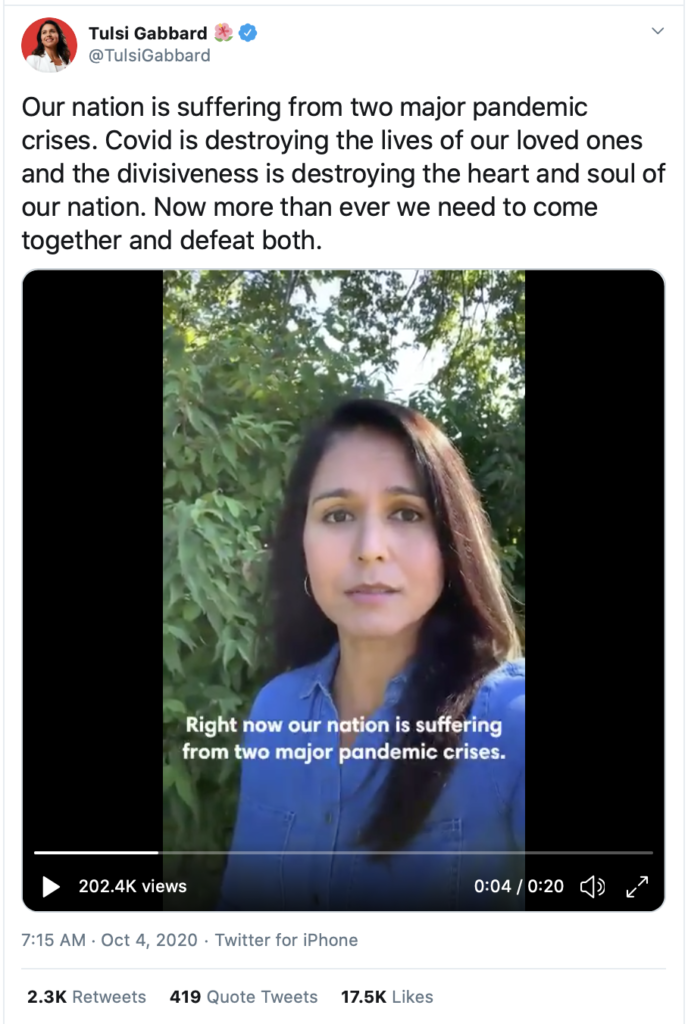
Pandemic #2: Divisiveness Caused by Social Media

For the first step in defeating Pandemic #2, please watch the new documentary, "The Social Dilemma." (You'll find it on Netflix).

As you use social media, try to cruise at 10,000 feet like a disinterested anthropologist and then ask yourself whether kind-hearted intelligent people should be talking at each other like much of what you will see.

Pandemic #2 is invisible, just like Pandemic #1, and you'll feel like you are in charge of your thoughts the entire time. Pandemic #2 quietly invades our minds, then erects filter bubbles around us that destroy the possibility of civil discourse on the most important issues facing us. Pandemic #2 destroys the possibility of e pluribus unum. We need to take action now, because huge misplaced financial incentives guarantee that Big Tech is not going to rescue us.

Continue ReadingPandemic #2: Divisiveness Caused by Social Media

Sam Harris Explores the Global Epidemic of Child Sexual Abuse

In his introduction to "The Worst Epidemic," Sam Harris warns that the subject matter might be difficult for listeners. The topic is the global epidemic of child sexual abuse involving children as young as one year old. Sam is joined by Gabriel Dance, a NYT reporter who has thoroughly investigated this issue. Until I forced myself to listen, I had assumed that this predatory behavior was relatively rare, but I was shocked to learn that sexual predators have exploited every corner of the Internet. To illustrate, Dance mentions that law enforcement experts estimate that of the 9 million citizens of New Jersey, 400,000 have been exposed to these highly illegal images and videos, some of this exposure being inadvertent, but much of it being intentional. It makes you wonder who we are, as a nation, that so many among us are willing to torture children. The tragedy is widespread, making the technical challenges and law enforcement needs overwhelming.

As a public service, Sam has put this episode in front of his paywall. The topic spirals in many directions, including the misleading concept of “child pornography,” the failure of governments and tech companies to grapple with the problem, the tradeoff between online privacy and protecting children, the National Center for Missing and Exploited Children, photo DNA, the roles played by specific tech companies, the ethics of encryption, “sextortion,” and the culture of pedophiles.

I am proud to say that I have been a paid subscriber of Making Sense for years. Sam Harris does a great job of exploring complex and oftentimes thorny issues unflinchingly, week after week.  From Sam's About Page:

His writing and public lectures cover a wide range of topics—neuroscience, moral philosophy, religion, meditation practice, human violence, rationality—but generally focus on how a growing understanding of ourselves and the world is changing our sense of how we should live.

If you are unfamiliar with the work of Sam Harris, I invite you to listen to this Episode, or any Episodes of Making Sense.

Continue ReadingSam Harris Explores the Global Epidemic of Child Sexual Abuse

The Problem of False Positives When Trying to Protect Your Website From Spam Comments on a WordPress Site

I've been running Dangerous Intersection since 2006, which now offers more than 7,000 posts.  When you are not running your own website, there are a lot of things that you need not worry about.  Technical issues often arise, and I've been doing my own tech work on my site.  That sometimes means I need to spend significant time to figure out why a Wordpress configuration, a widget or a plugin isn't working correctly. DI has generated a lot of comments over the years, almost 30,000 comments to date. It occurred to me today that there haven't been any comments for weeks.  I carefully analyzed my WordPress setup and could not see any problem.  No issues, which is typical of Wordpress, which is an amazing (and free) website platform.

Then I moved to my anti-spam protection plugin, Askimet, which has done a great job over the years.  But not anymore.  Recently, Askimet has been improperly identifying ALL of my incoming comments (even my own comments) as spam.  I tried to figure out how to reconfigure, but couldn't.  I have no intention of scanning thousands of spam comments each day (many millions of spam comments over the years) in order to identify the real comments, manually pulling them out of the "spam" folder. Thus, I thought, "Maybe it's time for a new form of comment spam protection."

I did some research and decided to install CleanTalk Anti-Spam, a comprehensive program with a delightfully easy installation.  There is no Captcha involved.  I don't quite understand how they do it, but it CleanTalk is a wonderful system with rave reviews on Wordpress and more than 430,000 installations.  I'm not getting paid anything for recommending CleanTalk.  I am writing this with the hope that others who are frustrated with the deluge of spam comments that you get when you run a blog will appreciate this option.

I've been testing out CleanTalk for the past fifteen minutes and it's working like a charm.  CleanTalk is free for one year, then costs $8/year, which is more than reasonable, given how well the program works. I have no problem paying low prices for excellent services that will save me many hours over the year.

Continue ReadingThe Problem of False Positives When Trying to Protect Your Website From Spam Comments on a WordPress Site