
The Continuing Relevance of John Stuart Mill at Schools and Colleges

Last week I attended a seminar sponsored by Heterodox Academy. The title: Does Mill Still Matter? Among those featured at the seminar were Jonathan Haidt, Richard Reeves and Dave Cicirelli, co-creators of "All Minus One," an illustrated version of the second chapter of Mill's On LibertyThis new book can be downloaded for free.

I transcribed the following excerpts of Jonathan Haidt comments. What follows are Haidt's words at the live seminar, minimally edited for print.

What I think is happening on campus is that we've traditionally played a game in which somebody puts forth an argument and then somebody critiques it. And that's what we've done for 1000’s of years, until about 2015. And then, a new game came into town, where people weren't seeing this like tennis, a game we are playing a game together. They saw it more as a battle like boxing or something where it was a struggle for dominance and power. And when you think of it that way, yeah, it's hard work. And it's painful. But if you think about it as like, you know, playing tennis or a game together, you're expending calories. It's not exactly hard work. It's hard play. And that's what I've always loved about being an academy is that it always felt like hard play. Until 2015.

A common phrase that began in 2014-2015, which is, “you are denying my existence” or “If that speaker comes [to campus to talk], then he or she is denying my existence.” And, you know, it's suddenly came out of nowhere. And we're all talking about what do you mean, denying your existence? And it's because this new way of thinking, where it's all a battle for power, and it's all about identity. And so if there's an is there's a speaker who's critical that on transition-- doesn't accept the reigning dogma on the trans issue? Well, that person thinks, or you might think, that they're critiquing an argument about something. But critiquing the argument is critiquing the identity, which means you're denying that I exist. That really helps us understand why there's such incoherence on campus since 2015, because some people are taking any criticism of their ideas as an attack on their person. And therefore you think I don't belong here on campus. And again, you can't have a university like that.

I also just want to add in one of my favorite quotes I've found in the five or six years I've been working on this topic. This is from Van Jones when he spoke at the University of Chicago. He was asked by, David Axelrod, what he thinks about students who are demanding no platforming and safe spaces and things like that. And while this isn't exactly million in that he's not really talking about, like the benefit to truth, but he's talking about the way this actually makes you stronger and smarter. This is just so brilliant. He says, there's a certain kind of safety, that it’s safety from physical attacks. You know, of course, we care about physical safety. But then he says, I don't want you to be safe ideologically. I don't want you to be safe, emotionally, I want you to be strong. And that's different. I'm not going to pave the jungle for you put on some boots and learn how to deal with adversity, I'm not going to take all the weights out of the gym. That's the whole point of the gym. This is the gym. And Richard and his friends protested outside as a political act. And then they went in because it was the gym, and they actually wanted to hear what he had to say. And that, I think, is the model of a politically engaged college student, or what it should do.

I was asked, What do you think is most fundamental question? And they say, Oh, you know, is there a god? Or what's the meaning of life? No, that's like, a big question. Fundamental means, basic, like the thing that everything else is built on. The fundamental question of life, is approach or avoid. That's it. As soon as life began moving, as soon as you get little tails on bacteria, you have to have some mechanism for deciding this way or that? Approach or avoid? And all of the rest of the billion years of brain evolution is just commentary on that question.

And so the human brain has these gigantic tracts of neurons on the front left cortex, specialized for approach. And then a frontal cortex specialized for avoid. And so all sorts of things go with this. So when we're in explorer mode, some features of it are, we're more, we're curious. We take risks. You might feel like a kid in a candy shop with all these different things to explore. You think for yourself. And the model of a student in this mindset would be whoever grows the most by graduation, or whoever learns the most by graduation wins. If that's your attitude, boy, are you going to profit from being in college for four years. [More . . . ]
Continue ReadingThe Continuing Relevance of John Stuart Mill at Schools and Colleges

The Woke Endgame: Evergreen State College

I didn't want to be spending so much time writing about Wokeness, but it has become clear to me that this is an ideology that reverses many of the hard-earned gains we have made through the Civil Rights Movement and that Wokeness ideology leads to endless societal dysfunction. Because human flourishing important to me, I have no choice but to speak out, at a time where many of my friends and acquaintances have the exact same concerns I do, but are afraid to speak out. Their fears is are based on these things:

1. They don't want to get into yelling matches with activists, which they see as inevitable;

2. They fear being called names like "racist"  for things that are not racist.

3. They fear mobs of people following them, threatening them and their families or damaging their property;

4. They fear loss of their reputations based on false accusations by mobs, and

5. They fear the loss of their jobs and/or careers based upon mass-cancellation techniques.

I realize this all sounds hyperbolic, but my conclusions are based on the many dozens of occurrences on which I have written about at this website, as well as many other articles by many other writers. Common responses to my writings have been A) ad hominem attacks, B) scoldings that I have no right to discuss certain topics, as though only certain people have the right to talk about certain things, and C) Whataboutism - Why am I not writing about something else that they would rather I write about, e.g., white supremacist groups? In response to this last point, I already see widespread ridicule over white supremacy. It is not taking root in any of our sense-making institutions such as schools (including prestigious colleges), media outlets (including STEM journals and magazines) and government offices.

I see the opposite happening with Wokeness, and it seems to be spreading logarithmically with only scattered voices having the courage to stand up and cry out, "Emperor Has No Clothes." Those voices include Andrew Sullivan, Matt Taibbi, Seerut K. Chawla, Glenn Greenwald, Brett Weinstein, Heather Heying, Eric Weinstein, Bari Weiss, Sam Harris, Jesse Singal, Jordan Peterson, Jonathan Haidt, Helen Pluckrose, James Lindsay, Benjamin BoyceJonathan Kay, Claire Lehman, John McWorther, Glenn Loury, Caitlin Flanagan, Heterodox AcademyColin Wright, Joe Rogan, Buck Angel, Peter Boghossian, Coleman Hughes, Bill Maher, Peter Rufo, The 40 Black Intellectuals who recently spoke out against the racism by Smith College, and the plucky crew at Quillette Magazine. There are others out there and I am not excluding any of them intentionally.  Most of these people lean significantly to the left on many social issues, yet Woke advocates commonly call them "conservatives," which is a modern version of an attempted ad hominem attack.

I want to give special attention to James Lindsay's excellent Woke Encyclopedia at New Discourses, so very helpful in that the Woke onslaught always involves long streams of highly suspect terminology.

What provoked this article?  I just finished watching several episodes of "The Complete Evergreen Story," by Benjamin Boyce.  As described by James Lindsay, 

Benjamin Boyce was a student at The Evergreen State College as it melted down, thanks to the applications of critical race Theory on campus. There, not only did he have a first-person view of the mayhem the campus descended into as it happened, he was responsible for filming and documenting a great deal of the footage that has since come to light and found a home in documentaries. Ever since, he has been on a quest to further understand what happened at Evergreen and to document it in full, not to mention similar issues as they crop up in the surrounding Washington state communities.

Boyce has presented this Evergreen tragedy in 23 chapters. His story covers the destruction of what was, and what could still be, an excellent college. What happened in 2017, however, left Evergreen in intellectual and social shambles and resulted in dramatic reductions in the number of students attending Evergreen.

It turns out that students aren’t clamoring for the privilege of paying for an education in such a hostile environment. Evergreen accepts 97% of applications, but enrollment dropped to 2,854 full-time students last fall, compared to 3,810 the semester of the protests. Enrollment increased over the same period at other Washington universities.

The story of Evergreen College was entirely ignored by most left leaning media powerhouses.  The New York Times has yet to write a single word about the 2017 Woke-triggered implosion at Evergreen College.

I am writing this article to provide the above links to the writers I have found most informative and instructive about the Woke movement.  I am linking to these writers with the hope that those who are fearful of speaking out can read these works as an aid to finding their own voice.  I am also writing this article as a warning and a prophecy that Evergreen State College was not simply an occurrence but a vision for where we are headed unless we all find the spine to stand up and draw a line in the sand.  Unless we do these things together, everything will become Evergreen State.

Here are episodes 1, 2 and 3 of Benjamin Boyce's comprehensive documentary regarding Evergreen State.

I'll end with some deep pessimism. I fear that conversation is no longer productive with the Woke. This is clear in many places today as I have documented at this website. it is abundantly clear in the Evergreen videos, as numerous students demonstrated that they are incapable of having a meaningful conversation with the clear-headed, patient, politically liberal Evergreen College biology professor, Brett Weinstein.


Continue ReadingThe Woke Endgame: Evergreen State College

Critical Race Theory Compared to the Civil Rights Ideals of the 1960s

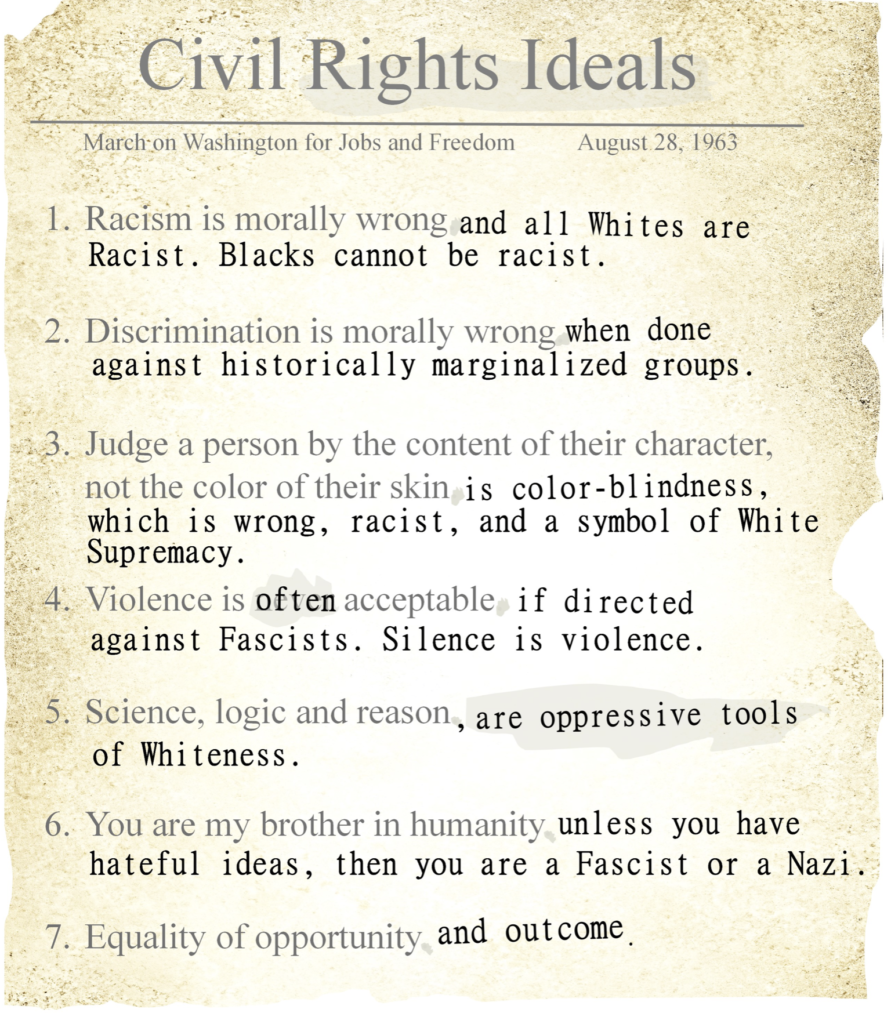
Critical Race Theory claims to be the new improved way to deal with racial issues. How does the Woke doctrine, spreading through American schools and workplaces, compare to the principles of the Civil Rights Movement of the 1960's?

The creator of the above image is Woke Temple at Twitter. The "original document" above doesn't exist (I confirmed this through personal communication with "Woke Temple"), but it accurately serves as a summary of some of Martin Luther King's core teachings.  The "corrections" in the graphic accurately reflect commonly espoused principles of Critical Race Theory (For more on CRT, consider the lectures and writings of prominent CRT advocates Robin DiAngelo and Ibram Kendi).  See also this glossary entry for CRT at New Discourses.

It should be apparent that one cannot honor the memory and teachings of Martin Luther King and, at the same time, support Critical Race Theory. They are mutually exclusive, so each of us needs to decide where we stand on this clash of ideas.

In the early 1960s, I was a young boy.  I barely watched the news back then and I didn't appreciate the importance of the civil rights movement. That said, I always knew it was a bad idea to judge each other based on the way we looked. It made deep visceral sense, as did the platitude: "Don't judge a book by its cover."  Now that I'm much older, I sometimes imagine going back in time to march with Martin Luther King to make a strong show of support for the real Civil Rights Movement.

For those of us who were too young to march with MLK, 2021 is our second chance to stand up for true Civil Rights Movement.  Are you willing to be called names like "racist" by a loud group of zealots in order to take this strong moral stand? That would be such a small price to pay compared to what MLK had to endure.  Are you willing to allow people to call you names to help keep this country from decaying back to days where we judge each other by immutable physical characteristics like color of skin?  Where millions of people obsess about what "race" someone is?  To a system of categorizing each other that makes no more sense than astrology or phrenology? Again, this is your chance - - your voice is needed, and all you need to do is to say out loud those thoughts you are already thinking.  Judging each other by the way we look is an outrageously dysfunctional approach to interact with each other.

The longer we don't take a strong stand against Critical Race Theory, the more entrenched CRT will become in numerous schools (grade schools and colleges and see here), media outlets and governmental offices. Here's how bad it recently got at a major national museum.  See also John McWhorter's  analysis: CRT is a new fundamentalist religion.

You know what is at stake.  We've already set aside a national holiday in his honor.  Are you ready to speak up in support of Martin Luther King?

--

Quotes of Martin Luther King that bear on the principles set forth in the "document" above:

[Don't Judge Others by the Color of their Skin]

I have a dream that my four little children will one day live in a nation where they will not be judged by the color of their skin but by the content of their character. I have a dream today.

[Violence, Hatred, Love]

Hate begets hate; violence begets violence; toughness begets a greater toughness. We must meet the forces of hate with the power of love... Our aim must never be to defeat or humiliate the white man, but to win his friendship and understanding.

The ultimate weakness of violence is that it is a descending spiral begetting the very thing it seeks to destroy, instead of diminishing evil, it multiplies it. Through violence you may murder the liar, but you cannot murder the lie, nor establish the truth. Through violence you may murder the hater, but you do not murder hate. In fact, violence merely increases hate. Returning violence for violence multiplies violence, adding deeper darkness to a night already devoid of stars. Darkness cannot drive out darkness; only light can do that. Hate cannot drive out hate; only love can do that.

[Segregation]

Now is the time to rise from the dark and desolate valley of segregation to the sunlit path of racial justice. Now is the time to lift our nation from the quicksands of racial injustice to the solid rock of brotherhood. Now is the time to make justice a reality for all of God's children

[More . . . ]

Continue ReadingCritical Race Theory Compared to the Civil Rights Ideals of the 1960s

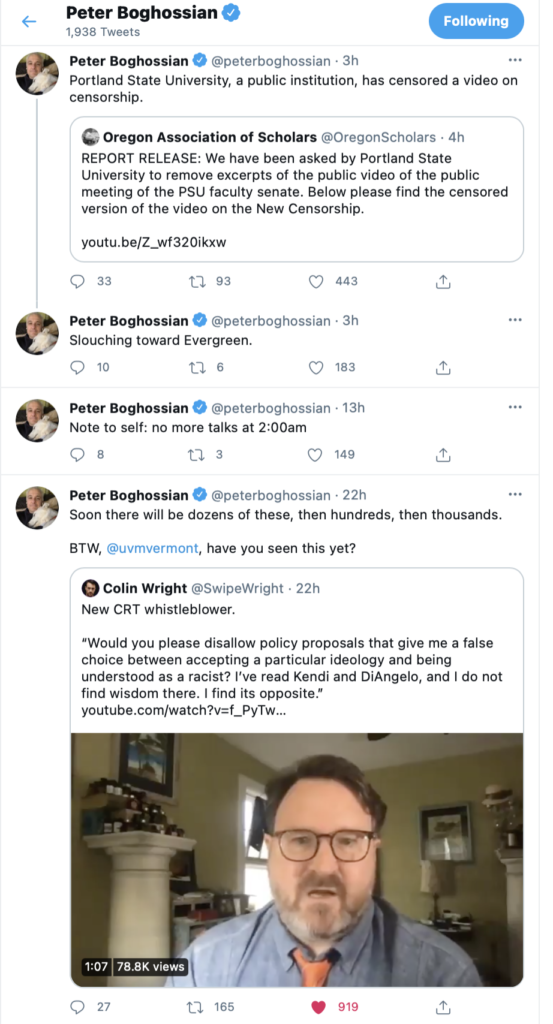
Peter Boghossian: Portland State Censors Censorship Video. What to Expect Now . . .

Portland State University Professor Peter Boghossian has linked to a video that warns of actions by Portland State University to hide a public PSU video in which outrageous actions of censorship are being proposed by employees of PSU, including professors. Those proposed outrageous actions are described here in writing. Here's an excerpt from this written report:

The resolution then makes a series of sleights of hand, describing the sharing and commentary on the course slides in various dark tones, using words like “intimidation.” For example: “When faculty become active in, or even endorse or tacitly support, public campaigns calling for the intimidation of individual colleagues they disagree with, or with an entire faculty they disagree with, they are undermining academic freedom.” Thus, in a single sentence, the resolution imposes a gag order on criticisms of a university’s professors, programs, teaching, and research - - criticism which is itself the heart of academic freedom -- as an abuse of academic freedom. The resolution then affirms the new description of normal criticism as “bullying” and “cynical abuse” stating: “As Faculty, we must be thoughtful in our exercise of academic freedom and guard against its cynical abuse that can take the form of bullying and intimidation.”

The resolution, in redefining normal debate and criticism, as acts of “intimidation” and “bullying”, falls afoul not just of common sense but of constitutional protections and normal workplace employment law, especially for a public university where faculty governance and academic freedom are core principles subject to state laws. Nor does it contemplate the implications the resolution would have if applied to Woke Studies professors who regularly engage in such “intimidation” of their unWoke colleagues.

The resolution was presented for discussion and approval at a Portland State faculty senate meeting of March 1, 2021. Even by the standards of the contemporary academy, the live- streaming faculty senate “debate” on the resolution was notable in making painfully clear the disappearance of viewpoint diversity on campus and the emergence of a new racial justice activism animating taxpayer-funded universities. The meeting was live-streamed and then uploaded for public viewing on YouTube (the relevant half-hour section is from minutes 34:25 to 1:03:25).

PSU has now taken down the above video, so we can no longer see this public meeting of a public university.

Boghossian ends his Tweet by pointing to yesterday's video created by Aaron Kindsvatter, the most recent college professor to blow the whistle on oppressive Woke policies imposed by an American university (University of Vermont).  It is impossible to overlook the similarity of Kindsvatter's complaints to the complaints of Jodi Shaw, who has been forced out of Smith College due to the hostile work environment Shaw experienced at Smith.

Boghossian ends his Tweet thread with this comment: "Soon there will be dozens of these, then hundreds, then thousands."

I agree. The tide is starting to turn.

Continue ReadingPeter Boghossian: Portland State Censors Censorship Video. What to Expect Now . . .

A Detailed Case-Study in Theatrical Woke Defiance at Haverford College

In "Race and Social Panic at Haverford: A Case Study in Educational Dysfunction," Quillette's Jonathan Kay gives a detailed account of how Woke-permeated campus-wide insanity can be triggered by nothing in particular. Kay makes a strong case that Haverford College, a private and expensive far-left-leaning liberal arts institution, self-spiraled into moral panic in a way that brings to mind the meltdown of Evergreen State, a story told and experienced by evolutionary psychology professors Brett Weinstein and Heather Heying.  See also, Weinstein's discussion of Evergreen with his brother, Podcaster Eric Weinstein ("The Portal").

The self-annointed thought police are still working overtime at Haverford, where free-speech is merely a phrase and where tribal truths are the reality.  I could not imagine sending any student to Haverford if they wanted to learn how to think self-critically and be prepared to hold a job in the outside world.

Jonathan Kay's long article leaves a pit in my stomach and casts a pall over my evening as I write this comment. He needed to fill his article with an extraordinary amount of details in order to substantiate his extraordinary conclusions, including the following:  A) Nothing insensitive or racist occurred at Haverford College leading up to the current shrill unrest. B) Nothing that happened at Haverford justified the long ridiculous list of student demands (to which the administration mostly acceded).  C) Most chillingly, the administrators of Haverford (and many other colleges) lack the the necessary resources to have meaningful conversations with students or to take respectable negotiating positions during these Woke-fueled paroxysms.

A few excerpts from Jonathan Kay's excellent article:

[T]he mania that swept Haverford College in late October and early November 2020 lays bare, with unusual clarity, the fervid atmosphere of grievance and self-entitlement that has made the administration of elite colleges and universities so difficult.

Of all the Haverford community members I spoke with, the only one who asked to be quoted by name was recently graduated philosophy major Alex Gutierrez, who once summarized the mindset of campus activists in an essay about Jacques Lacan. “Modern activists have psyches that are built for the joy of transgression,” he observed. “They engage in activism so they can repeatedly experience that joy, a joy that is denied them in everyday life because everyday life is dominated by the ethics of pleasure… And so they need to invent fictional dominant orders so that they can defy them. This is why protesters would actually be extremely unhappy if oppression went away. They want white patriarchy to be as powerful as possible, so they can defy it.”

Gutierrez wrote these words before his alma mater fell into upheaval in late October. But his analysis seems apt. When students complained that Raymond had caused them “harm” with her October 28th email, they weren’t really speaking up as activists denouncing racism on campus (since there doesn’t seem to be much of it), but as consumers whose parents paid good money for them to experience the sensation of transgressive social-justice heroism. “Normally, the administrators are the perfect target for student transgression,” Gutierrez told me. “They take the abuse and they’re not supposed to push back. That’s part of their role. That’s what students expect.”

Continue ReadingA Detailed Case-Study in Theatrical Woke Defiance at Haverford College