
Senator Bernie Sanders proposes changes to America’s corrupt banking system

At Huffpo, Senator Bernie Sanders, who remains one of my heroes, points out that the secret bailout by the Federal Reserve makes the better-known bailout look tiny:
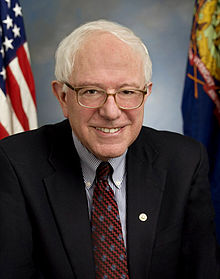
More than three years ago, Congress rewarded Wall Street with the biggest taxpayer bailout in the history of the world. Simultaneously but unknown to the American people at the time, the Federal Reserve provided an even larger bailout. The details of what the Fed did were kept secret until a provision in the Dodd-Frank Act that I sponsored required the Government Accountability Office to audit the Fed's lending programs during the financial crisis. As a result of this audit, the American people have learned that the Federal Reserve provided more than $16 trillion in low-interest loans to every major financial institution in this country, huge foreign banks, multi-national corporations, and some of the wealthiest people in the world. In other words, when Wall Street was on the verge of collapse, the federal government acted boldly, aggressively, and with a fierce sense of urgency to save our financial system from collapse with no strings attached.
The huge backdoor bailout is a slap in the face to American taxpayers, especially since the big Wall Street banks are bigger than ever and because they are taking more risks than ever, presumably emboldened by the fact that they are "too big to fail," and that the federal government will come bail them out yet again. Here's what Bernie Sanders proposes to clean up this despicable situation: 1) Break up the big banks. 2) Cap credit card interest rates ("Today, more than a quarter of all credit card holders in this country are paying interest rates above 20 percent and as high as 59 percent.") 3) Force the Federal Reserve to make low interest loans directly to small businesses. 4) Put an end to speculation that jacks up the price of petroleum products. 5) Demand that Wall Street invest in real businesses instead of "gambling on derivatives." 6) "Establish a Wall Street speculation fee on credit default swaps, derivatives, stock options and futures. Both the economic crisis and the deficit crisis are a direct result of the greed and recklessness on Wall Street." Sanders points out that there was such a fee (.2% tax on all sales and transfers of stock) from 1914 - 1966. Sanders points out that getting these measures passed will be enormously difficult, given that these Wall Street banks spent $5 billion on lobbying over the past decade.  Which leads to another enormous need: to get money out of politics.

Continue ReadingSenator Bernie Sanders proposes changes to America’s corrupt banking system

Letters from Scientology

Back when I was 16 (this was in 1972), I was playing in a band that had just hooked up with a new lead singer. During one band practice, he asked me whether I had ever heard of "Scientology." I said that I hadn't. He asked whether he could arrange to send me some literature on the organization and I said "sure." A few weeks later I received a brochure from Scientology. It claimed that the organization was scientific. I remember the literature containing photos of people being tested or trained using electronic meters with electrodes that were attached to their skin. I didn't know what to think of all of this at the time, but I didn't respond to the brochure's invitation to call a phone number to learn more. A week later, I received another piece of literature, and then another and another. Sometimes these were postcards, sometimes booklets. Sometimes they described various aspects of the organization. Sometimes they invited me to lectures, open houses and other events. I began to think of Scientologists as being a bit over the top; somehow, they reminded me of UFO believers (I don't actually like that term; I'm referring to the people who believe that sentient beings from other planets have visited Earth). The Scientology literature kept streaming in, week after week. Sometimes I received 4 or 5 pieces of mail in a week. I almost always received at least 3 mailings every week. I was living at my parents' house in Overland Missouri at that time, and I would glance at this stuff and throw it away. But it kept coming, month after month and then year after year. I never responded to any of this literature. I never made a phone call to anyone at Scientology and no one from Scientology ever called me. I did go to one open house at the St. Louis Scientology center, but I merely looked around for less than an hour, then left. I never signed anything or asked to stay on the mailing list. I moved away from home in 1978 to go to law school. The mailings continued to come, though, at least two per week. Even after I graduated from law school (three years later) the literature was still coming, at least one per week. To the best of my recollection, an occasional piece of Scientology literature was still being sent to my former house in Overland, even as I approached 30 years of age. This will be a wild guess, but I would bet that I received an average of 2 pieces of mail per week from Scientology from 1972 until 1985. that would mean that I received well over 1,000 pieces of mail from Scientology, even though I never responded. When I visited home and saw the piles of stuff waiting for me on the mail table, I felt sorry for the members of Scientology who were paying to send me all of that mail. I assumed (based on stories I read) that many young adults were handing over almost all of the disposable income to Scientology so that the organization could send me mail that I would throw away. Like many things I've experienced, there is no lesson I can draw from this experience, merely this anecdote regarding the endless mailings I received from Scientology.

Continue ReadingLetters from Scientology