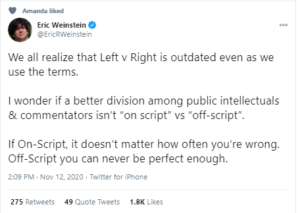
Or, instead of off-script and on-script, should we refer to people as "Thinks for Themselves" and "Doesn't Think for Themselves"? Labels of Left/Right are (often intentionally) deceptive, obscuring massive internal dissent within the "two" tribes for purposes of feigning homogeneity. Tribes use these labels to fluff up their feathers to try to appear coherent, like politically powerful voting blocks.
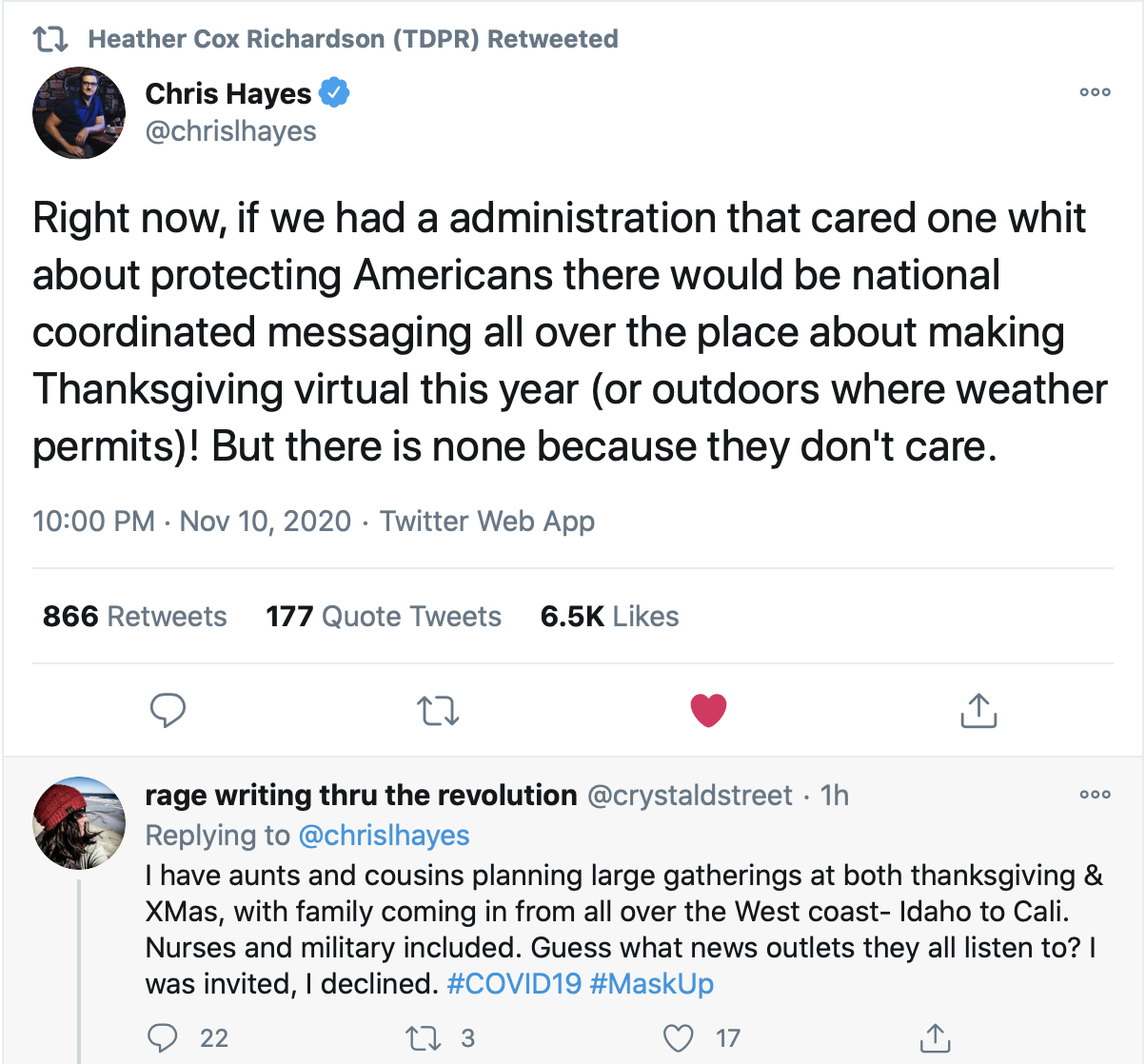
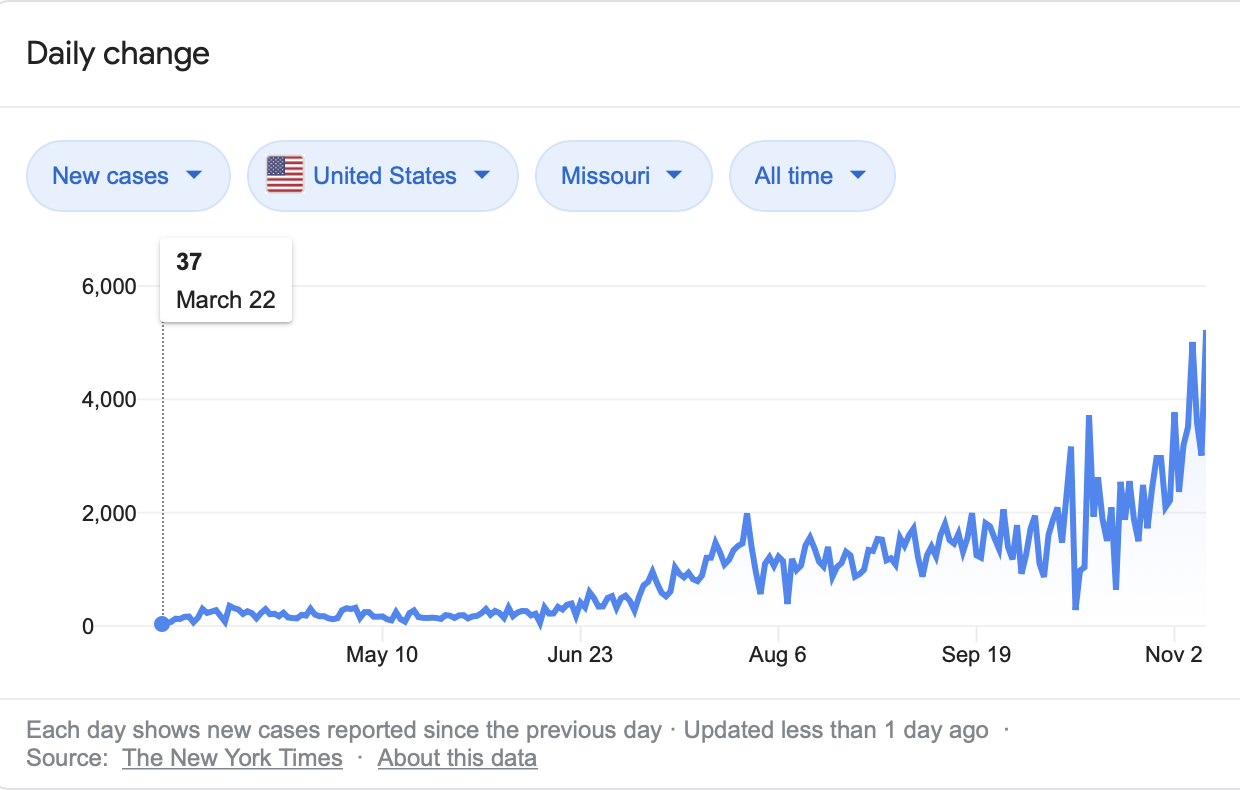
I agree with Chris Hayes here. Cold weather + holiday parties + travel + Thanksgiving feasts + Christmas gathering would seem to be a perfect storm for COVID, especially with numbers already spiking. We were concerned about the pandemic back in March, when the rate of infections was a tiny fraction of what it is now. This is insanity.
BTW, my elderly mother and her adult children WILL have an hour-long in-person Thanksgiving celebration this year. We will meet outside at my mom's house during the "heat" of the day, spread far apart from each other on lawn chairs, eating our BYO snack and drink for about an hour. Unless it's surprisingly warm, in which case we might linger longer.
What Orwell feared were those who would ban books. What Huxley feared was that there would be no reason to ban a book, for there would be no one who wanted to read one. Orwell feared those who would deprive us of information. Huxley feared those who would give us so much that we would be reduced to passivity and egotism.
Orwell feared that the truth would be concealed from us. Huxley feared the truth would be drowned in a sea of irrelevance. Orwell feared we would become a captive culture. Huxley feared we would become a trivial culture, preoccupied with some equivalent of the feelies, the orgy porgy, and the centrifugal bumble puppy.
As Huxley remarked in Brave New World Revisited, the civil libertarians and rationalists, who are ever on the alert to oppose tyranny, “failed to take into account man’s almost infinite appetite for distractions.”
In 1984, people are controlled by inflicting pain. In Brave New World, they are controlled by inflicting pleasure. In short, Orwell feared that what we fear will ruin us. Huxley feared that our desire will ruin us.
The film, "The Social Dilemma," is really about how it makes the worst of us rise to the top, right, so our hate, our outrage, our polarization, what we disagree about, black and white thinking, more conspiracy-oriented views of the world Qanon, Facebook groups, things like--that and i can we can definitely go into there's a lot of legitimate conspiracy theories i want to make sure I'm not categorically dismissing stuff--the point is that we have landed in a world where the things that we are paying attention to are not necessarily the agenda of topics that we would say in a reflective world is most important.
Joe Rogan:
There's a lot of conversation about free will and about letting people choose whatever they choose, whatever they enjoy viewing and watching and paying attention to, but when you're talking about these incredibly potent algorithms and the incredibly potent addictions that the people develop to these these things . . . and we're pretending that people should have the ability to just ignore it and put it away right and use your willpower.
--
Joe Rogan
Look at this [pointing to website news], Apple working on its own search engine as Google ties to be cut soon. I started using DuckDuckGo for that very reason. Just because they don't do anything with [your data]. You know, they give you the information, but they don't they don't take your data and do anything with it.
Tristan Harris
Let's say we get all the privacy stuff perfectly, perfectly right, and data protection and data controls and all that stuff. In a system that's still based on attention, in grabbing attention and harvesting and strip mining our brains, you still get maximum polarization, addiction, mental health problems, isolation, teen depression, suicide, polarization, breakdown of truth, right? So we really focus in our work on those topics because that's the direct influence of the business model on warping society.
We need to name this mind-warp when we think of it, like "the climate change of culture. We think these seem like different disconnected topics, much like with climate change. You'd say like, Okay, we've got species loss in the Amazon, we're losing insects, we've got melting glaciers, we've got ocean acidification, we've got the coral reefs dying, these can feel like disconnected things, until you have a unified model of how emissions change all those different phenomena, right? In the social fabric, we have shortening of attention spans, we have more outrage driven news media, we have more polarization, we have more breakdown of truth, we have more conspiracy-minded thinking. These seem like separate events, and separate phenomena, but they're actually all part of this attention extraction paradigm, that the company's growth--as you said--depends on, extracting more of our attention, which means more polarization, more extreme material, more conspiracy thinking and shortening attention spans.
Because we also say if we want to double the size of the attention economy, I want your attention to be split into two separate streams. Like I want you watching the TV, the tablet and the phone at the same time, because now I've tripled the size of the amount of extractable attention that I can get for advertisers, which means that by fracking for attention and splitting you into more junk, so attention that's "thinner." We can sell that as if it's real attention, like the financial crisis, where you're selling thinner and thinner financial assets as if it's real, but it's really just a junk asset.
And that's kind of where we are now, where it's sort of the junk attention economy. Because we were we have shortened attention spans and we're debasing the substrate of that makes up our society because everything in a democracy depends on individual sense-making and meaningful choice, meaningful for you, meaningful independent views. But if that's all basically sold to the highest bidder that debases the soil from which independent views grow, because all of us are jacked into this sort of matrix of social media manipulation, that's ruining integrating our democracy. And that's really, there's many other things that are ruining and hurting our democracy. That's a sort of invisible force, it's upstream, that affects every other thing downstream. Because if we can't agree on what's true, for example, we can't solve any problem.
Joe Rogan
Your organization highlights all these issues in an amazing way. And it's very important. But do you have any solutions?
Tristan Harris
It's hard, right? So I just want to say that this is as complex a problem as climate change, in the sense that you need to change the business model. I think of it like we're on the fossil fuel economy and we have to switch to something beyond that thing, right? Because so long as the business models of these companies depend on extracting attention, can you expect them to do something different?
Joe Rogan
You can't, but how could you? There's so much money involved and now they've accumulated so much wealth that they have an amazing amount of influence.
Tristan Harris
And the asymmetric influence, can buy lobbyists, can influence Congress and prevent things from happening. I think we're seeing signs of real change. We had the antitrust case that was just filed against Google. In Congress. We were seeing more hearings . . .
I'll try to say this dispassionately: This is that time of year when many of my neighbors aim extremely loud high frequency devices at their leaves in an attempt to decrease entropy. The devices usually have a hypnotic effect on my neighbors, causing them to walk slowly and haphazardly, thus lengthening the duration of these cacophonous sessions.
Hello, I invite you to subscribe to Dangerous Intersection by entering your email below. You will have the option to receive emails notifying you of new posts once per week or more often.