Alternatives to “Likes” on Social Media

Most social media platforms invite users to reply "Like" a Tweet, Post or Photo. It might be fun, for instance, when a dozen people "Liked" a photo of my salad. As argued, in "The Social Dilemma," however, piles of like can serve to steer people into tribes. This can happen when people post conclusions rather than thoughtful discussions.  It can happen when people make ad hominem attacks on their least favorite politicians and simplistic cartoons of complex social issues, such as immigration.

What is social media for?  That's a good question and it might evoke ten different answers from ten people.  Is it for cat videos and photos of one's children or is it appropriately used for discussing critically important social issues?  The suggestion that I'm about to make is for those of us who see social media as an opportunity to engage in serious conversations about important issues of the day with others in our network. Those not interested in serious discussions are invited to continue sharing cat photos.

I would suggest that in addition to the "Like" option, we add a few other options, including the following:

  • Your post merely parrots a talking point of one of the two political parties.
  • You are making an ad hominem attack on a person, not providing me with useful information.
  • You are engaged in a [cognitive bias] [logical fallacy].
  • Your post caused me to think about a topic in a new way.
  • Your post made me less certain of an opinion that I had.
  • Your post made me realize that this topic is more complex than I realized.
  • Your post states the facts fairly, but I still disagree with you.
  • You provided me with new intriguing information that I appreciate.
  • Your post made me angry, but I am glad you read it.
  • Your post irritates me, I disagree with you, but I value you as a friend.

I'm sure there are others that should be considered.  The main question is whether we are satisfied hoot panting for each other to display tribal loyalties or whether we want to be challenged to understand out world better . . .

Continue ReadingAlternatives to “Likes” on Social Media

Circular Thinking 101: Ibram Kendi’s Definition of Racism

Ibram X. Kendi is exulted as an intellectual leader by most people who peddle in Critical Race Theory. The movement is purportedly concerned with "racism." What is racism? Click the image of John McWhorter's Tweet below to watch a one-minute video:
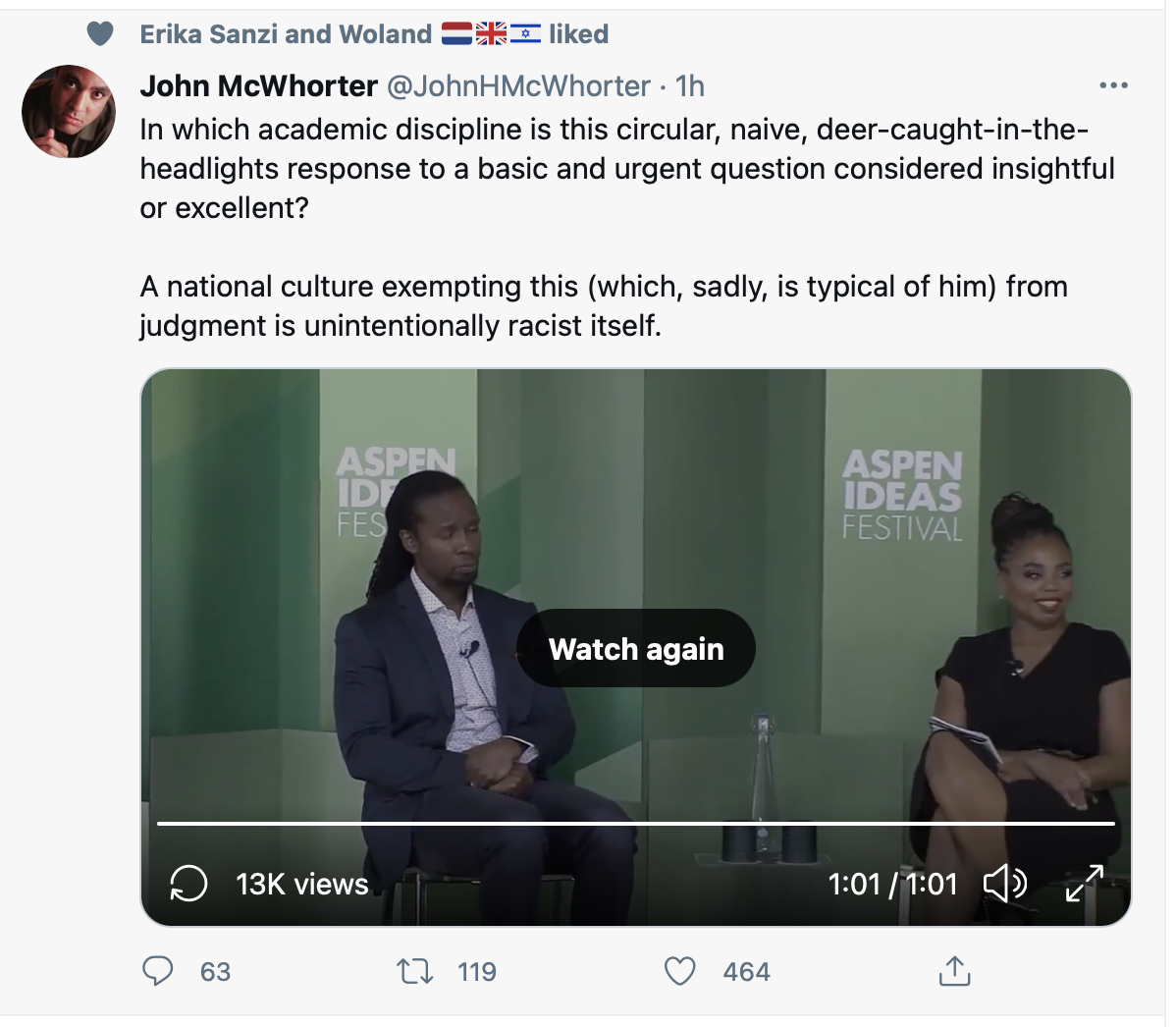
Here is Kendi's definition of "racism" in writing: "A collection of racist policies that lead to racial inequity that are substantiated by racist ideas"

Now ask yourself whether Kendi answered the question or whether he completely evaded answering the question. It should be clear that "racism" is a key term. If his definition wobbles, his entire thought process wobbles. I should also note that I've read other passages by Kendi in which he is similarly (and I suspect, coyly and consciously) circular. 

Consider the definition of circular reasoning:

Circular reasoning (Latin: circulus in probando, "circle in proving"; also known as circular logic) is a logical fallacy in which the reasoner begins with what they are trying to end with.. . . Begging the question is closely related to circular reasoning, and in modern usage the two generally refer to the same thing.

Let us substitute to illustrate.  What is Communism? "A collection of communist policies that lead to communist inequity that are substantiated by communist ideas"

What is activism? "A collection of activist policies that lead to activist inequity that are substantiated by activist ideas"

As McWhorter suggests above and elsewhere, Ibram Kendi is not a serious thinker (and see here). McWhorter's point in the Tweet is to the extent that people don't hold Kendi to high standards for rigorous thinking, to the extent that they avert their eyes when Kendi embraces circular reasoning of a foundational term of his expansive theory, this is the "soft racism" of assuming that Kendi can't cut it because he is "black." Kendi is thus widely celebrated among the Woke and he commonly gives highly-compensated lectures discussing something he cannot define. Again, Kendi is vigorously embracing circular logic to underpin a term upon which he constructs his entire system. What other highly celebrated "thinker" would be given a pass for such an abject failure?

Notice that Kendi's "definition" or "race," he doesn't mention the common understanding of racism: treating someone badly because they are of another "race." What is "race"? According to Merriam-Webster, "race" refers to "any one of the groups that humans are often divided into based on physical traits regarded as common among people of shared ancestry." In short, "racism" is treating someone badly because they are seen as part of a group of people who look different than other groups of people. You will not hear Kendi ever basing his theory on this common understanding of "racism" because there is so little of it remaining in American society.

IIn many articles at this website, I've attacked the concept of "race.  Dividing people by "race" is as irrational as dividing them on the basis of astrology or phrenology. That is why I use so many scare quotes when I discuss "race." That said, "racism" is a real thing in our society, a disgusting and festering attitude with a long history. I've consistently held that even though I do not recognize "race" to be a legitimate way to characterize the personality, history or skills of any person, those who engage in "racism" should be socially ridiculed and sued for any harm they cause.  My approach is thus grounded.  I'm aware that there are some people who still treat each other badly based purely on personal appearance (e.g, skin tone, hair texture or facial features). This is a bad thing because is impairs human flourishing and harms people, including financially. I have presented a problem that was formerly prevalent, much less so in modern times. I personally know this because I lived through the 50's and 60's. I see how American culture has increasingly and exuberantly embraced "black" people, setting many incentives for hiring minorities and recruiting them as students. 61.2% of "blacks" are now economically categorized as middle class.  Kendi rejects every empirical approach to "racism," however, because he wants lawmakers to assume (in the absence of evidence) that all "racial" disparities are the result of racial attitudes.  Multivariate analyses are an anathema to Kendi. To a person with a hammer, everything looks like a nail.

For these reasons, Kendi has constructed his entire "anti-racism" theory on his circular definition of "racism" and he doesn't care that he is peddling such slop. And in a stunning display of the soft bigotry of low expectations, Kendi is not called out on this blatant circularity, arguably among the lowest hanging fruit on the tree of logical fallacies.  Another key part of Kendi's theory is "structural racism" or "systemic racism." Those terms are equally problematic, as John McWhorter points out in his article, "CAN WE PLEASE DITCH THE TERM "SYSTEMIC RACISM"?" Here is an excerpt from McWhorter's article:

First let’s review what systemic racism means. There are inequities between whites and blacks. The reason is not that blacks are inherently less capable than whites. This presumably means that the discrepancies are traceable to devaluation of black people of some kind at some point in the pathway. This devaluation, even if not conscious, is a kind of racism, and this means that the society “is racist.” Thus the way to get rid of this kind of discrepancy is to undo the racism in the system.

But note that if we take this as a succession of logical statements rather than as a musical sequence valuable primarily because the term racism is intoned within it, then we hit a snag. Just what do we do to undo “racism” that is bound up in a complex system, and especially given that the system has a past that is unreachable to us now, as well as a present?

Here, The Elect burn to insist that, well, systemic racism exists anyway! And you the reader may want to reiterate that systemic racism exists. It does. There are indeed such discrepancies. The question is not whether they exist, but what one does about them.

“Undoing the racism in the system,” in this light, is word magic, not an intelligent prescription for change in the real world. Grouchy? Not really – just grounded.

In Ibram Kendi's world, ubiquitous "systemic racism" is the Holy Spirit.

Continue ReadingCircular Thinking 101: Ibram Kendi’s Definition of Racism

Twelve Fallacies About Free Speech, Refuted

At Areo, Greg Lukianoff (An attorney who is the President and CEO of FIRE, Foundation for Individual Rights in Education) wrote this article to refute twelve fallacious arguments about free speech. Here are the fallacies:

  • Free speech was created under the false notion that words and violence are distinct, but we now know that certain speech is more akin to violence.
  • Free speech rests on the faulty notion that words are harmless.
  • Free speech is the tool of the powerful, not the powerless.
  • The right to free speech means the government can’t arrest you for what you say; it still leaves other people free to kick you out.
  • But you can’t shout fire! in a crowded theatre.
  • The arguments for freedom of speech are outdated.
  • Hate speech laws are important for reducing intolerance, even if there may be some examples of abuse.
  • Free speech is nothing but a conservative talking point.
  • Restrictions on free speech are OK if they are made in the name of civility.
  • You need speech restrictions to preserve cultural diversity.
  • Free speech is an outdated idea; it’s time for new thinking.
  • I believe in free speech, but not for blasphemy.

Visit Areo for Lukianoff's responses to each of these fallacies.

In response to the fallacy that free speech is an outdated concept, Lukianoff gave this succinct defense of John Stuart Mill, from On Liberty (available from free at this link):

John Stuart Mill’s central arguments in On Liberty remain undefeated, including one of his strongest arguments in favour of freedom of speech—Mill’s trident—of which I have never heard a persuasive refutation. Mill’s trident holds that, for any given belief, there are three options:

A) You are wrong, in which case freedom of speech is essential to allow people to correct you.
B) You are partially correct, in which case you need free speech and contrary viewpoints to help you get a more precise understanding of what the truth really is.
C) You are 100% correct. In this unlikely event, you still need people to argue with you, to try to contradict you, and to try to prove you wrong. Why? Because if you never have to defend your points of view, there is a very good chance you don’t really understand them, and that you hold them the same way you would hold a prejudice or superstition. It’s only through arguing with contrary viewpoints that you come to understand why what you believe is true.

Lukianoff ends his article with this:

Free speech is valuable, first and foremost, because, without it, there is no way to know the world as it actually is. Understanding human perceptions, even incorrect ones, is always of scientific or scholarly value, and, in a democracy, it is essential to know what people really believe. This is my “pure informational theory of freedom of speech.” To think that, without openness, we can know what people really believe is not only hubris, but magical thinking. The process of coming to knowing the world as it is is much more arduous than we usually appreciate. It starts with this: recognize that you are probably wrong about any number of things, exercise genuine curiosity about everything (including each other), and always remember that it is better to know the world as it really is—and that the process of finding that out never ends.

Continue ReadingTwelve Fallacies About Free Speech, Refuted

About Lindsay Shepherd

Today I learned about the 2017 case of Lindsay Shepherd, a graduate student/teaching assistant at Wilfrid Laurier University (WLU) in Waterloo, Ontario. Her crime was to allow an even-handed classroom discussion about a Canadian law compelling the use of particular pronouns according to Jordan Peterson.

Her case also reminded me of the importance of (at least sometimes) secretly recording conversations.

Here is what happened, thanks to her foresight in recording a massively dysfunctional conversation Shepherd was forced to have with her supervisor, Nathan Rambukkana.

Shepherd is now an author. You can follow her at https://twitter.com/NewWorldHominin

Here is an excerpt from a review of Shepherd's new book, Diversity and Exclusion: Confronting the Campus Free Speech Crisis::

This continuing campaign against Shepherd based on a pursuit of ideological purity should be regarded as a dark stain on the entire academic community. Throughout the book it is clear that Shepherd’s love of teaching is what defines her commitment to “open inquiry and the pursuit of truth.” As such, that unnamed college missed an opportunity to hire a first-rate educator – not to mention a heck of a storyteller. Sadly, demonstrable ability and commitment are now less important on campus than political alignment. That said, given her obvious attributes of drive, character, intelligence and sense of opportunity, it seems highly unlikely we’ve seen or heard the last of Lindsay Shepherd. As her experiences at Laurier make plain, she has an awful lot to say. And she’s not afraid to say it.

Continue ReadingAbout Lindsay Shepherd

How Pervasive is the Teaching of Critical Race Theory?

Last month, Andrew Gutmann started speaking out against critical race theory, as it was being taught at his daughter's private expensive Manhattan school, Brearley School. In his letter to the Brearly community, he accused Brearly of teaching children illiberal and indoctrinating antiracism initiatives and divisive obsession with race. Gutmann has founded Speak Up For Education. .

Today, Gutmann authored an opinion piece at The Hill. Here is an excerpt:

There appears to be widespread belief that opposition to critical race theory is a view held solely by the political right. This perception is wrong. It is certainly true that the conservative media has almost exclusively embraced viewpoints unfavorable to critical race theory while the liberal-oriented media has been overwhelmingly approving. But our polarized media does not seem to accurately reflect the view of most Americans.

Since my letter became public, I have received several thousand supportive emails and messages from people across this country, including many from self-described Democrats and liberals. The tone of most of the messages sent to me is not at all political in nature; instead, the tenor is one of desperation and powerlessness.

I have received emails from parents expressing devastation that their kids, as young as five years old, are coming home from school after being taught to feel guilty solely because of the color of their skin. I have received messages from grandparents feeling hopeless that their grandchildren are being brainwashed and turned against their own families. And I have received notes from teachers brought to tears because they are being required, day after day, to teach fundamentally divisive, racist doctrines and being forced to demonize their own students.

Perhaps the most powerful – and most frightening – of the notes I have received are the several dozen from those who identify themselves as having immigrated to America from the former Soviet Union or from countries in formerly communist Eastern Europe. These emails are never political in nature and are nearly identical in message: These first-generation Americans all write that they have “seen this movie before.” They are familiar with the propaganda, the tactics of indoctrination and the pervasive fear of speaking up that plague today’s United States. Simply put, they cannot believe this is happening here.

Continue ReadingHow Pervasive is the Teaching of Critical Race Theory?