
The Problem With Our Political Primaries

I will vote for Biden/Harris even though there is no rational way to justify how Biden should be the Democrat nominee. He is cognitively rickety and burdened with a long history of being on the wrong side of history (albeit with some notable positives). Today, Joe Biden is not among the best and brightest. I will vote for him anyway because Trump is much worse in terms of factual understanding, moral character and temperament. That said, what we're about to witness leading up to November is Kabuki Theater rather than a meaningful election because the corrupt primaries set the stage. But how did we get here, again? How dysfunctional were the primaries? Is there any expectation that the 2024 presidential primary will better reflect the will of the voters? No way, unless we dramatically reform the system from the bottom up.

Eric Weinstein nailed it on Episode 37 of his excellent podcast, "The Portal." I have taken the time to transcribe Eric's introduction to this episode. High school teachers should throw away their Civics coursebooks and start the court by making Eric's statement required reading:

Hello, it's Eric with a few thoughts this week on the coming US election before we introduce this episode's main conversation. Now, I should say upfront that this audio essay is not actually focused on the 2020 election, which is partially concluded, but on the election of 2024 instead. The reason I want to focus on that election is that precisely because it is four years away, we should know almost nothing about it. We shouldn't know almost anything about who is likely to be running or what the main issues will be. And we should be able to say almost nothing about the analysis of the election. Unfortunately, almost none of that is true. Now, obviously, we can't know all of the particulars. However, we still know a great deal more than we should. And that is because the ritual is not what many suppose it to be: a simple nationwide open contest to be held on a single day after several unrestricted long form debates with unbiased rules enforced by trusted referees.

What is most important is that prior to the 2024 election, there will have to be an appearance of a primary election. So what actually is a primary election and what function does it serve? It's hard to say, but if you think about it, this is really the awkward disingenuous and occasionally dangerous ritual by which a large and relatively unrestricted field of candidates needs to be narrowed to the subset that is acceptable to the insiders of the parties, their associated legacy media bosses in the party mega-donors. Now the goal of this process is to--in the famous words of Noam Chomsky--manufacture consent from us, the governed, so that we at least feel like we have selected the final candidates who, in truth, we would likely never have chosen in an open process. I've elsewhere compared this ritual to the related process referred to by professional illusionists as "magicians choice," whereby an audience member is made to feel that they've selected something like a card from a deck out of their own free will, but that the magician has actually chosen from a position of superior knowledge and control long before the trick has even begun.

In the modern era, of course, consent has become a much more interesting word, especially of late. And perhaps that fact is important in this context too. The constellation of issues carry over surprisingly well. To bring in more terminology from the national conversation on consent, the party rank and file are groomed, if you will, by the party-affiliated media as to who is viable and who should be ignored and laughed at through a process of what might be termed political negging. The candidates are also conditioned by being told that they can only appear in party-approved debates, which must be hosted exclusively by affiliated legacy media outlets, which emphasize soundbites and theatrical gotcha moments over substance, despite the internet's general move towards in-depth discussion made possible in large part by the advent of independent long-form podcasts like this one. Thus, both voters and candidates are prevented from giving informed and uncoerced consent by the very institutional structures most associated with democracy itself.
Continue ReadingThe Problem With Our Political Primaries

Jonathan Haidt Discusses Two Versions of Identity Politics: “Common Enemy Politics” and “Common Humanity”

I've followed Social Psychologist Jonathan Haidt closely for many years (as you can see by searching for his name at DI). He is the author of several excellent books, including The Happiness Hypothesis, The Righteous Mind: Why Good People Are Divided by Politics and Religion and The Coddling of the American Mind. Haidt's thought process crosscuts the prevailing two wings of political thought in the United States. In this extended interview with Joe Rogan, Haidt dissects many topics, including identity politics. He urges that this phrase encompasses two separate approaches, "Common Enemy Politics" and "Common Humanity."

Haidt also distinguishes between two prevalent types of conversations, two types of "games" being played that often make conversations frustrating. Many of us insist upon playing the "truth seeking game," while others play a game that assumes a Manichean battle where A) no one gains except at the expense of someone else, B) where people are not seen as individuals but a members of groups, and C) you can tell who someone is merely by their appearance. Much of the fruitless dialogue on social media and elsewhere makes a lot more sense once we realize that these two approaches have virtually nothing in common--they serve entirely different purposes. Just because we exchange words does not mean we are, in any meaningful way, communicating.

I'm strongly in agreement with Haidt's analysis.

Haid's distinction parallels David Sloan Wilson's distinction between science-oriented "factual realism" and group-survival-oriented "practical realism."

In addition to embedding the video of the interview, I invested some time to create a transcript of several sections of this interview, from about Min. 33 - 55. I have cleaned up the wording to omit throat-clearings and false starts, but I have worked hard to be true to the substance of the conversation.

--

Haidt – Rogan Interview

33:18 JH: You have to look at different games being played. Yale was a place that taught me to think in lots of different ways and it was constantly blowing my mind when I took my first economics course. It was like wow, here's a new pair of spectacles that I can put on and suddenly I see all these prices and supply. I never learned to think that way, where I learned about Freud in psychology or sociology. A good education is one that lets you look at our complicated world through multiple perspectives. That makes you smart. That's what a liberal arts education should do. But what I see increasingly happening, especially at elite schools, is the dominance of a single story, and that single story is life is a battle between good people and evil people, or rather good groups and evil groups, and it's a zero-sum game. So if the bad groups have more, it's because they took it from the good groups, so the point of everything is to fight the bad groups. Bring them down create equality and this is a terrible way to think in a free society. That might have worked you know in biblical days when you got the Moabites killing the Jebusites or whatever, but you know we live in an era in which we've discovered that that the pie can be grown a million-fold. So to teach students to see society as a zero-sum competition between groups is primitive and destructive.

34:22 JR: In your book, you actually identify the moment where these micro aggressions made their appearance and they were initially a racist thing.

JH: Yeah. The idea of a micro aggression really becomes popular in a 2007 article by Derald Wing Sue at Teachers College. He talks about this concept of microaggressions. There are two things that are good about the concept, that are useful. One is that explicit racism has clearly gone down--by any measure explicit racism is plummeted in American across the West—but there could still be subtle or veiled a racism.

37:27 JR It's ultimately for everyone's sake, I mean, even for the sake of the people that are embroiled in all this controversy and chaos. It would be fantastic across the board if there was no more sexism, there was no more racism, there was no more any of these things. It would be wonderful. Then we could just start treating humans as just humans. Like this is just who you are you're just a person. No one cares. What a wonderful world we would live in if this was no longer an issue at all.

JH: Beautifully put.

JR: How does that get through?

38:01 JH: We were getting there, okay? That's what the twentieth century was. We were shaped by the late 20th century. The late 20th century was a time in America in which, you know, earlier on there was all kinds of prejudice. I mean, when I was born, just right before you were born, it was legal to say you can't eat here because you're Black and so that changed in 1964-65. But it used to be that we had legal differentiations by race and then those were knocked down. But we still had social [discrimination] and it used to be that if you were gay that was something humiliating. It had to be hidden. If you look at where we were in 1960 or ’63, when I was born and then you look at where we got by 2000, the progress is fantastic on every front, so that's all I mean when I say we were moving in that direction.

Continue ReadingJonathan Haidt Discusses Two Versions of Identity Politics: “Common Enemy Politics” and “Common Humanity”

The Stifled Discussion of Whether Peer Contagion is Triggering the Sharp Rise in Gender Transitions

Increasingly, when I express my concerns about the sudden dramatic increase in teenaged girls who are declaring themselves to be men trapped in women’s bodies, I receive a rash of ad hominem attacks. For example, I have been accused of being a “conservative,” though I have never affiliated myself with the Republican Party. I have been accused of being anti-trans, which is utterly false. In my view, every adult has the right to do whatever they want to do with their body. I will happily address every adult with whatever pronoun they choose. It is my opinion that all members of the transgender community should all be vigorously protected pursuant to civil rights laws and every other law that applies to every other person.

My concern in writing this article is not about adults. It is about teenagers, especially teenaged girls. Although there appear to be some teenaged girls who are legitimate candidates for transitioning, the recent numbers of girls clamoring for this treatment is extraordinarily and suspiciously high. I also have a personal stake in this controversy. I have friends whose daughters who in various stages of undergoing what might be needless and dangerous medical treatment.

Here are some of the facts that are cause for my concern. These are excerpts from a 2020 article by Abigail Schrier in Quillette titled, “Discovering the Link Between Gender Identity and Peer Contagion”:

In America and across the Western world, adolescents were reporting a sudden spike in gender dysphoria—the medical condition associated with the social designation “transgender.” Between 2016 and 2017, the number of gender surgeries for natal females in the United States quadrupled, with biological women suddenly accounting for—as we have seen—70 percent of all gender surgeries. In 2018, the UK reported a 4,400 percent rise over the previous decade in teenage girls seeking gender treatments. In Canada, Sweden, Finland, and the UK, clinicians and gender therapists began reporting a sudden and dramatic shift in the demographics of those presenting with gender dysphoria—from predominately preschool-aged boys to predominately adolescent girls. . .

In 2016, Lisa Littman, ob-gyn turned public health researcher, and mother of two, was scrolling through social media when she noticed a statistical peculiarity: Several adolescents, most of them girls, from her small town in Rhode Island had come out as transgender—all from within the same friend group. . . . Dr. Littman began preparing a study of her own, gathering data from parents of trans-identifying adolescents who’d had no childhood history of gender dysphoria. . . . She assembled 256 detailed parent reports and analyzed the data. Her results astonished her.  Two patterns stood out: First, the clear majority (65 percent) of the adolescent girls who had discovered transgender identity in adolescence—“out of the blue”—had done so after a period of prolonged social-media immersion. Second, the prevalence of transgender identification within some of the girls’ friend groups was, on average, more than 70 times the expected rate.

Many of the adolescent girls suddenly identifying as transgender seemed to be caught in a “craze”—a cultural enthusiasm that spreads like a virus. “Craze” is a technical term in sociology, not a pejorative, and that is how I use it here. (Dr. Littman never does.) It applies to Hula-Hoops and Pokémon and all sorts of cultural fads. If this sudden spike in transgender identification among adolescent girls is a peer contagion, as Dr. Littman hypothesized, then the girls rushing toward “transition” are not getting the treatment they most need. Instead of immediately accommodating every adolescent’s demands for hormones and surgeries, doctors ought to be working to understand what else might be wrong. At best, doctors’ treatments are ineffective; at worst, doctors are administering needless hormonal treatments and irreversible surgeries on patients likely to regret them. Dr. Littman’s theory was more than enough to touch a nerve.

Dr. Littman has been treated unfairly, even grotesquely, by the academic community and by the news media, as reported in this same article. This side issue is well worth considering, as a red flag indicating that many news outlets are being driven by ideology rather than science on this issue.

These same issues are in the process of being discussed in an ongoing series of letters between journalist Abigail Shrier and evolutionary psychologist Heather Heying. [Heying also discussed this issue at the DarkHorse Podcast with Brett Weinstein]. Here is an excerpt from the letters-in-progress:

There are many reasons to believe we are in the midst of a transgender “craze”— a mass enthusiasm that captivates a population so that matters more essential to its welfare fall neglected, to borrow Lionel Penrose’s use of the term. There are the alarming statistics, indicative of an epidemic: For a century, gender dysphoria has been understood to begin in early childhood (ages 2 to 4) and afflict males almost exclusively. In the last decade, apparently out of nowhere, gender dysphoria’s predominant demographic has shifted from young boys to teen girls. (The rise in girls presenting at gender clinics in the UK has been estimated at 4,400%).

All across the West, adolescent girls are suddenly identifying as “trans” with friends, clamoring for hormones and surgeries. Teen girls who are struggling with anxiety and depression but who had no childhood history of gender dysphoria at all. Under the guidance of numberless trans social media influencers, with the encouragement of peers, clusters of girls are transforming themselves from desperately unpopular to the toast of the virtual town.

In my book, I offer several explanations of how this particular social contagion came to befall teen girls. And one of the many flags I plant is this, garnered from academic psychologist Jean Twenge: Teen girls today spend a whole lot less time with each other in person (an hour less per day) than those of prior generations. That’s less time hanging out in each other’s rooms, combing the details of their lives for hidden grandeur; less time savoring gossip and telling secrets; less time caught in the current of breathless laughter, half-shrieking the lyrics of a song.

I wonder whether, as an evolutionary biologist, you agree with the significance of this loss?

[As indicated, the above series of letters is ongoing].

In light of these disturbing statistics, you would think that this topic of gender transitions would be a hot issue that is being vigorously discussed by news media from across the political spectrum. You would be wrong.

Continue ReadingThe Stifled Discussion of Whether Peer Contagion is Triggering the Sharp Rise in Gender Transitions

More About the Woke Version of 2 + 2

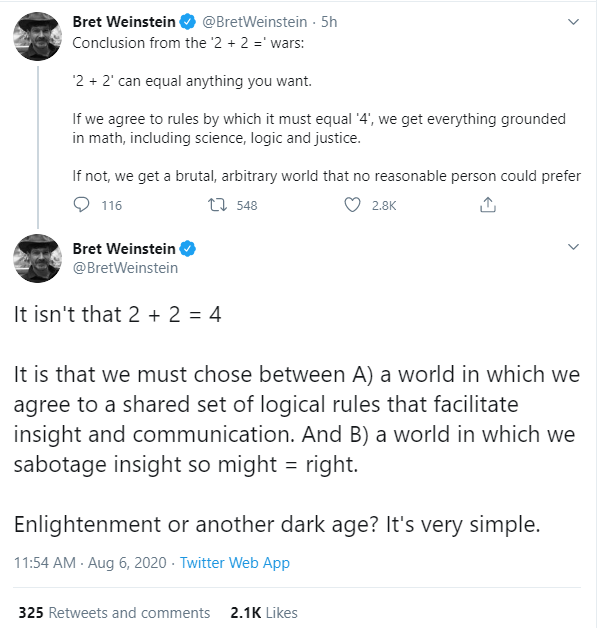
More on 2 + 2.   Whether you want to make it add up to 4 is, indeed, "a choice," as we are hearing from Woke-land. That choice, however, has the vast power Dan Dennett ascribed to his concept of "universal acid." That power can be either constructive or destructive. To the extent that we choose to teach (in classrooms and elsewhere) that 2 +2 ≠ 4, this creative choice would permeate everything. not only math. This fanciful and proudly rebellious choice would keep spreading to encompass everything else we believe too, because the explosive power of knowledge depends upon compounding. Our big impressive truths are exapted from our simplest of truths, even truths so simple that we verify them by counting fingers. This ability to compound our know-how from little grounded truths to much bigger truths allows us to discover vaccines and to design aircraft.

--

Yes, it's a choice, but it's a choice with ramifications. We can fuck around, acting like we can individually conjure up entirely new inert mental axioms willy-nilly each day, intentionally oblivious to verifiability, and oblivious to what anyone else is doing. Or we can collaborate in a mentally disciplined way using principles hard-gained from Enlightenment thinkers and others, such that there are correct and incorrect answers to many things based on A) whether those things actually function in predictable and meaningful ways and B) whether they further human flourishing.

I tend to see morality in terms of a personal aesthetic deeply tied to my vision for human flourishing. What does your personal sense of aesthetics (or morality) demand? A world where 2 + 2 equals 4? Or a world unhinged from any ability to collaborate with other sentient beings, a world where we pass the time organizing under rival warlords and throwing rocks at each other?

Continue ReadingMore About the Woke Version of 2 + 2

Joe Rogan Discusses Polarization, Education, Woke Culture and More with Jonathan Haidt

This episode of Joe Rogan's podcast, first released 18 months ago, features moral psychologist Jonathan Haidt, who has studied the culture wars as deeply as anyone. I recommend the entire discussion as a fruitful approach to the current madness. Haidt focuses on how we have raised children since the 1990s and the dangers of overprotecting them. At about 1:20, Haidt shows some stunning graphs showing that girls are have been terribly hurt (much more than boys) by the advent of social media and smart phones, along with unrealistic conceptions of beauty.

This excerpt by Haidt begins with his description of classical liberalism (Min: 55:10):

I think young people are losing touch with some of the hard-won lessons of the past, so I'm not going to say “Oh, we have to just accept whatever morality is here.” I still am ultimately liberal in the sense that what I dream of is a society in which people are free to create lives that they want to live. They're not forced to do things. They're not shamed. There's a minimum of conflict and we make room for each other. If we're going to have a diverse society, we've really got to be tolerant and make room for each other. That's my dream. I think in the last five or ten years, we've gotten really far from that. My first book, "The Happiness Hypothesis," was about ten ancient ideas. One is that we're too judgmental. You know “Judge not, lest ye be judged.” But I think the new version of that . . . if there were a 21st century Jesus, he'd say: “Judge a lot more. Judge all the time. Judge harshly. Don't give anyone with the benefit the doubt. Don't let anyone judge you. That is not going to be a recipe for a functioning society. So, no, I do not accept this aspect of 21st century morality.

Continue ReadingJoe Rogan Discusses Polarization, Education, Woke Culture and More with Jonathan Haidt