Matt Taibbi: The Perils of Ukraine Whataboutism and the Wisdom of George Orwell

An excerpt from Matt Taibbi new article: "Orwell Was Right: From free speech to "spheres of influence" to our passion for endless war, we've become the doublethinkers 1984 predicted":

One would hope there would be at least a few Americans left who’d hear about Russia barring the BBC and Voice of America and at least recognize the sameness of the issue involved with banning RT and Sputnik. Or, seeing how pathetic and manipulative it is for Russians to prevent reporting on war casualties, we’d recall the folly of the ban we had for nearly twenty years on photographs of military coffins, or the continuing pressure on embeds to avoid publishing images of American deaths from our own war zones. We should be able to read that Twitter and Facebook are cracking down on the “fake accounts” spreading “misinformation” that “Ukraine isn’t doing well” and notice that Russia’s measures against “fake news” and “disinformation” about its own military failures — though far more draconian and carrying much more severe penalties — are rooted in the same concept.

We don’t, however, because we long ago reached the doublethink phase predicted by Orwell, where most of the population is conscious of double standards but ignores them effortlessly. A healthy person should be able to be horrified by what’s happening in Russia and also see a warning about the degradation that ensues from using “pre-emptive” force, or from trying to control discontent by erasing expressions of it. But years of relentless propaganda have trained Americans to doublethink their way out of such insights. Cornel West just laid all of this out in an interview with the New Yorker:

Everybody knows if Russia had troops in Mexico or Canada there would be invasions tomorrow. [Biden] sends the Secretary of State, telling Russia, “You have no right to have a sphere of influence,” after the Monroe Doctrine, after the overthrowing of democratic regimes in Latin America for the last hundred-and-some years. Come on, America, do you think people are stupid? What kind of hypocrisy can anybody stand?

That doesn’t mean that Putin is not still a gangster—of course he is. But so were the folk promoting the Monroe Doctrine that had the U.S. sphere of influence for decade after decade after decade after decade, and anybody critical of you, you would demonize. Yet here are you, right at the door of Russia, and can’t see yourself in the mirror. That’s spiritual decay right there, brother, it really is.

We’ve been trained to rage against this thinking. We even have our own borrowed Newspeak word for the offense: Whataboutism. The offender supposedly does a bait-and-switch, distracting with charges of hypocrisy without refuting the actual argument. But a Soviet giving a professionally two-faced answer to questions about Gulags by saying, “And you lynch blacks” isn’t the same as the much more serious thing West is talking about. Lying to others is shameful, but lying to ourselves and not even realizing it, that’s hardcore spiritual decay. We’re being driven faster toward the cliff-edge of this moral insanity with each new act of mass forgetting.
Continue ReadingMatt Taibbi: The Perils of Ukraine Whataboutism and the Wisdom of George Orwell

In 2021, 111 Professors Were Targeted for Protected Speech

From the Foundation for Individual Rights in Education (FIRE):

“Scholars Under Fire: 2021 Year in Review” documents last year’s attempts to penalize scholars for speech and research that, even when controversial, is protected by the First Amendment. FIRE documented 111 attempts to target scholars for their speech in 2021, all of which have been added to FIRE’s Scholars Under Fire Database. This reflects a dramatic increase from 30 attacks against scholars in 2015.

“Even one attack on free speech is one too many,” said FIRE Research Fellow Komi German, one of the report’s authors. “Our colleges should be built on the foundation that differences of opinion should give rise to debate and discussion — not sanctions and firings. If you asked someone which country had 111 scholars targeted in 2021, they might guess an authoritarian regime like China or Russia, not a democratic nation like the United States.”

Here is the executive summary.

Continue ReadingIn 2021, 111 Professors Were Targeted for Protected Speech

Ukraine: Forbidden Discussions

I'm despondent that the mainstream news outlets are so intensely jingoistic, so focused on the logistics of war, so unwilling to look into the mirror. This is not surprising given the vast numbers of retired military and spy state talking heads who now work for the left leaning MSM. It's also unsurprising given that this is how war propaganda always works, illustrated brilliantly by "War Made Easy."

Here are a three snippets of conversation that I with the news media would take much more seriously:

First, this is from Freddie DeBoer's Substack:

[R]ight now, [the United States is] investing hideous amounts of treasure to maintain an order that we can’t afford and that no one really believes we can maintain. Perhaps the Ukrainians will beat back the Russians and they’ll be welcomed into NATO and we can all cheer that the good guys won. But hegemony does not last forever, and sooner or later you’re going to have to ask more adult, more useful questions than, “who’s the goodie, and who’s the baddie?” Otherwise the superpower eventually goes down the hard way.

I find myself considering this quote from a spokeswoman for the Chinese Foreign Ministry.

When the U.S. drove five waves of NATO expansion eastward all the way to Russia’s doorstep and deployed advanced offensive strategic weapons in breach of its assurances to Russia, did it ever think about the consequences of pushing a big country to the wall?

It doesn’t take sympathy for Putin to see that this is a very good question.

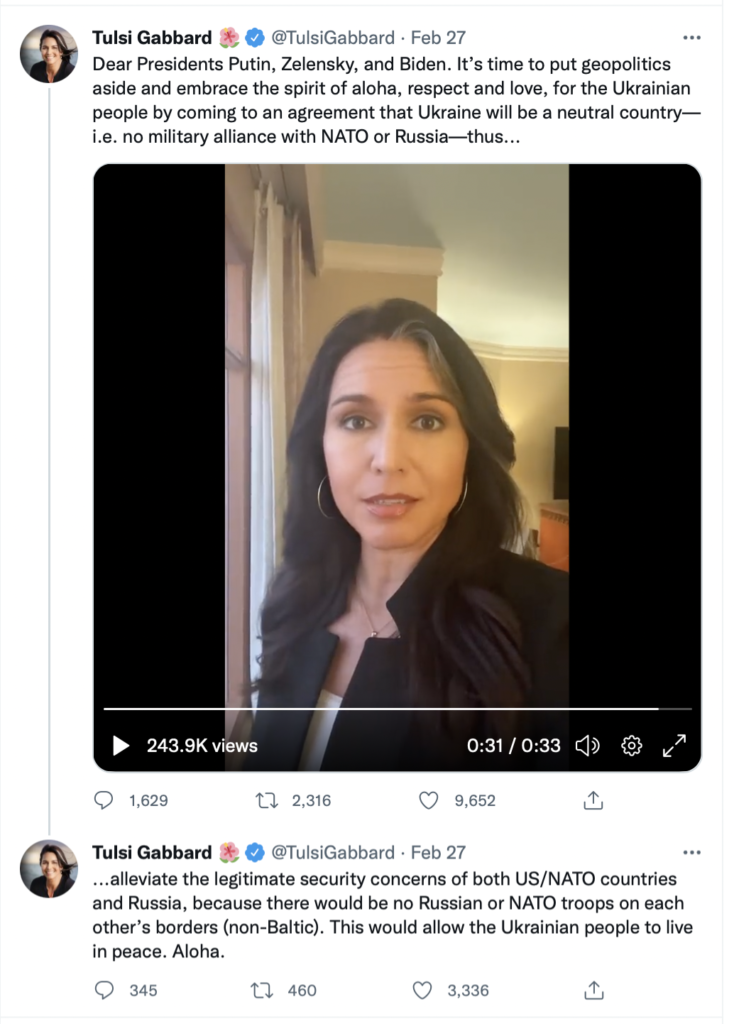
Second, Tulsi Gabbard tweeted this:

Third, Matt Taibbi reminds us that history matters:

I would like to point out that we already tried regime change in Russia. I remember, because I was there. And, thanks to a lot of lurid history that’s being scrubbed now with furious intensity, it ended with Vladimir Putin in power. Not as an accident, or as the face of a populist revolt against Western influence — that came later — but precisely because we made a long series of intentional decisions to help put him there.

Once, Putin’s KGB past, far from being seen as a negative, was viewed with relief by the American diplomatic community, which had been exhausted by the organizational incompetence of our vodka-soaked first partner, Boris Yeltsin. Putin by contrast was “a man we can do business with,” a “liberal, humane, and decent European” of “alert, controlled poise” and “well-briefed acuity,” who was open to anything, even Russia joining NATO. “I don’t see why not,” Putin said. “I would not rule out such a possibility.”

Fourth, this excerpt is from Glenn Greenwald's detailed analysis of our tribal dysfunction that mushroom when that exciting topic of war hits the tabletop:

In the weeks leading up to the Russian invasion of Ukraine, those warning of the possible dangers of U.S. involvement were assured that such concerns were baseless. The prevailing line insisted that nobody in Washington is even considering let alone advocating that the U.S. become militarily involved in a conflict with Russia. That the concern was based not on the belief that the U.S. would actively seek such a war, but rather on the oft-unintended consequences of being swamped with war propaganda and the high levels of tribalism, jingoism and emotionalism that accompany it, was ignored. It did not matter how many wars one could point to in history that began unintentionally, with unchecked, dangerous tensions spiraling out of control. Anyone warning of this obviously dangerous possibility was met with the “straw man” cliché: you are arguing against a position that literally nobody in D.C. is defending.

. . .

There is a reason I devoted the first fifteen minutes of my live video broadcast on Thursday about Ukraine not to the history that led us here and the substance of the conflict (I discussed that in the second half), but instead to the climate that arises whenever a new war erupts, instantly creating propaganda-driven, dissent-free consensus. There is no propaganda as potent or powerful as war propaganda. It seems that one must have lived through it at least once, as an engaged adult, to understand how it functions, how it manipulates and distorts, and how one can resist being consumed by it.

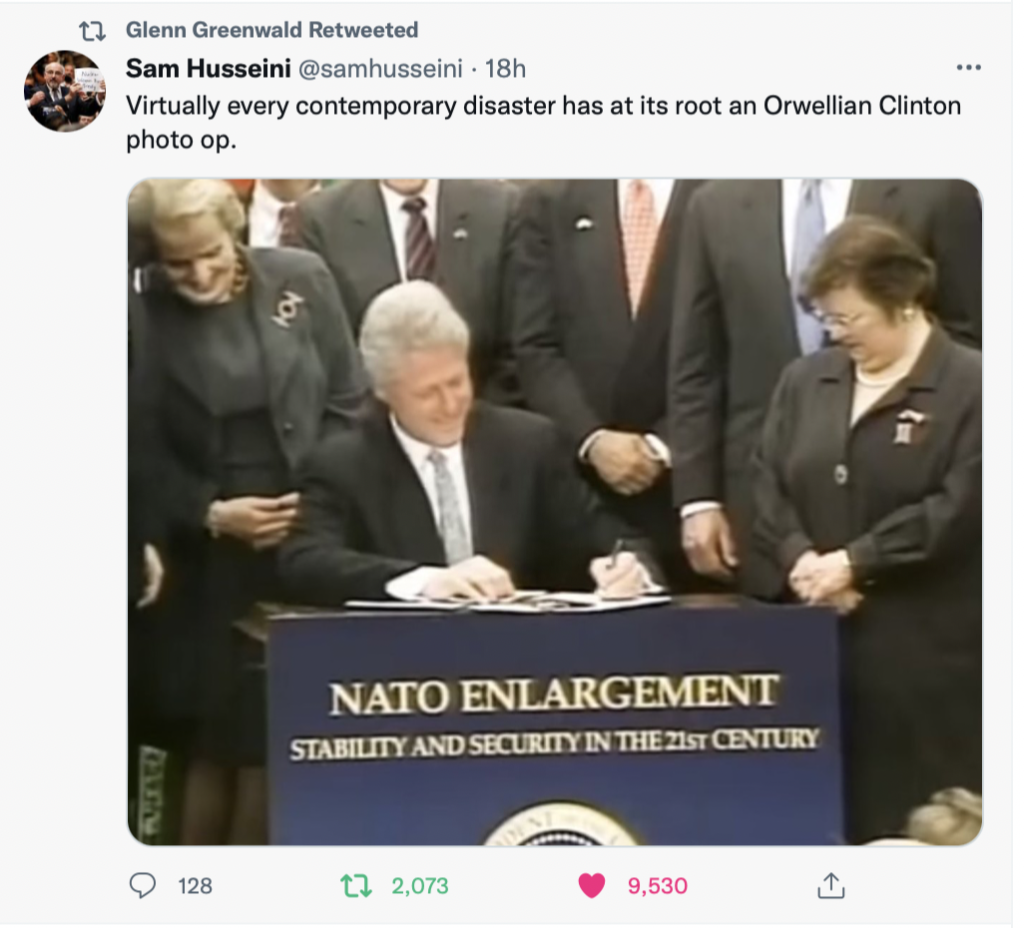
I will end with a photo:

Continue ReadingUkraine: Forbidden Discussions

Twitter Suspends, then Reinstate’s “Defiant L,” Whose Quest is to Expose Hypocrisy

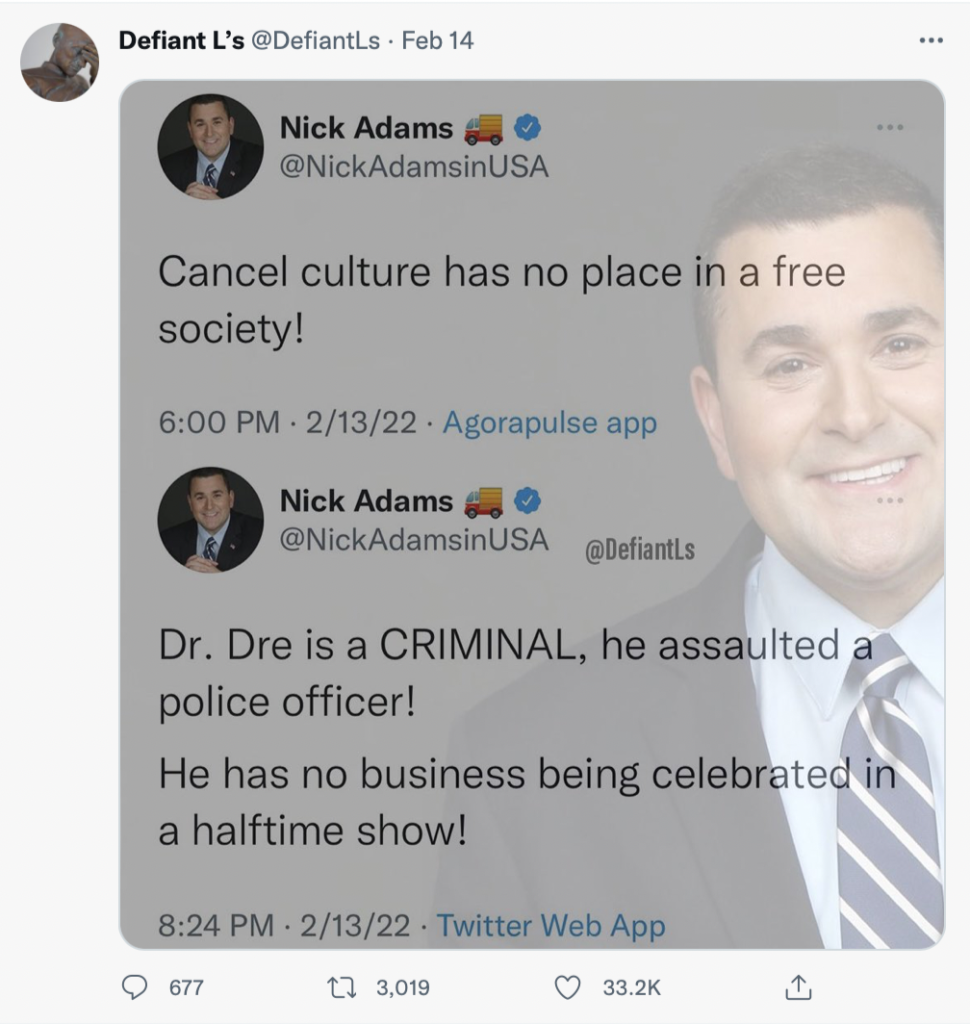
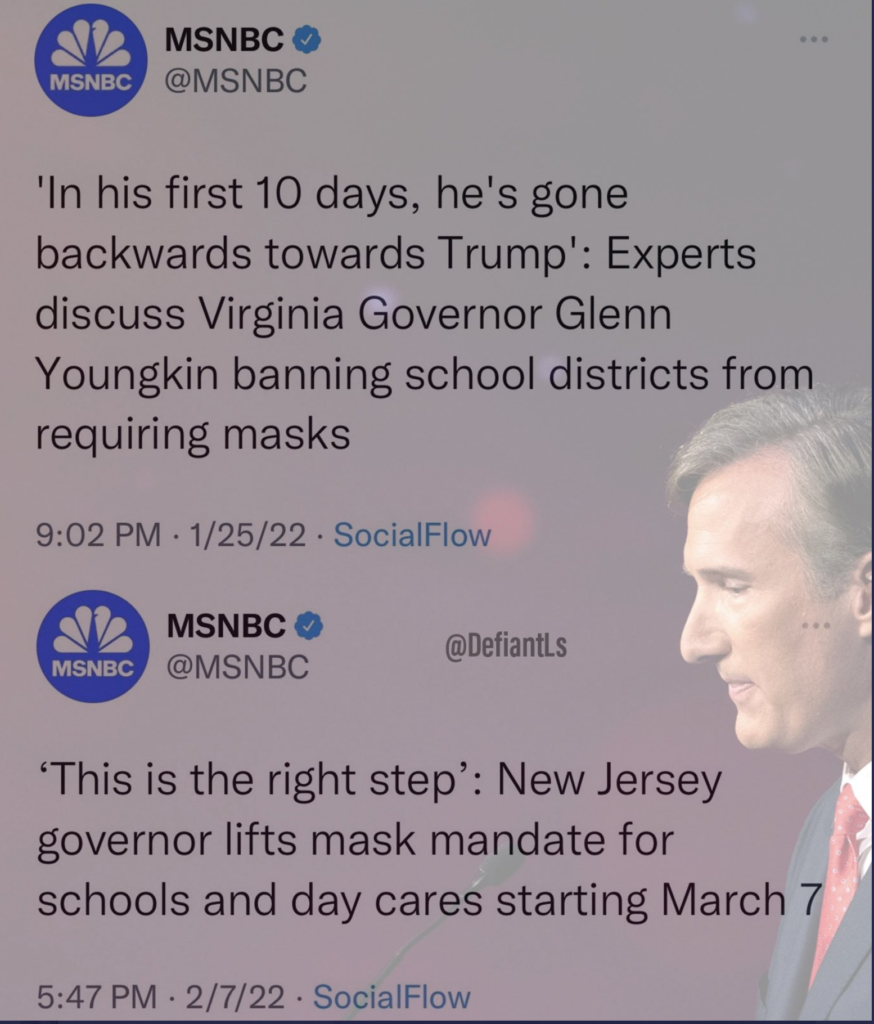
"Defiant L" has raised the exposing of hypocrisy to a high art, day after day. I don't think we will ever run out of hypocrisy based on the sheer volume of these posts. Note: Twitter recently suspended "Defiant L" with no explanation, but now the suspension has been lifted, after a massive outpouring against the suspension.

Continue ReadingTwitter Suspends, then Reinstate’s “Defiant L,” Whose Quest is to Expose Hypocrisy

The Type of Real Life Government Freddie deBoer Can Believe In

I enjoy reading the writings of Freddie deBoer, who describes himself as a "Marxist of an old-school variety." Here is an excerpt from his most recent Substack post: Title is "I want a political movement that is . . .

We would be concerned first and foremost with reality, and we would therefore privilege “is” statements over “ought to be” statements. My ideal movement would recognize that the obsession with the symbolic has become a road to nowhere for the left-of-center. Our relentless habit will be to say, what does this do for actually-existing poor people? What does this do for actually-existing Black people? What does this do for actually-existing women or gay or trans people? What does this policy, argument, or claim do in fact, for real human beings, in material terms? Put another way, if we got our way, could we see the effects of that with our own two eyes? I can see hungry Black kids getting food. I can’t see white liberals “holding space” for Black people. We must return to the real. It’s past time . . .

An effective left movement would identify building a mass movement by appealing to the unconvinced as its most central, most essential goal. All strategies and messaging would be bent towards the goal of rational appeal to potential supporters. We would identify obscurantism, factionalism, purity signaling, and other behaviors that limit the potential numbers of the movement as counterproductive. We would limit the use of specialized vocabulary and other forms of in-group signaling. We would constantly consider how our practices and discourses actually grow or fail to grow the ranks of the movement.

We would not abandon principle in the name of popularity, but we would insist that principles that inherently exclude large swaths of the human population cannot be the basis for a successful movement. We would seek to welcome, not alienate, those not already convinced. We would utilize traditional democratic principles such as voting and representation for decision-making. We would recognize that all “flat” movement structures, leaderlessness, and other anti-hierarchical systems of decision-making have repeatedly failed as means of governance in past left-wing movements. We would affirm and defend the rights of minority voices and dissent within the decision-making process. We would recognize the basic, beautiful radicalism of voting and democracy and defend them against the tyranny of structurelessness . . .

We would recognize that left movements have traditionally suffered terribly from assaults on individual rights, such as in anti-Communist purges, redbaiting, and anti-left eliminationism. We would acknowledge that the illiberalism and rights-trampling of several so-called Communist governments in the 20th century prompted an enormous backlash to left anti-capitalism. We would understand that a robust, functional left social movement would be strong enough to live alongside those who disagree with it, and would have no need of silencing them. We would move confidently in the knowledge that our core beliefs will eventually win because they are correct, and so feel no particular desire to silence those who dissent from those beliefs.

Continue ReadingThe Type of Real Life Government Freddie deBoer Can Believe In