Jonathan Haidt Explains Why Progressives Should Support Heterodox Academy

Jonathan Haidt, speaking on behalf of Heterodox Academy, which he co-founded. Here is an excerpt:

Universities are by their very nature progressive institutions. They encourage students and faculty to study the existing order and try to come up with something better. They broaden students’ minds and encourage curiosity about different people and ways of living. The ranks of nearly all progressive institutions are full of the top students from our top universities.

But something started going wrong on many campuses in the early 2010s. The combination of more polarizing social media, an intensifying culture war, and a changing Republican party drove an intense new kind of activism among a subset of progressive students that — whatever its noble motives — is damaging what is most precious about university life: the ability to have open and wide-ranging conversations. Students and faculty across the political spectrum now say that they are “walking on eggshells,” afraid that one slip could bring about terrible social consequences. As they learn to avoid making verbal “mistakes” in an unforgiving environment, students are being trained in habits of mind and heart that are antithetical to their own mental health, their own success in life, and the success of their political activism.

This is why many leading progressives have been warning, since 2015, that the new university culture is harmful to the country overall and to the Democratic party in particular . . .

Continue ReadingJonathan Haidt Explains Why Progressives Should Support Heterodox Academy

Two Versions of Free Speech

Tara Henley describes two versions of free speech citing to Jacob Mchangama's excellent new book. Henley's article is "Who gets to speak?If we want a free society – we must affirm freedom of speech for everyone, including Joe Rogan and the truckers." Here's an excerpt:

Danish lawyer Jacob Mchangama is set to publish his brilliant debut next week, Free Speech: A History from Socrates to Social Media. In it, the human-rights advocate chronicles “elite panics” of the past, which, he points out on Twitter, hold relevance for the current moment.

Elite panics involve an outbreak of angst among the wealthy and powerful — and they’ve been happening for millennia. And, while such outbursts can reflect real concerns, Mchangama writes in his book, “it is notable that they tend to erupt whenever the public sphere is expanded.” He goes on to explain: “Upon the introduction of new technology that gives access to those previously unheard, the traditional gatekeepers of public opinion fear that the newcomers will manipulate the masses through dangerous ideas, and propaganda, threatening the established social and political order.”

These conflicts, Mchangama notes, represent a clash between egalitarian and elitist conceptions of free speech. One sees free speech as a right for all; the other would have it be a privilege for those enlightened enough to use it properly.

Continue ReadingTwo Versions of Free Speech

What Happens When Academics Go to a Comedy Club to Start a Conversation that is Finished by Comedians?

A recent episode of Glenn Lourie's podcast occurred in the NY comedy club, The Cellar. The conversation was started by academics and thinkers including Glenn Loury, Roland Fryer and Coleman Hughes. Once under way, the comedians entered the conversation and many interesting things were spoken. Oh, and many of those interesting (and serious) things were hilarious. The comedians included Andrew Schulz, Judy Gold, Shane Gillis, T.J., Rick Crom, Nikki Jax and Sam Jay. Definitely worth an hour and a half of your time. I love hearing comedians talking shop and that is a lot of the conversation. There is another main theme, however. Can the comedians save us from cancel culture and wokeness?

Continue ReadingWhat Happens When Academics Go to a Comedy Club to Start a Conversation that is Finished by Comedians?

David Sachs’ Response to “Big Tech are Private Companies” and “Go Invent Your Own Internet”

Bari Weiss recently interviewed David Sachs on Common Sense, Bari's Substack. It is an excellent discussion of issues you will not see in legacy media outlets, who would like to see alternative media competition crushed. Here's an excerpt:

BW: The criticism that I hear a ton in response to what you're saying is: David, these are private companies. If I invent YouTube and I pay for the servers of YouTube and I've set up the whole architecture of the company, why can't I do what I want? Same with Facebook. Why don't I get to decide that I don't want some kind of clickbait or fake news or whatever on my thing? I'm going to police it. Who are you to tell me I can't?

DS: I think it's a very disingenuous argument. The same people who say that these social media companies, these big tech companies, should be free to do whatever they want because they're private companies are the same people pushing six bills through Congress right now to restrict and regulate those companies because they see them as monopolies. So they don't even believe their own argument. They all start making these libertarian arguments when these big tech companies are restricting speech in a way that they like. When they agree with the outcome, they want to give these companies the freedom to produce that outcome.

We need to fundamentally understand that free speech in our society has been privatized. The town square has been privatized. When the Constitution was written, the internet didn't exist. Back then, the town square was a physical place that you could go to, and there was a multiplicity of town squares all over the country. There were thousands of them and anybody could put their soapbox down and speak, and anyone could gather around and listen. That’s why, if you look at the First Amendment, it doesn't just protect freedom of speech and of the press. It also protects the right to peaceably assemble.

Well, where do people assemble today? They assemble in these giant social networks that have these gigantic network effects. That is where speech, especially political speech, occurs. And if you are shut out of that digital town square, to what extent do you still even have a First Amendment? To what extent do you have a right to speech? Well, I don't think you do. If you were to grab your soapbox today and go on the courthouse steps, they'll think you're a lunatic. You have no free speech right in this country if you are kicked off of these social networks.

So, I don't think it's good enough to say, well, these are private actors and, therefore, they can do whatever they want. Those private actors have too much power. They have the power to decide whether you, as an American, have an effective free speech right in this country. I think that's unacceptable. I think the Founders, the Framers of the Constitution, would never have permitted that.

...

BW: What do you say to the people who argue: If you don't like the way YouTube conducts itself, if you don't like the way Facebook conducts itself, no problem. Go make another one. Why is that not an acceptable solution to this problem?

DS: This is what you heard when Twitter and Facebook banned Trump. Their argument was: Go to a different app. And then Apple and Google banned Parler, which was the different app. And then the argument was, Well, that's not censorship. Just go create a website. And then Amazon Web Services started banning websites. So, at some point, when are you going to say this is an undue imposition on free speech? What am I supposed to do? Go create my own internet? All I wanted to do was post a tweet. Let’s not be obtuse to the power of these monopolies. I think people are being selectively oblivious to the network effects.

BW: We hear that phrase a lot: network effects. What does it mean?

DS: A network-effect business is one where the value of the service increases with the number of users. So if you think about Twitter or Facebook or the phone company, the more people who are on the service, the more value it has to everybody else. The value actually increases exponentially because the number of connections that can be made increases exponentially every time someone joins the service. If you or I want to create our own Twitter clone, it'll be very, very hard to do that because nobody else will be on it. So you have this huge chicken and egg problem. This is why these social networks are so powerful. They’ve got these huge network effects based on the fact that everybody is already on them, and it gets very, very hard to try and create a competing one.

Continue ReadingDavid Sachs’ Response to “Big Tech are Private Companies” and “Go Invent Your Own Internet”

Youtube Disappears Six Years of Work by Chris Hedges

Youtube's Mission Statement:

Our mission is to give everyone a voice and show them the world. We believe that everyone deserves to have a voice, and that the world is a better place when we listen, share and build community through our stories.

Bullshit.

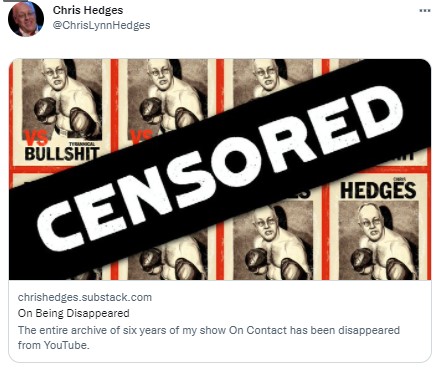
Six years of work by Chris Hedges. Youtube doesn't like it, so now it is gone.

Excerpt from the website of Chris Hedges:

The most vocal cheerleaders for this censorship are the liberal class. Terrified of the enraged crowds of QAnon conspiracy theorists, Christian fascists, gun-toting militias, and cult-like Trump supporters that grew out of the distortions of the money-drenched electoral system, neoliberalism, austerity, deindustrialization, predatory capitalism, and the collapse of social programs, they plead with the digital monopolies to make it all go away. They blame anyone but themselves. Democrats in the U.S. Congress have held hearings with the CEOs of social media companies pressuring them to do more to censor content. Banish the troglodytes. Then we will have social cohesion. Then life will go back to normal. Fake news. Harm reduction model. Information pollution. Information disorder. They have all sorts of Orwellian phrases to justify censorship. Meanwhile, they peddle their own fantasy that Russia was responsible for the election of Donald Trump. It is a stunning inability to be remotely self-reflective or self-critical, and it is ominous as we move deeper and deeper into a state of political and social dysfunction.

What were my sins? I did not, like my former employer, The New York Times, sell you the lie of weapons of mass destruction in Iraq, peddle conspiracy theories about Donald Trump being a Russian asset, put out a ten-part podcast called the Caliphate that was a hoax, or tell you that the contents on Hunter Biden’s laptop was “disinformation.” I did not prophesize that Joe Biden was the next FDR or that Hillary Clinton was going to win the election.

"The deplatforming of voices like mine, already blocked by commercial media and marginalized with algorithms, is coupled with the pernicious campaign to funnel people back into the arms of the establishment media such as CNN, The New York Times, and The Washington Post. In the US, as Dorothy Parker once said about Katharine Hepburn’s emotional range as an actress, any policy discussion ranges from A to B. Step outside those lines and you are an outcast. This is the reason Matt Taibbi, Glenn Greenwald and I are on Substack.

It is perhaps telling that our greatest investigative journalist, Sy Hersh, who exposed the massacre of 500 unarmed Vietnamese civilians by US soldiers at My Lai and the torture at Abu Ghraib, has trouble publishing in the United States. I would direct you to the interview I did with Sy about the decayed state of the American media, but it no longer exists on YouTube.

Continue ReadingYoutube Disappears Six Years of Work by Chris Hedges