UNC Adopts Chicago Principles and the Kalven Committee Report Principles

Hopefully we will see a lot more universities adopting the Chicago Principles. UNC recently took this big step . . . and more:

On July 27, the University of North Carolina (UNC)–Chapel Hill’s Board of Trustees made a strong, new commitment to safeguard the free exchange of ideas on campus. Colleges and universities face immense pressure to comport with majority beliefs, but UNC’s trustees proactively resolved to maintain institutional neutrality on controversial political and social issues.

The trustees’ unanimous resolution built on the previous work of the faculty. To the credit of the UNC Faculty Assembly, it adopted in 2018 the Chicago Principles on Freedom of Expression, an action affirmed by the trustees in March 2021. The faculty resolution read, in part, “By reaffirming a commitment to full and open inquiry, robust debate, and civil discourse we also affirm the intellectual rigor and open-mindedness that our community may bring to any forum where difficult, challenging, and even disturbing ideas are presented.”

The trustees took a remarkable further step. In addition to confirming once more the decision of the Faculty Assembly, they put the university in the vanguard of institutions committed to a robust heterodoxy of views and opinions by also adopting what is known as the Kalven Committee Report on the University’s Role in Political and Social Action. The UNC resolution notes that the Kalven Report “recognizes that the neutrality of the University on social and political issues ‘arises out of respect for free inquiry and the obligation to cherish a diversity of viewpoints’ and further acknowledges ‘a heavy presumption against the university taking collective action or expressing opinions on the political and social issues of the day.’

For more on the need for universities to maintain institutional neutrality, see Mark McNeilly's article at the HxA Blog: "Universities Should Adopt Institutional Neutrality." An excerpt:

Institutional neutrality is the idea that the university, as the Kalven Report states, “cannot take collective action on the issues of the day without endangering the conditions for its existence and effectiveness.” It comes to this conclusion on the basis of the view that “the mission of the university is the discovery, improvement, and dissemination of knowledge.” The university follows this mission to advance society and humankind. What higher mission could there be?

The instrument of the mission, per the Report, “is the individual faculty member or the individual student. The university is the home and sponsor of critics; it is not itself the critic.” Thus, “to perform its mission in the society, a university must sustain an extraordinary environment of freedom of inquiry and maintain an independence from political fashions, passions, and pressures. A university, if it is to be true to its faith in intellectual inquiry, must embrace, be hospitable to, and encourage the widest diversity of views within its own community.”
Continue ReadingUNC Adopts Chicago Principles and the Kalven Committee Report Principles

Reporters Who Keep Us in the Dark so that They can be Popular with their Peers

Freddie DeBoer points out one of the biggest stories that is not being reported. It is a story that affects (and often corrupts) ALL the big stories. It appears that reporters think of themselves as being back in high school and it appears that their need to be seen as admirable by their peers affects whether they will ask serious questions or whether they will pursue a story at all.

DeBoer is an excellent writer and I subscribe to his Substack. This is a critically important story that is kryptonite to all of the "news" reporters out there with misplaced priorities--in other words, the many "news" reporters who would rather be popular than do the difficult job of being real journalist. Here's an excerpt.

In the fifteen years I’ve written for public consumption, this is the topic I’ve returned to most. I have argued that people who work in the media are in great majorities unduly concerned with being popular among their peers, and that this desire distorts our newsmedia and what it covers in destructive ways. I also believe that the most important site of this kind of social conditioning is Twitter. A corollary to this is that the industry, which will give the most trivial subjects immense amounts of coverage (like, say, the “Try Guys”) avoids talking about the powerful impact of the desire to be popular, a kind of within-industry omerta that prevents anyone from looking too closely at how the sausage gets made. I told this story my first year of writing, I’ve told it most every year since, and I’m telling it again now. Because nothing ever changes.

There are, of course, many people of both talent and integrity within the industry who do their best to avoid this social capture. Many of them are open-minded about who they read and what they’ll engage with. Indeed, the median writer is (unsurprisingly) more thoughtful and willing to challenge consensus than the crowd. But even the most independent of them tend to at least maintain the code of omerta, refusing to publicly question the in-crowd dynamics even if they won’t play into them with their own behavior. And I do get it; they have to live and work in that industry and coexist alongside the peers that they might be criticizing in aggregate. It would, though, make me feel slightly less crazy if more people would say, even occasionally, “people in the industry really want to be well-liked, and they change their public personas and their work to remain so.” What’s frustrating for me is that, while they may not share my level of disdain for this condition, many individual writers have privately conceded the broad contours of what I’m saying. But they don’t do so publicly. Like I said. Omerta.

Of course, the disciplinary action taken against people who speak the way I am is exactly what you’d expect: insiders accuse critics of insiderism of merely being jealous that they aren’t insiders themselves. It can’t be the case that someone like myself could genuinely, organically observe the ways in which media cliquishness distorts the practices of journalism and commentary and advocate for something better. Any such critics must necessarily merely want to be a part of the hierarchy they criticize, sour grapes. Again, it never changes.

What I never understand is why no enterprising media reporter doesn’t ever try to report this out. There are no industries where insiderism and patronage don’t impact the labor market to some degree, so why not try to explore that influence? How does the insiderism of elite media Twitter influence the industry and thus our national story?

Continue ReadingReporters Who Keep Us in the Dark so that They can be Popular with their Peers

The “News” Media is the Dying Canary in the Coal Mine

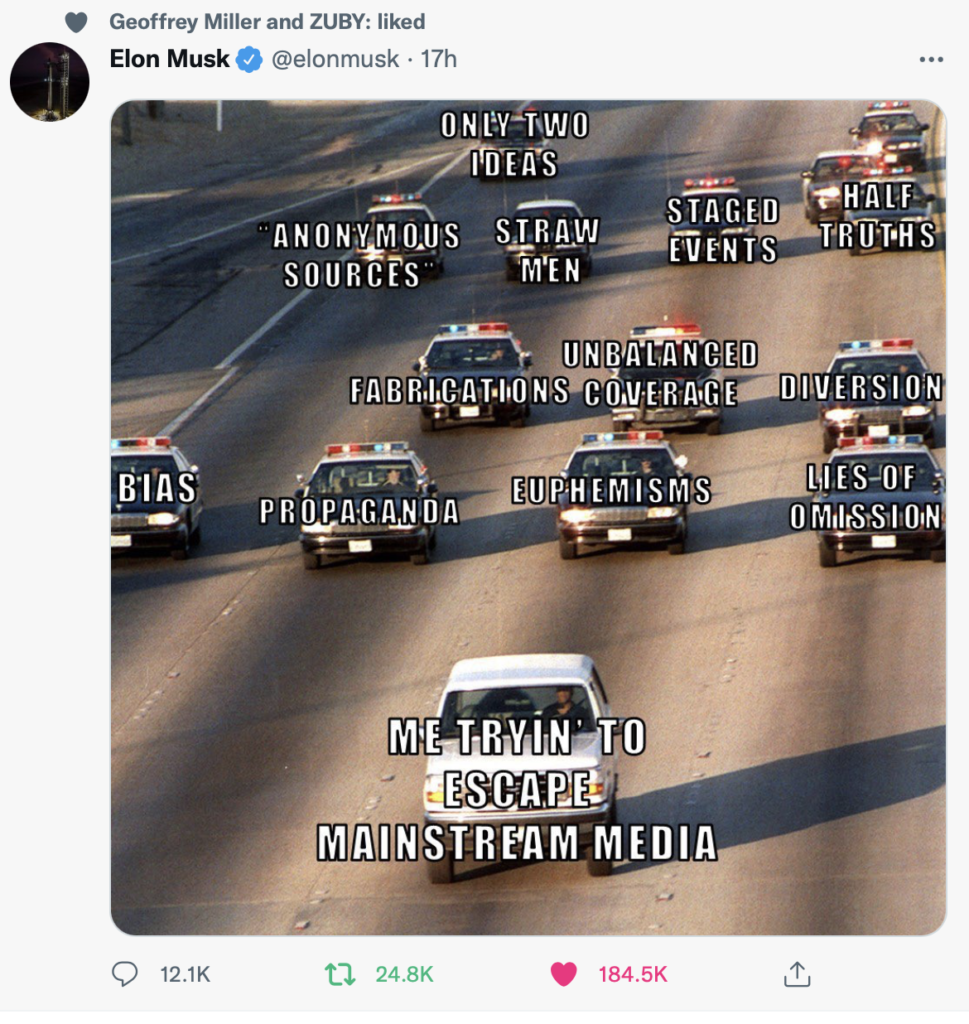
I have lost respect for many institutions over the past few years. Not so much the members, but the leadership (which causes many member to fall silent). Exhibit A is our so-called "news" media. I have been collecting dozens and dozens of examples at my website, Dangerous Intersection.

It often boils down to these organizations failing to be curious about what is going on. Failing to question powerful people. Failing to vigorously cross-examine the leaders of the political parties they obediently serve. Journalists should be out there pissing off ALL of our leaders with probing questions, but they are too often serving as stenographers and megaphones for highly questionable positions. This great danger to our country is invisible as long as you cling to one side or the other (democrat serving or republican serving) "news" media.

I challenge anyone reading this to start reading "the other side" and, better yet, independent journalists, in order to get a much better view of what is going on. You'll find many of those independent journalists have left mainstream news to strike out on their own (e.g., on Substack), disgusted with what has happened to their employers.

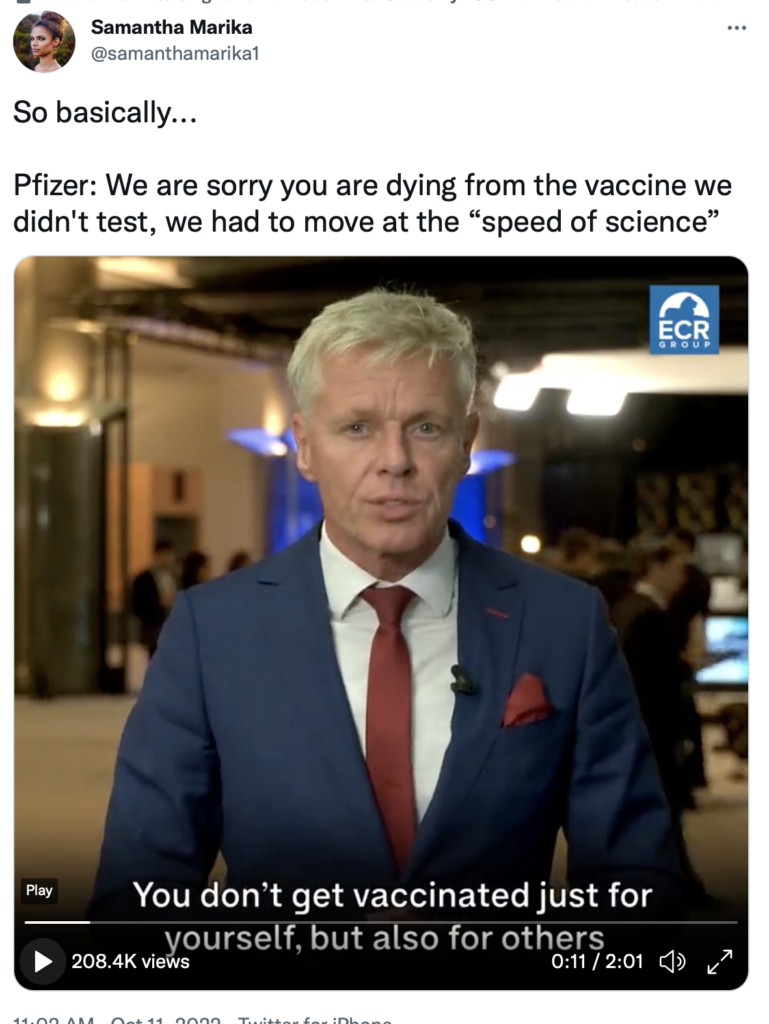
Here's a recent example: Why were reporters failing to grill Pfizer executives and our political leaders on whether the vaccinations would stop transmission of COVID? How many dozens of bad policies resulted because our "news" reporters decided to parrot public officials rather than vigorously question them?

Continue ReadingThe “News” Media is the Dying Canary in the Coal Mine

Statement by FIRE on Attempts by Venmo and PayPal to Deny Financial Services based on the Speech and Viewpoints of Users

FIRE Statement on Free Speech and Online Payment Processors Foundation for Individual Rights and Expression by FIRE (September 30, 2022):

The issue: Online payment processors like Venmo and PayPal often deny Americans access to these vital services based on their speech or viewpoints.

The concern: When these companies appoint themselves the arbiters of what speech and views are acceptable, shutting people and organizations out of the online financial ecosystem for wrongthink, they seriously undermine our culture of free expression.

Imagine you could no longer use PayPal, Venmo, or another online payment processor because you run an organization that defends free speech for controversial speakers, operate an independent media outlet that challenges mainstream narratives, sell erotic fiction or “occult” materials, or . . . tried to submit an article about Syrian refugees into a newspaper awards competition.

These are not hypotheticals. They’re real, and they illustrate why online payment service providers should stay out of the business of policing their users’ speech and views.

Follow the link for the entire article by FIRE. The article includes numerous examples of abuses by these financial services companies.

Continue ReadingStatement by FIRE on Attempts by Venmo and PayPal to Deny Financial Services based on the Speech and Viewpoints of Users