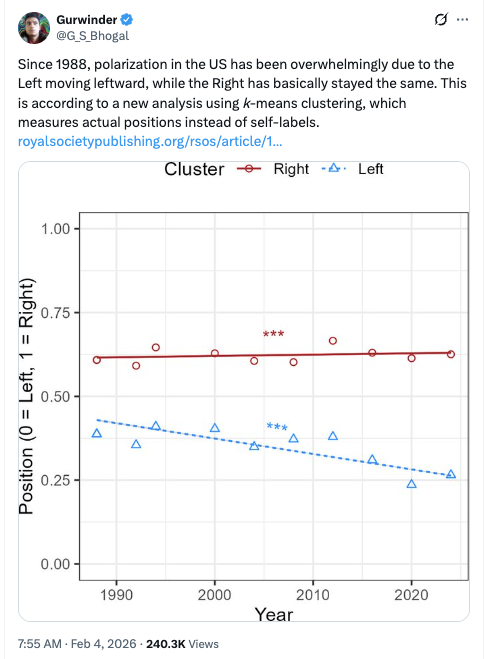
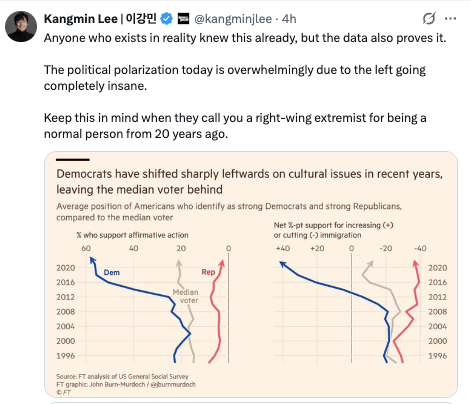
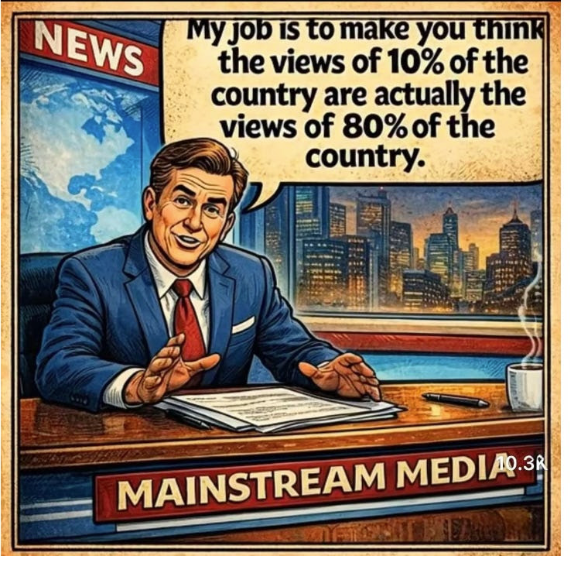
PSYOP Manual for the US Army
Like to see how the US Army planned to psychologically manipulate foreign populations? It might be especially interesting now that we know that these techniques have now been turned against Americans. Here's Robert Malone's short post along with a link to the army PSYOP manual.
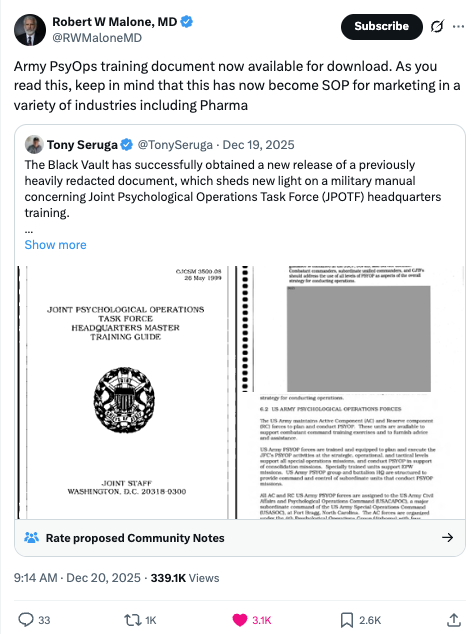
What is a PSYOP? According to p. A3 of the manual:
1.5 PSYCHOLOGICAL OPERATIONS (PSYOP)Psychological Operations are planned to convey selected information and indicators to foreign audiences to influence their emotions, motives, objective reasoning, and ultimately the behavior of foreign governments, organizations, groups, and individuals. The purpose of PSYOP is to induce or reinforce foreign attitudes and behavior favorable to the originator's objectives.
I then asked Grok:
What types of psyop techniques described in this 1999 Army Psyop manual are being utilized by corporate media today to skew public understanding of what is going on in the world or how to think about it?
Psyop Techniques from the 1999 Manual and Parallels in Corporate Media
The 1999 Joint Psychological Operations Task Force Headquarters Master Training Guide (CJCSM 3500.08) outlines frameworks for military psyop, focusing on influencing foreign audiences through planned information dissemination, analysis, and evaluation. While it's a military document (canceled in 2004), its principles—such as propaganda, deception, and target analysis—bear resemblance to strategies observed in corporate media today. Corporate media, including major networks and social platforms, often shapes public perception through selective framing, emotional appeals, and rapid narrative amplification, which can skew understanding of global events or issues like politics, economics, and social dynamics.
Below is a table summarizing key techniques from the manual, their descriptions, and observed parallels in modern corporate media. These parallels are drawn from analyses of media practices, including psychographic targeting, misinformation campaigns, and sentiment manipulation. Note that media entities may not intentionally label their actions as "psyop," but the effects align with the manual's methods. Claims are substantiated where possible from diverse sources, including academic studies, investigative reports, and public discourse, representing viewpoints from military, tech, and conspiracy-oriented perspectives.
Click "More" for Grok's table.
These techniques aim to induce favorable attitudes in the manual's context, but in media, they can skew understanding by prioritizing engagement over accuracy—e.g., dividing audiences ("us vs. them") or exploiting biases like Magruder's Principle (reinforcing pre-existing beliefs). Diverse sources note this in politics (e.g., election interference) and business (e.g., market manipulation), with X discussions highlighting perceived ops in everyday news. While not all media actions are deliberate psyops, the patterns enable narrative control at scale.
[More . . . ]