J.K. Rowling’s Individual Points Regarding Gender Ideology

Speaking of assassinations, J.K. Rowling occasionally posts some of the many death threats she receives. They are shocking in their intensity and details. What has she done to deserve these threats? She recently took the time to spell out her positions on gender ideology. I follow these issues closely and I largely agree with her on these issues (though I have other opinions too and some of my view are more nuanced). This makes me wonder. Instead of framing the issue broadly as one of "gender ideology," I wonder how people would respond to the individual points that Rowling raises below? Or, at least, how would they respond if they could vote by secret ballot, without any fear that someone would harm or kill them? I assume that almost all people would agree with many or most of her positions. I would like to see the data.

Here is Rowling's Sept 1, 2025 post:

Here is Rowling's Sept 1, 2025 post:
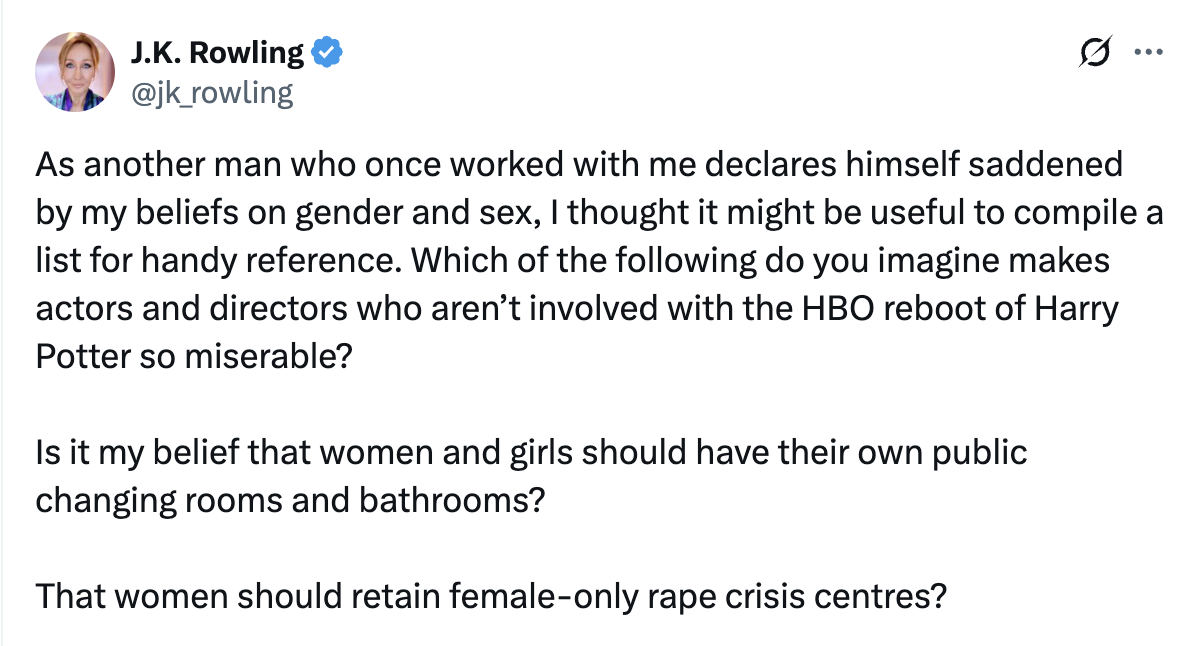
As another man who once worked with me declares himself saddened by my beliefs on gender and sex, I thought it might be useful to compile a list for handy reference. Which of the following do you imagine makes actors and directors who aren’t involved with the HBO reboot of Harry Potter so miserable?

Is it my belief that women and girls should have their own public changing rooms and bathrooms?

That women should retain female-only rape crisis centres?

That men don’t belong in women’s sport?

That female prisoners shouldn’t be incarcerated with violent men and male sex offenders?

That women should remain a protected class in law, because they have sex-specific needs and issues?

That language should reflect reality rather than ideological jargon, especially in a medical context?

That women shouldn’t be harassed, persecuted or fired for refusing to pretend humans can change sex?

That women should not be threatened with violence and rape when they assert their rights?

That freedom of speech and belief are essential to a pluralistic democratic society?

That troubled minors, especially those who are gay, autistic and trauma-experienced, should be given mental health support instead of irreversible surgeries and drug treatments on non-existent evidence of benefit?

That gay people shouldn’t be pressured to include the opposite sex in their dating pools, nor should they be smeared as ‘genital fetishists’ when they don’t?

That cross-dressing heterosexual male fetishists aren’t actually oppressed, but having the time of their lives piggybacking off gender identity ideology?

That said ideology, and the privileged, blinkered fools pushing it because they suffer zero consequences themselves, have done more damage to the political left’s credibility than Trump and Farage could have achieved in a century?

Let me have your thoughts.

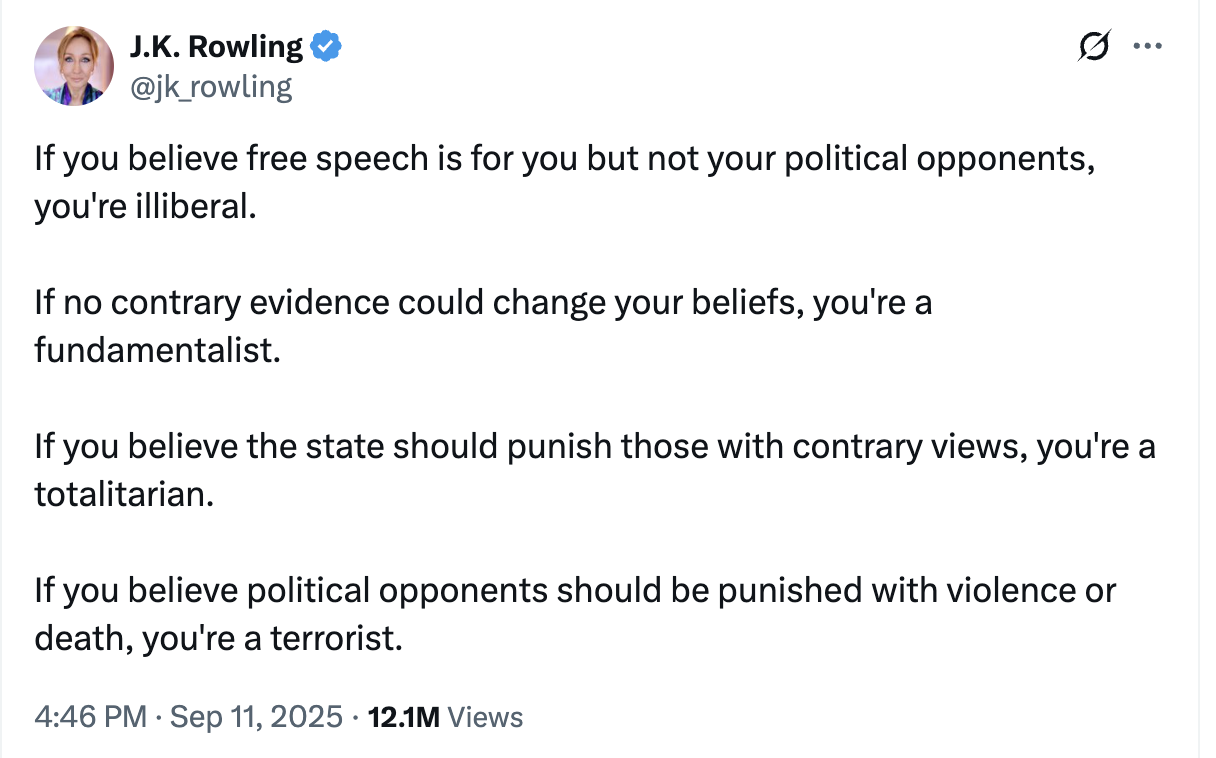
Here's a good way to end this post, with Rowlings' post from yesterday:

If you believe free speech is for you but not your political opponents, you're illiberal.

If no contrary evidence could change your beliefs, you're a fundamentalist.

If you believe the state should punish those with contrary views, you're a totalitarian.

If you believe political opponents should be punished with violence or death, you're a terrorist.
Continue ReadingJ.K. Rowling’s Individual Points Regarding Gender Ideology

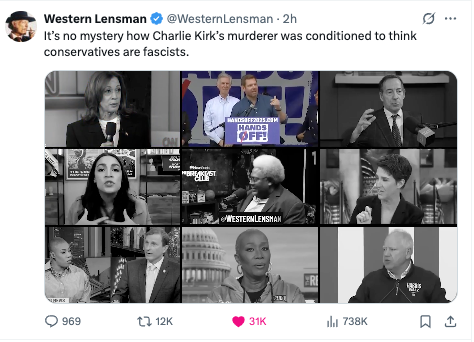
How Could it be that Politicians We Disagree with Come to be Seen as Facists?

Why don't we simply see politicians we disagree with as politicians we disagree with? How is it that so many people seem then as so morally degenerate that we need to get rid of them and the end justifies the means?

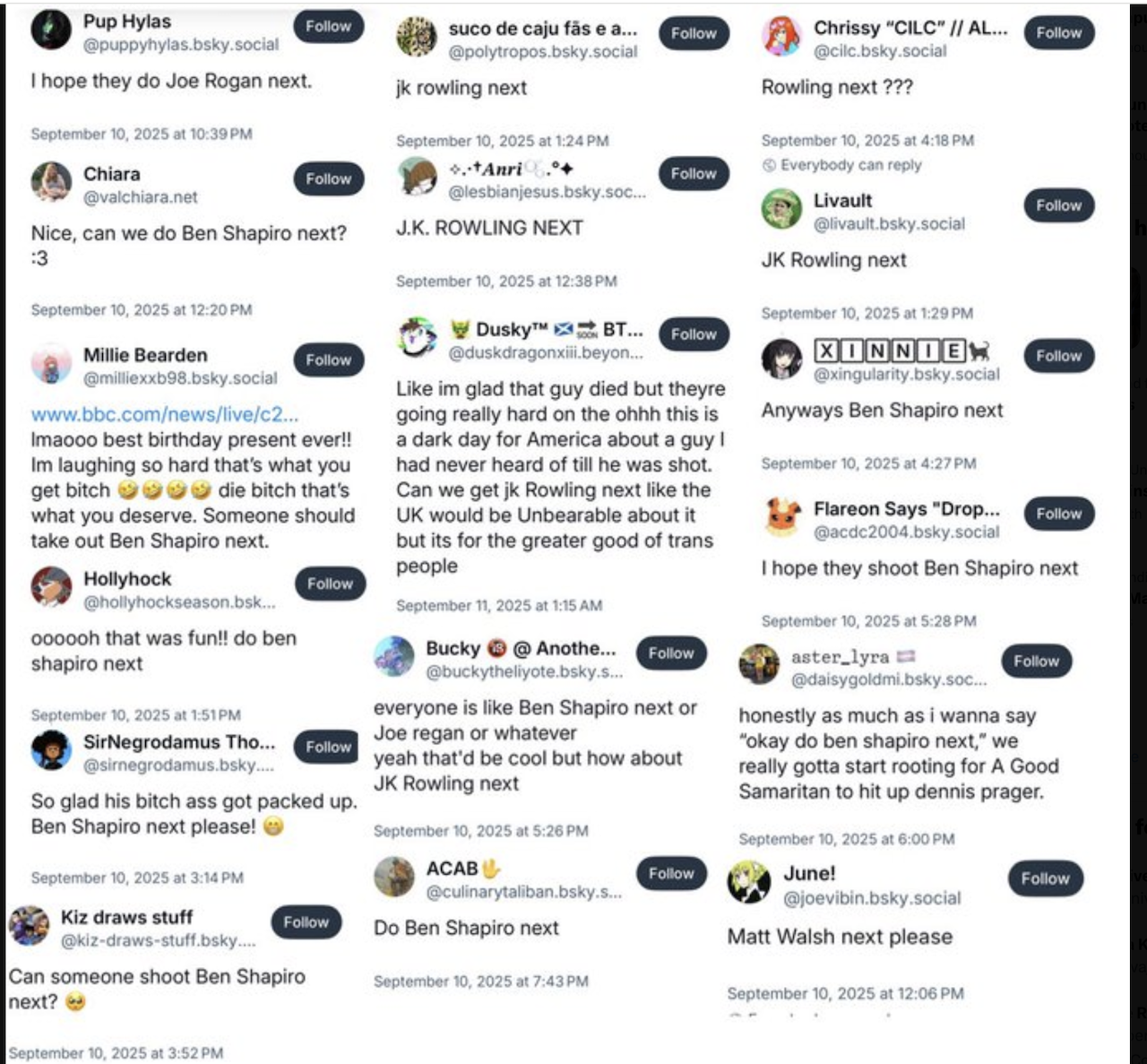
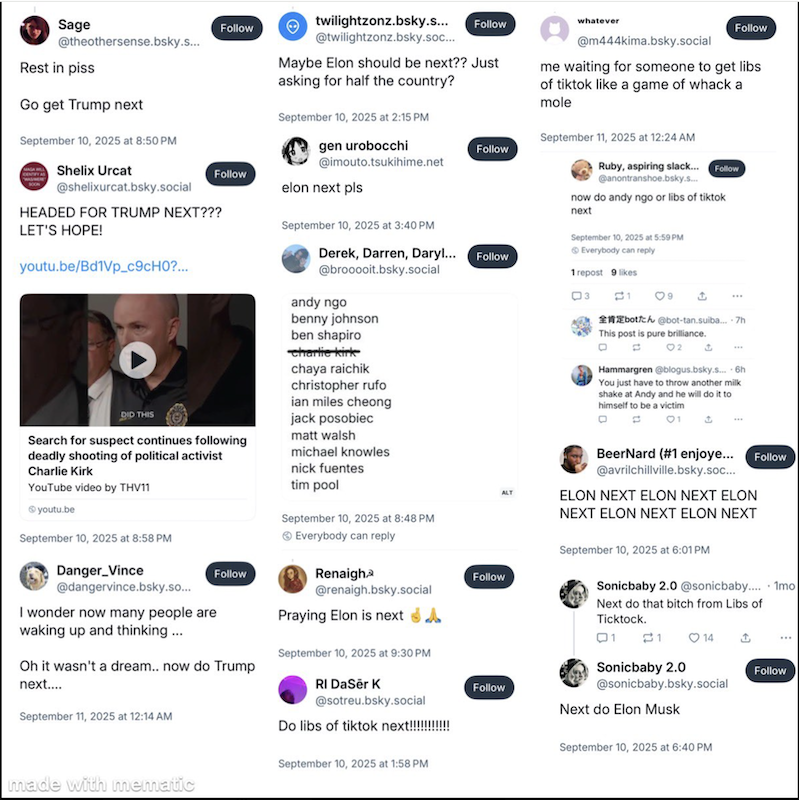
The end result of this conditioning is what is currently flooding BlueSky (the social media platform catering especially to people leaning to the Left) in the wake of the assassination of Charlie Kirk:

Continue ReadingHow Could it be that Politicians We Disagree with Come to be Seen as Facists?

FIRE Survey: College Violence is On The Upswing

Nico Perrino, the Executive VP of the Foundation for Individual Rights and Expression (FIRE) has authored "Charlie Kirk's assassinationViolence must never be a response to speech."

Unfortunately, since 2021, we’ve seen a steady rise in support for violence in response to speech on campus. Earlier this week, we released our finding that one in three students express some support for the use of violence to stop a campus speech. That’s up from 20 percent only three years ago. While we do not know the identity of the gunman, what happened yesterday is indicative of a broader cancer in our body politic that we must address.

But it must not be addressed with censorship.

For more than 25 years, FIRE has challenged colleges that use speculative and amorphous security rationales to justify censoring controversial speakers. Through public records requests and other means, we’ve often found these rationales serve as a pretext to shut down debate and capitulate to demands for censorship. Indeed, according to our Deplatforming Database, Kirk was the subject of at least 14 attempts to stop him from speaking on campuses since 2021. Over the years, FIRE has repeatedly written to colleges that sought to silence Kirk’s organization and supporters.

The philosopher Alfred North Whitehead once observed: “The purpose of thinking is to let the ideas die instead of us dying.”

Continue ReadingFIRE Survey: College Violence is On The Upswing

The Characteristics of People who Commonly Engage in Ad Hominem Attacks

I asked Grok: "What characteristics would you attribute to people who refuse to engage on the issues and instead engage in ad hominem attacks?"

Grok's response (I think it's an excellent response):

People who consistently avoid substantive debate on issues and resort to ad hominem attacks—insulting the person rather than addressing their arguments—often exhibit a cluster of psychological, cognitive, and behavioral traits. These aren't universal, as context matters (e.g., stress or cultural norms can play a role), but based on observations from psychology, rhetoric, and social dynamics, here are some common characteristics I'd attribute to them:Intellectual insecurity or defensiveness: They may feel their beliefs or knowledge are under threat, leading them to deflect by attacking the messenger. This stems from a fragile ego or imposter syndrome, where engaging deeply risks exposing weaknesses.

1. Lack of substantive knowledge or preparation: Without strong facts or reasoning to back their position, they fall back on personal jabs as a shortcut. It's easier to call someone "stupid" than to research and counter an argument effectively.

2. Emotional immaturity or high reactivity: Prone to letting emotions override logic, they might have poor impulse control or unresolved anger issues, turning discussions into personal vendettas. This aligns with traits seen in low emotional intelligence (EQ).

3. Cognitive biases in overdrive: Things like confirmation bias (only seeking info that supports their view) or black-and-white thinking make them dismiss opposing ideas outright, viewing disagreement as a personal affront rather than an intellectual challenge.

4. Manipulative or bad-faith tendencies: In some cases, it's a deliberate tactic to derail conversations, common in trolls, propagandists, or those with narcissistic traits who prioritize "winning" over truth-seeking. They might enjoy provoking reactions for entertainment or control.

5. Poor communication or conflict resolution skills: Often stemming from upbringing, education gaps, or social environments that reward aggression over dialogue, they haven't learned (or choose not to use) tools like active listening or constructive criticism.

These behaviors can be self-reinforcing, as they alienate thoughtful interlocutors and surround the person with echo chambers. If it's a habit, it might indicate deeper issues like anxiety disorders or even cluster B personality traits (e.g., borderline or antisocial tendencies), though that's speculative without clinical context. On the flip side, everyone slips into ad hominem occasionally under pressure—it's the refusal to engage that's the red flag.

Continue ReadingThe Characteristics of People who Commonly Engage in Ad Hominem Attacks

About “You”

If you are not aggressively doubting, investigating and fighting for your personal autonomy every hour, you are no longer the author of "your" thoughts. As Soloman Asch warned us, if you aren't pushing back hard against your own people, you will become a mere sock puppet.

For much more, see Robert Malone's new book, PsyWar. I'm half-way thorugh. This summary is by Grok (though I've tweaked it a bit:

* Robert W. Malone MD, MS, an mRNA technology pioneer and physician-scientist, and Jill Glasspool Malone PhD. Psywar delves into the mechanisms of modern psychological warfare, or "PsyWar," which the authors define as government-orchestrated campaigns using propaganda, censorship, and psychological operations (psyops) to manipulate public opinion and behavior.

* The book focuses on how these tactics have been deployed against the American people, drawing from historical contexts to contemporary applications. It argues that PsyWar is a tool for enforcing a "New World Order" through techno-totalitarianism and global control structures. Specifically addressing 5th generation psyops—often tied to fifth-generation warfare—the text explores asymmetric, information-based conflicts that blend psychological manipulation with technology, surveillance, and behavioral control to achieve dominance without traditional military engagement. Malone, known for his critiques of COVID-19 policies and vaccine mandates, frames these as examples of psychological bioterrorism and administrative state overreach.

* Key topics covered include:

* - **Propaganda and Behavioral Control**: Techniques for shaping public perceptions and actions through media and information manipulation.

* - **Psychological Bioterrorism**: The use of fear-based psyops in health crises to enforce compliance.

* - **Deep State Censorship and Surveillance Capitalism**: How government and corporate entities collaborate to monitor and suppress dissent.

* - **Fifth-Generation Warfare**: Non-kinetic strategies emphasizing psyops, cyber elements, and hybrid threats to undermine societies.

* - **PsyWar Tactics and Techno-Totalitarianism**: Modern tools like AI-driven censorship and data exploitation for totalitarian ends.

* - **The New World Order and Global Control**: Visions of centralized power structures enabled by these warfare methods.

* The authors emphasize the critical role of free speech in countering these threats, advocating for a return to constitutional principles to resist totalitarian creep and restore personal sovereignty. The book has been discussed in podcasts and reviews as a call to action against perceived government psyops, particularly in the context of recent global events.

Continue ReadingAbout “You”