What Else Isn’t True?

What else did we think we knew for decades that now turns out to be bullshit? The the most important lessons we are being taught over the past five years are A) the inextricably fraught relationship between knowledge and power and B) the critical need to be courageous and skeptical whenever we try to make sense of the things of the world in order to swat away the oftentimes insidious power of tribalism.

Steven Pinker:

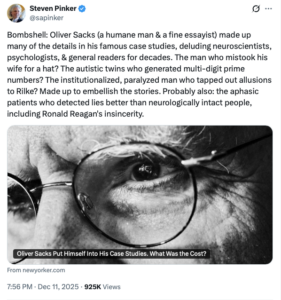
Bombshell: Oliver Sacks (a humane man & a fine essayist) made up many of the details in his famous case studies, deluding neuroscientists, psychologists, & general readers for decades. The man who mistook his wife for a hat? The autistic twins who generated multi-digit prime numbers? The institutionalized, paralyzed man who tapped out allusions to Rilke? Made up to embellish the stories. Probably also: the aphasic patients who detected lies better than neurologically intact people, including Ronald Reagan's insincerity.

Continue ReadingWhat Else Isn’t True?

The Downside of Agreeableness

What is it to be (or not be) "agreeable"?

Michael Malice:

Michael Malice:

I score a zero or close to it on agreeableness Meaning, it makes little sense to me to say things or act in a certain way simply to accommodate others I view it as a form of dishonesty and long-term disaster If you are high-agreeableness, how would you explain it to me?

Question to Grok: With regard to the Big Five trait of agreeableness, what is the consequence of being extremely agreeable? What is the opposite of Agreeableness?

Consequences of Being Extremely Agreeable

ExtremeAgreeableness, a trait characterized by high levels of compassion, cooperation, and a desire to maintain harmony, can have both positive and negative consequences:Positive Consequences:Strong Relationships:

- Highly agreeable individuals are often well-liked, fostering trust and positive social bonds due to their kindness and empathy.

- Conflict Avoidance: Their tendency to prioritize harmony can de-escalate conflicts and promote group cohesion.

- Team Collaboration: They excel in cooperative settings, making them effective in team-oriented environments.

Negative Consequences:Difficulty Asserting Needs:

- Extreme agreeableness may lead to suppressing personal needs or opinions to avoid conflict, resulting in unmet needs or resentment.

- Vulnerability to Exploitation: Highly agreeable people may be taken advantage of, as they are less likely to confront manipulative behavior.

- Reduced Leadership Effectiveness: Excessive agreeableness can hinder decision-making or assertiveness, making it challenging to take charge in competitive or high-stakes situations.

- Neglect of Self-Interest: Constantly prioritizing others can lead to burnout or diminished self-esteem if their own goals are consistently sidelined.

Opposite of Agreeableness

The opposite of agreeableness in the Big Five personality framework is low agreeableness, often described as antagonism or disagreeableness. Individuals with low agreeableness exhibit traits such as:Competitiveness: Prioritizing personal goals over group harmony, often thriving in competitive environments.

- Skepticism or Cynicism: Being less trusting and more critical of others’ intentions.

- Assertiveness or Aggressiveness: Willingness to confront others, express disagreement, or pursue self-interest, sometimes at the expense of relationships.

- Lower Empathy: Less concern for others’ feelings, which can manifest as bluntness or insensitivity.

While low agreeableness can lead to conflicts or strained relationships, it can also be advantageous in situations requiring tough decision-making, negotiation, or standing firm on principles.

Continue ReadingThe Downside of Agreeableness

About “You”

If you are not aggressively doubting, investigating and fighting for your personal autonomy every hour, you are no longer the author of "your" thoughts. As Soloman Asch warned us, if you aren't pushing back hard against your own people, you will become a mere sock puppet.

For much more, see Robert Malone's new book, PsyWar. I'm half-way thorugh. This summary is by Grok (though I've tweaked it a bit:

* Robert W. Malone MD, MS, an mRNA technology pioneer and physician-scientist, and Jill Glasspool Malone PhD. Psywar delves into the mechanisms of modern psychological warfare, or "PsyWar," which the authors define as government-orchestrated campaigns using propaganda, censorship, and psychological operations (psyops) to manipulate public opinion and behavior.

* The book focuses on how these tactics have been deployed against the American people, drawing from historical contexts to contemporary applications. It argues that PsyWar is a tool for enforcing a "New World Order" through techno-totalitarianism and global control structures. Specifically addressing 5th generation psyops—often tied to fifth-generation warfare—the text explores asymmetric, information-based conflicts that blend psychological manipulation with technology, surveillance, and behavioral control to achieve dominance without traditional military engagement. Malone, known for his critiques of COVID-19 policies and vaccine mandates, frames these as examples of psychological bioterrorism and administrative state overreach.

* Key topics covered include:

* - **Propaganda and Behavioral Control**: Techniques for shaping public perceptions and actions through media and information manipulation.

* - **Psychological Bioterrorism**: The use of fear-based psyops in health crises to enforce compliance.

* - **Deep State Censorship and Surveillance Capitalism**: How government and corporate entities collaborate to monitor and suppress dissent.

* - **Fifth-Generation Warfare**: Non-kinetic strategies emphasizing psyops, cyber elements, and hybrid threats to undermine societies.

* - **PsyWar Tactics and Techno-Totalitarianism**: Modern tools like AI-driven censorship and data exploitation for totalitarian ends.

* - **The New World Order and Global Control**: Visions of centralized power structures enabled by these warfare methods.

* The authors emphasize the critical role of free speech in countering these threats, advocating for a return to constitutional principles to resist totalitarian creep and restore personal sovereignty. The book has been discussed in podcasts and reviews as a call to action against perceived government psyops, particularly in the context of recent global events.

Continue ReadingAbout “You”

Are You in a Cult?

James Lindsay suggests how to tell if you are in a cult:

I was asked in an interview yesterday what some signs are that you're in a cult. Here are the three best signs:

1) Ask yourself if you can support or defend someone the group doesn't like without fear. If not, you're in a cult.

2) Ask yourself what would happen if you left the group. If you'll be punished, shunned, and ostracized, you're in a cult.

3) Ask yourself what would happen if you expressed a moderating opinion within the group. If you'd be punished, bullied, or shamed, you're in a cult.

Most cults today aren't Jonestown or the Moonies. They're online phenomena headed by "influencers." By failing to recognize where and how cults form in the era of social media, we leave ourselves very vulnerable to their malicious tactics."

Continue ReadingAre You in a Cult?

Whitney Webb: What to Do About the Puppetmaster

Whitney Webb argues that the general public is unaware of the power structure of oligarch networks and their connection to the national security state. She argues that the CIA, created by Wall Street bankers with ties to organized crime, has historically served corporate interests. She calls for individuals to disengage from big tech companies, which are heavily interconnected with intelligence agencies and have unsavory associations. She advocates for independence from these systems to avoid being controlled by them, emphasizing the need for personal responsibility and action rather than relying on the political system. Transcript of Whitney Webb:

What I attempt to do. I mean, basically, at the end of the day, this into these entities and this power structure had been successful because people have not really been aware of what, what's been going on, and how interconnected a lot of these oligarch networks ultimately are, and how connected they are to our national security state. Because a lot of people, you know, if we're just talking about, back to my point earlier, talking about Mossad, talking about the CIA, who does the CIA work for? Who does Mossad work for?

In the case of the CIA, it's very clear that it was created by Wall Street bankers who entered into questionable alliances with organized crime, and bankers and organized crime are both ultimately interested in expanding their their rackets and is making as much money as possible. And so eventually you have certain economic networks and court you know, the this, these, these alliances dominated what is now corporate America, the multinational corporation that's who the CIA has throughout most of its history, conducted coups on behalf of so we have to go a level up if we really want to know what's going on and Look beyond CIA and Mossad and see, you know, who's really, at least at the scale up a key part of the power structure that's really running the show, because, you know, it's important for them that the public doesn't really look that high up, because then it just seems like We can't really do anything about it, but I think people ultimately can.

What I've argued a lot for a long time is that people need to try and extricate themselves from the biggest iteration of what this mob is today, which is really big tech, which is, again, connected to a lot of it. Connect a lot of these CEOs connected to figures like Epstein or other questionable associations, and also almost all of the big Silicon Valley companies today have their have origins or funding tied to the CIA or to DARPA or to entities like that and that.

We should boycott them as much as possible, and not use their services as much as possible, and not be dependent on these entities. Because if we're dependent then, you know, they can do whatever they want to us. Yeah, and so you know the best way to not give up is to work to be as independent of those systems as possible. Because if we're dependent on them you're basically a slave to these people at the end of the day, which is what I think most Americans do not want.

There's a lot of efforts being made to sort of keep people in in the box of where they think, Oh, well, if I vote for this party or this politician and this candidate, I don't have to do anything to ensure my independence from the system. I can remain dependent on the system and hope that politician XYZ will magically, you know, save the day and fix the country and, you know, ends this ruling power of 80 plus years of, you know, intelligence and organized crime. Yeah, I think it's really something that has to be sort of done on an individual level, and people need to take individual responsibility if they don't want to be part of the system, particularly as we move into this increasingly digital future that these very small handful of companies are going to completely control.

In sum, here is what we can do:

  • Boycott and avoid using services from big tech companies that have ties to the CIA and DARPA.
  • Encourage others to become more independent from the current power structure and not be dependent on the system.
  • Raise awareness about the interconnected nature of oligarch networks, intelligence agencies, and multinational corporations.
Who is Whitney Webb?  According to Grok:

[More . . . ]

Continue ReadingWhitney Webb: What to Do About the Puppetmaster