Disgraceful Behavior by GoFundMe
Should you trust GoFundMe? Not based on the incident involving GrayZone, discussed by Max Blumenthal and Glenn Greenwald:
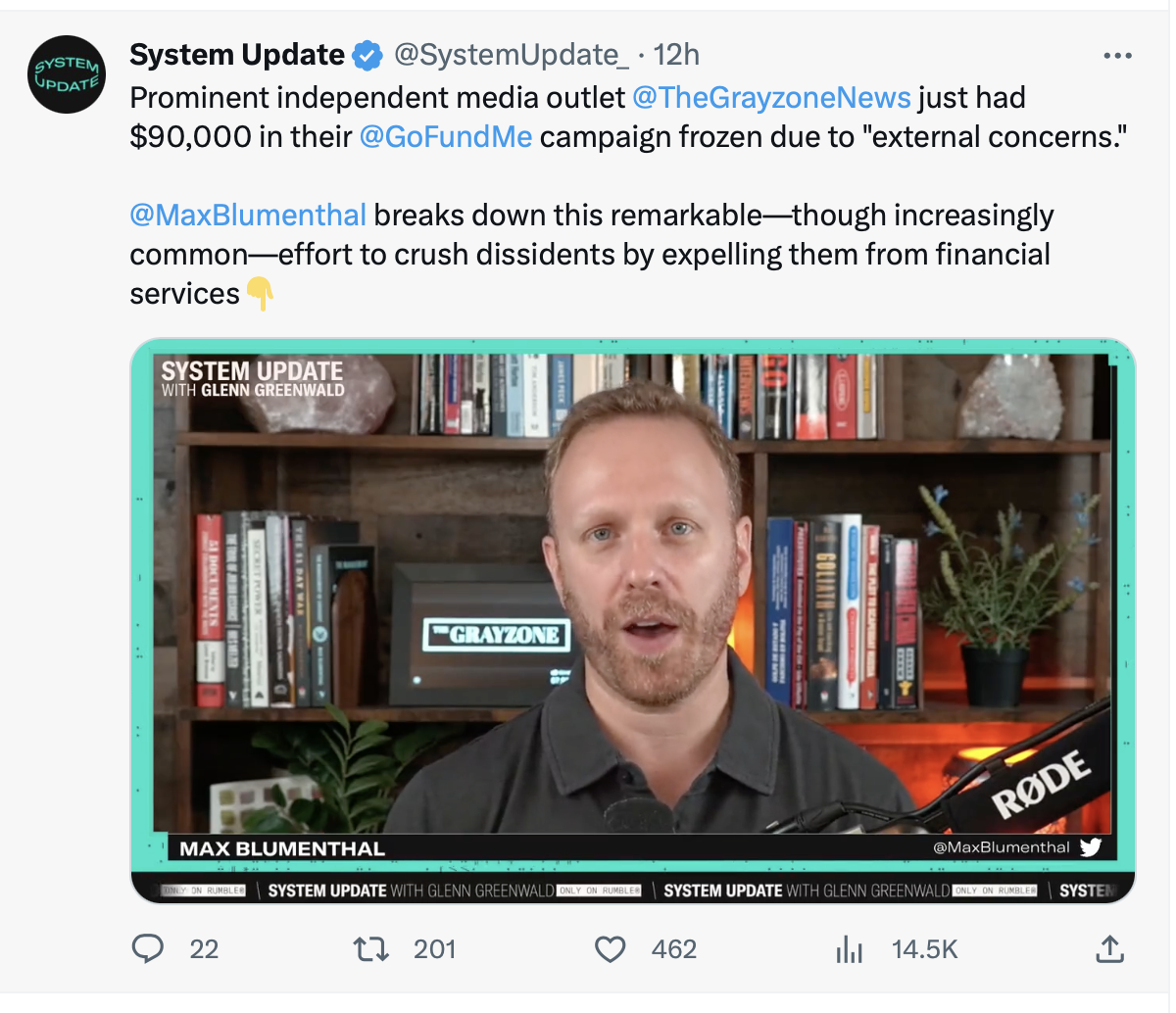

Should you trust GoFundMe? Not based on the incident involving GrayZone, discussed by Max Blumenthal and Glenn Greenwald:
If you detest Florida's Stop Woke Act, you should also detest the way that California is trying to turn college professors into its ideological puppets. These are both blatant violations of the First Amendment.
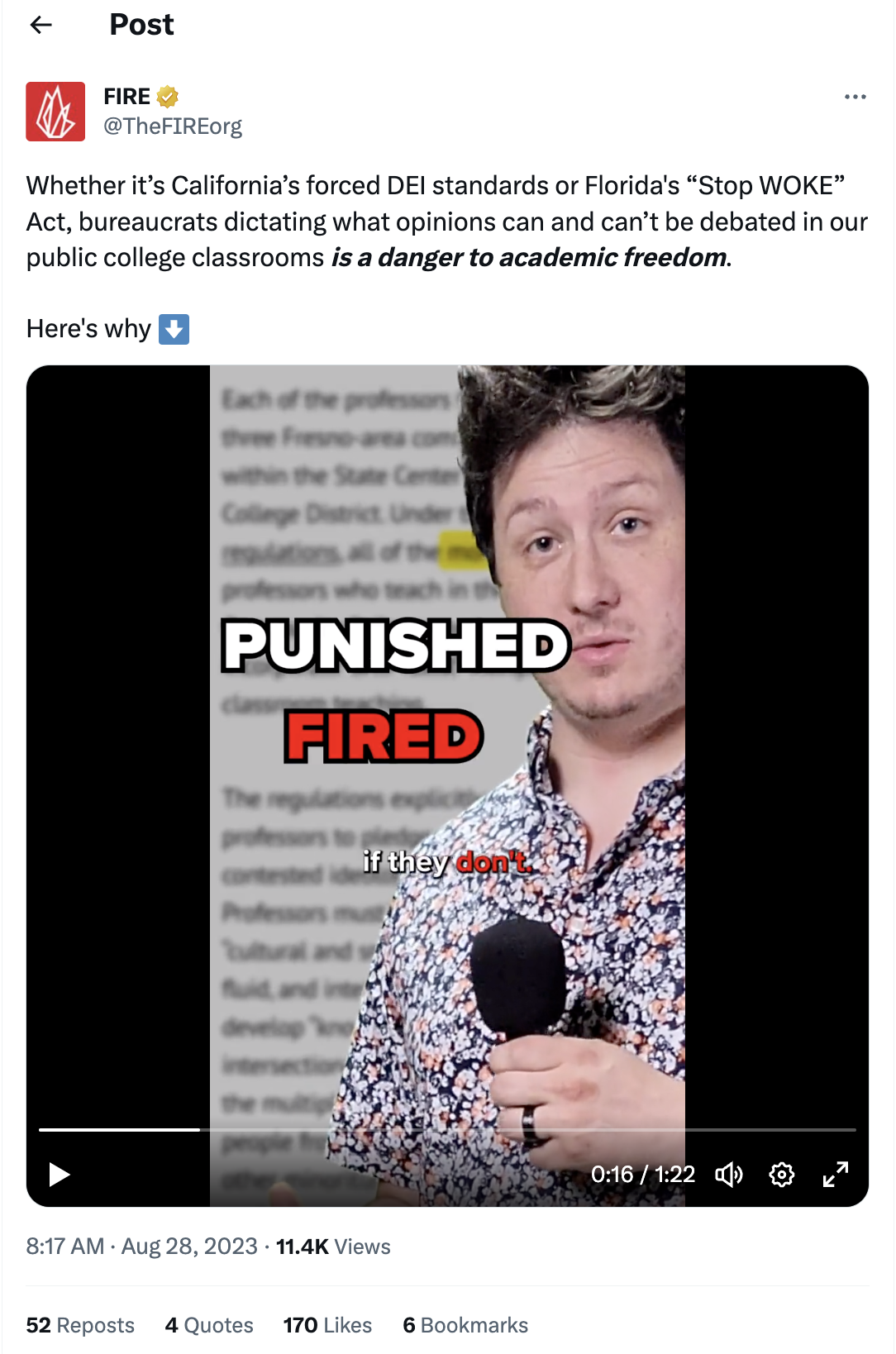
Instead of compelling speech at colleges and allowing professors to be disciplined for doing their jobs, what should college administrators be doing? Greg Lukianoff of FIRE offers this advice:
First, stop breaking the law. When a public university restricts freedom of speech, it violates the First Amendment. Although private universities do not share the same legal obligations, many of them make promises to preserve and promote the free speech rights of students and faculty, and they must honor those commitments.
Speaking of commitments, Greg’s second piece of advice is to enshrine free speech protections in official campus policy. One such policy, the “Chicago Statement,” has been adopted by more than 100 colleges and institutions and is viewed by FIRE as the gold standard for free speech commitments.
But you can’t stop there. It’s easy enough to congratulate yourself for putting a commitment in writing, but the real test is when a campus controversy arises over speech protected by the Constitution or by your school’s commitment to free speech. What do you do then? Do you try and wait it out? Hope that everything will blow over?
Well, FIRE hopes not, because your silence will have a chilling effect on free speech. As the university president, you must “defend the free speech rights of your students and faculty loudly, clearly, and early,” says Greg.
One of the most difficult things you will have to do as president will be to defend unpopular speech, even speech that you disagree with, but that is your obligation. Ultimately, the responsibility falls on college leadership, especially presidents, to publicly and unapologetically show their support for free expression. According to FIRE’s 2022 College Free Speech Rankings, students at the top-ranked schools reported that their administration’s stance on free speech is clear and that their administration would likely defend a speaker’s rights during a controversy on campus, a sentiment that is far less common at schools lower in the rankings.
What else can you do? Well, after you have planned for all of that, you should prepare to teach free speech from day one through campus activities and events. In doing so, you’ll clearly convey to students and faculty that the university places a high value on freedom of speech and civil discourse. FIRE even has free speech orientation materials on our website for interested schools.
Finally, as the leaders of scholarly institutions, you must treat commitments to freedom of speech as yet another scholarly endeavor. Universities should survey students, professors, and administrators to “understand their attitudes toward free expression, and to gather opinions of the campus climate for debate, discussion, and dissent.”
The case of Canadian psychologist Jordan Peterson illustrates how cancel culture works. The chilling effect is how and where most of the damage occurs. Here is an excerpt of an article at The Free Press titled, "Jordan Peterson Goes to ‘War’: The psychologist sells out auditoriums. But he can be stripped of his clinical license because of his tweets. He tells TFP why he won’t back down:
Most of Peterson’s work is technical. (Even the titles of his research are intimidating, like his 2007 paper “Reducing memory distortions in egoistic self-enhancers: Effects of indirect social facilitation.”) Other projects by Peterson are completely anodyne, like his guide and program to improve essay writing.
That’s not what the Ontario Court has taken issue with.
The problem isn’t his clinical practice or his academic research. It’s his worldview. Specifically, his tweets and a few podcast comments, which the College of Psychologists of Ontario, a licensing body for psychologists in the province, considered “unprofessional.”
“The percentage of people who actively oppose what I’m saying is very, very tiny,” Peterson said. “But some of them are extremely committed. And so they can bring disproportionate sway to the decision.” ...
Even if Peterson ultimately loses his license, a man with his following on social media can’t ever be “cancelled.” (And he no longer sees patients anyway.) The more chilling effect of the court’s decision is that it acts as an intimidation toward all other clinical psychologists: self-censor if you share Peterson’s views, or face punishment.
“In all of the areas in which we see pervasive self-censorship, it only takes one example for people to become unwilling to speak their mind. Or even one threat,” Pamela Paresky, a psychologist and author, told The Free Press. “When people say that cancel culture isn’t real because they don’t see people that have legitimately been cancelled, they don’t understand that cancel culture isn't about the cancelling, it’s about the culture. And it’s a culture of fear.”
As seen in some of my posts, more than a few American Universities have decided, officially and/or de facto, that their core mission does not include unbridled learning driven by curiosity. Here is a brief description of how the new Princeton Principles came to be:
On April 14-5, 2023, a group of eminent scholars and practitioners gathered at Princeton University to explore ways to strengthen and rebuild the open, rules-based international order. In the shadow of the COVID pandemic and Russia’s war on Ukraine, they searched for “first principles” and reform ideas for twenty-first century global governance architecture, focusing in particular on rules and institutions for the world economy and great power security cooperation.
The newly published Princeton Principles for a Campus Culture of Free Inquiry seek to "advance free inquiry, honor intellectual merit, and respect the diverse ideas that arise naturally from the pursuit of truth." These are detailed principles that address many of the problems that have bedeviled universities, especially over the past ten years. Further, these Princeton Principles perfectly complement the Chicago Principles and the Kalven Committee Recommendations.
Do you have secure copies of your data? I do. James Lindsey has this warning.
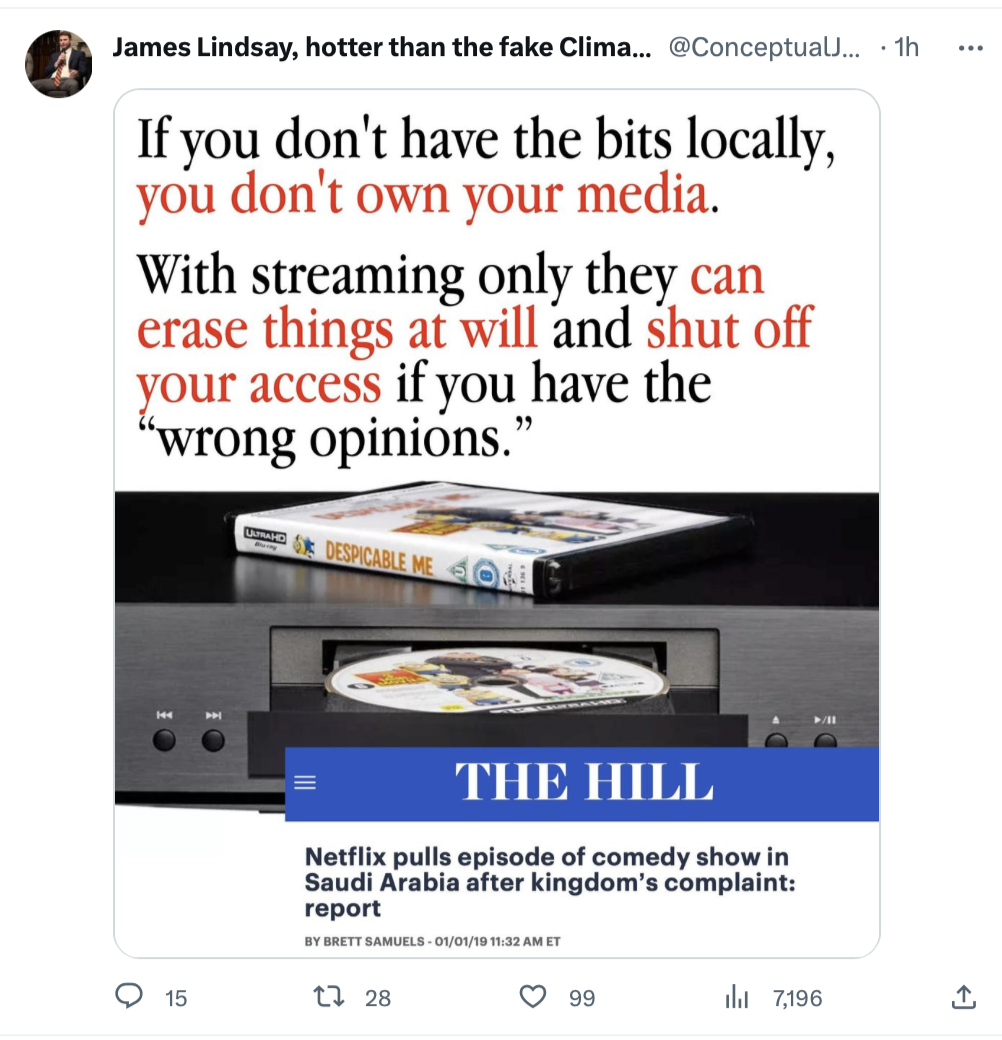
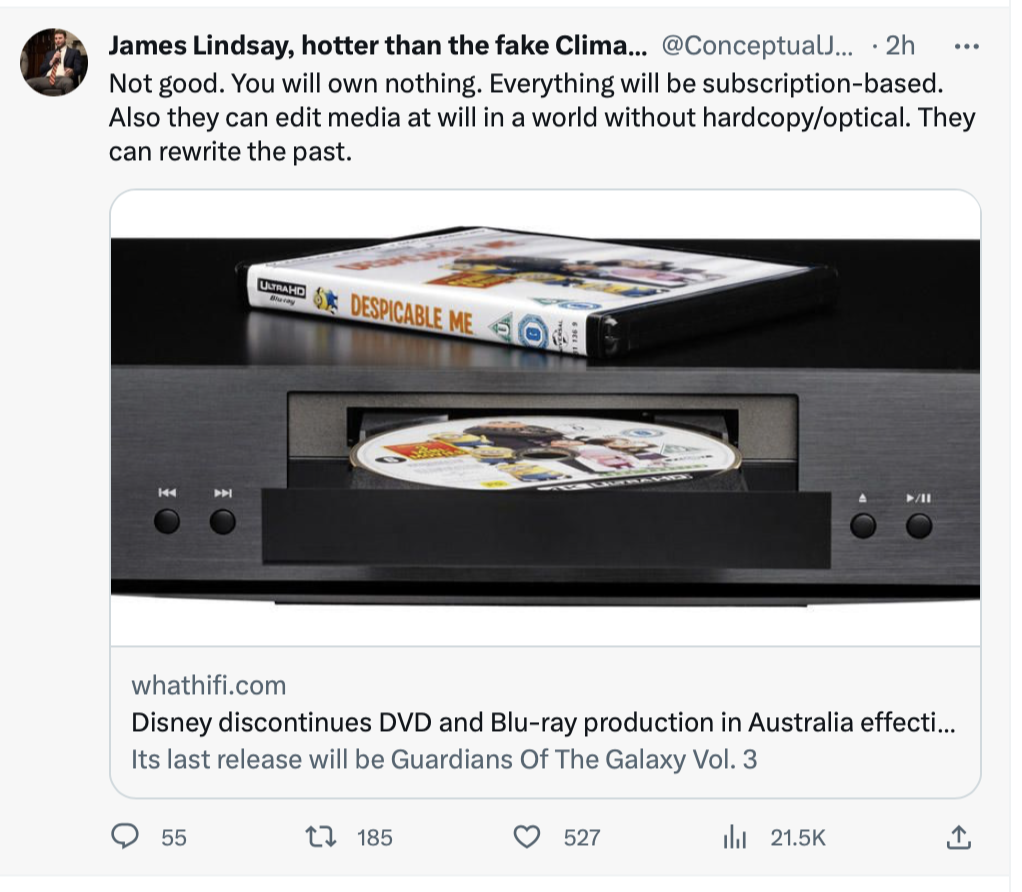 I create pdfs of my books and the Internet articles I value. Saving only the links is precarious. I buy my books in paper. It's for this reason. Too many things are disappearing these days. Things can disappear off the internet for innocent reasons too, of course. Sometimes, website are shut down for financial reasons or because the person maintaining the website doesn't want to maintain it. But way too many documents are becoming inconvenient to persons unknown in recent years and then they are no more . . .