
Mike Benz: Censorship Versus Propaganda

Thanks to some heroic people like Mike Benz, many of us have seen the scales falling from our eyes regarding the insidiousness and the perniciousness of the censorship-industrial complex. And it's largely funded by you, the taxpayer.  Over the past couple of years, I've seen the scales falling from the eyes of Dr. Drew in a very public way.
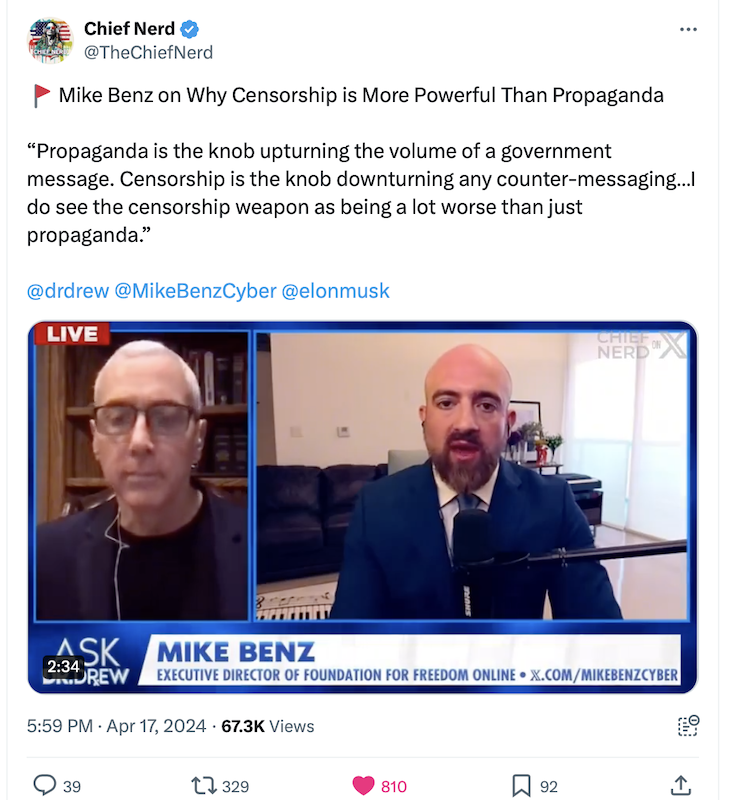
In this video, Mike Benz discussed the dangers of censorship and propaganda in the digital age, particularly during the COVID-19 pandemic. He argues that censorship is a more insidious threat than propaganda because it can silence counter-narratives and undermine public faith in institutions. He noted that while propaganda can still provide a 'fighting chance' against it, censorship can completely silence opposing viewpoints. I created a transcript of the above discussion:

I see censorship as being the flip side of propaganda. Propaganda is the knob upturning of the volume of a government message. Censorship is the knob down turning of any of any counter messaging. And until the social media censorship expanded-AI toolkit was really unveiled, starting after the 2016 election here in the US, there really was no ability to do censorship at mass scale in a peer-to-peer way.

You had famous examples of of censorship in the 20th century where, you know, JFK basically gave command orders to the mainstream media not to not to report certain things about the Cuban missile crisis when it looked like we were on the verge of world war three in 1961. But they couldn't reach into the dinner table conversations of 300 million Americans and just turn down their volume if they start talking about a key phrase like lab leaked. And, you know, so in this case, I do see the censorship weapon as being actually a lot worse than just propaganda, because propaganda still allows people to have a fighting chance against it, they simply don't believe it or the institutions lose so much credibility that when they see a propaganda poster, they roll their eyes and say, well, that means nothing to me and it means nothing to my friends or my clergy.

So the the issue here is the exactly what you identified around fear is was part of the censorship scheme. You see the way they censored COVID And when I say they, I mean these pentagon and CIA and State Department cutouts like Graphika, like the Atlantic Council, like the Stanford Internet Observatory, like the University of Washington, all staffed by former CIA or former DoD or former state folks. They, basically censored anything that might "undermine public faith and support or the severity of the virus and the government's response to it."

So for example, you know, the Department of Homeland Security's Cyber Security Division, which was their censorship, division, but they simply said any Mis- dis- or mal-information about COVID is a cyber attack because it's speech online that attacks a critical government response. This is why the cybersecurity task force was censoring COVID speech on Twitter. And they, for example, put out a video and in the heat of COVID, in 2021, where they instructed young children to report their own family members for for disinformation--if their family members simply cited CDC data, that compared the death rate of COVID to the death rate of the flu, they gave an example of someone tweeting "COVID is no more fatal than the flu" and they go through an instruction manual basically for a young child to report her own uncle for posting that. Not because it's wrong, because he cited CDC data, but because it would undermine the fear response.

Continue ReadingMike Benz: Censorship Versus Propaganda

Chris Rufo Assembles Profile of NPR CEO Katherine Maher Based on her thousands of Tweets

What can we tell about NPR CEO Katherine Maher based on a review of her tweets?  Chris Rufo notes that she has tweeted more than 29,000 times. He has found a few themes:

What you notice first about Maher’s public speech are the buzzwords and phrases: “structural privilege,” “epistemic emergency,” “transit justice,” “non-binary people,” “late-stage capitalism,” “cis white mobility privilege,” “the politics of representation,” “folx.” She supported Black Lives Matter from its earliest days. She compares driving cars with smoking cigarettes. She is very concerned about “toxic masculinity.”

On every topic, Maher adopts the fashionable language of left-wing academic theory and uses it as social currency, even when her efforts veer into self-parody. She never explains, never provides new interpretation—she just repeats the phrases, in search of affirmation and, when the time is right, a promotion.

Maher understands the game: America’s elite institutions reward loyalty to the narrative. Those who repeat the words move up; those who don’t move out.

This is the person in charge of NPR. As you can see from Rufo's article, she has also taken a hard stand in favor of censorship.

As CEO of the Wikimedia Foundation, Maher made censorship a critical part of her policy, under the guise of fighting “disinformation.” In a speech to the Atlantic Council, an organization with extensive ties to U.S. intelligence services, she explained that she “took a very active approach to disinformation,” coordinated censorship “through conversations with government,” and suppressed dissenting opinions related to the pandemic and the 2020 election.

In that same speech, Maher said that, in relation to the fight against disinformation, the “the number one challenge here that we see is, of course, the First Amendment in the United States.”

Rufo's article is titled, "Quotations from Chairman MaherNPR’s new CEO exemplifies the ideological capture of America’s institutions."

Continue ReadingChris Rufo Assembles Profile of NPR CEO Katherine Maher Based on her thousands of Tweets

Pathologist Ryan Cole Discusses his Concerns about the mRNA vax with Brett Weinstein

For those who fell for the false consensus and were tricked by public health and government officials into taking the COVID vac, here at least a dozen big things to worry about. Take your pick: cancer, blood clots (including enormous elastic clots reported by funeral homes), myocarditis. There something for everyone here, especially with the recent report on the cancer risks of pseudouridine (see end of this article).

Ryan Cole is an experienced pathologist who was severely abused by the medical establishment for daring the question the narrative (that story is that last 10% of this video). You can find this video on Rumble.com at Darkhorse podcast hosted by Brett Weinstein.

--

Recent article on the cancer dangers of pseudouridine: 

Continue ReadingPathologist Ryan Cole Discusses his Concerns about the mRNA vax with Brett Weinstein

Fighting Against the Rip Tidal Pull of Digitized Conformity

Matt Taibbi, in his latest, "Maintain Your Brain," at Racket News:

I started to worry over what looked like the removal of multiple lanes from the Information Superhighway. Wikipedia rules tightened. Google search results seemed like the digital equivalent of a magician forcing cards on consumers. In my case, content would often not even reach people who’d registered as social media followers just to receive those alerts.

I was convinced the issue was political. There was clear evidence of damage to the left and right independents from companies like NewsGuard, or the ideologically-driven algorithms behind Google or Amazon ad programs, to deduce the game was rigged to give unearned market advantages to corporate players. The story I couldn’t shake involved video shooter Jon Farina, whose footage was on seemingly every cable channel after J6, but which he himself was barred from monetizing...

We’re entering a stage of history where, like the underground resistance in Bradbury’s book, we’ll have to build some consciousness as a movement to save the human mind. Because thinking for oneself has already been denounced as a forbidden or transgressive activity in so many different places (from campuses to newsrooms and beyond), it’s probably already true that membership in certain heterodox online communities is enough to put a person on lists of undesirables.

Twenty-five years ago, most of us thought it would be a great idea to digitize everything and connect it to everything else. It was a great idea. My most recent moment of demoralization: now that everything is digitized and connected, it gives too much power to anyone who can manage to control it all. To open the gates to some and close them to others. It wasn't so terrible when their were hundreds of media outlets, but that's not the case any more. Worse yet, a lot of the censoring is being don surreptitiously (e.g., shadow-banning, stealth editing and outright censoring). Increasing numbers of us are getting the sense that we are yelling into the void. I just don't know the extent of it. I don't know who is in charge. I don't know where this is leading, but if they can do this to Matt Taibbi, they can easily do it to small fish like me.

Matt urges: "We’ll eventually want to get to know each other a little more, be a little more interactive." I think that is the right approach, living and interacting significantly more locally, which will make it more difficult for power-hungry others, especially when well-intentioned (Mike Benz calls it "The Blob"; Brett Weinstein refers to this somewhat coordinated effort as "Goliath"), to intervene, to pit us against each other, to make us disappear, to generate yet another false consensus . . . .

Continue ReadingFighting Against the Rip Tidal Pull of Digitized Conformity

The Overwhelming Power of Negation

Greg Lukianoff discusses Martin Gurri's Revolt of the Public. He focuses in on negation. As Greg discusses, It's easy to tear things down and it can be contagious as it becomes a badge of tribal membership to tear more and more things down. A big problem, however, is the concomitant violation of Chestson's Fence: Do tear something down until and unless you first know why it was there in the first place. What happens next is described by the law of unintended consequences. To me, these three principles seem to define the present age. Here's an excerpt from Lukinanoff's article, the byline of which is "Our media revolution has only been able to tear things down. We need to learn how to build."

Unfortunately, in its current state, this media revolution has only been able to tear things down: institutions, ideas, and yes, even people (a.k.a. Cancel Culture). This idea is what Gurri calls “negation.” Here’s Gurri explaining further:

“Negation” comes from Hegel’s dialectical logic ...  In my terms, it’s the complete repudiation of the system by the public, usually expressed through some aborted form of protest.
. . . Gurri shows how this phenomenon manifested itself in the 2011 Arab Spring, and how it has had ripple effects in Spain, Israel, and the American Occupy Wall Street movement. ... According to Gurri, this hopeless point of view amounted to a kind of nihilism in which nothing is proposed to replace what needs to be torn down:

If you push the negation of the system far enough without any interest in providing an alternative, you arrive at the proposition that destruction by itself is a form of progress. ... You can see this nihilism in everything from “End the Fed,” to “abolish the police,” to Cancel Culture on both the right and the left — and to the absolute negation of all assumptions represented by QAnon and other conspiracy theories.

One thing must be said about the “crisis of authority” we find ourselves in due to the overwhelming power of negation: Very often, what critics have discovered is that our existing “knowledge” was based on some pretty thin evidence, bad assumptions, and sometimes not much more than the pieties of some elites. Understanding the crisis of authority as only being wrongfully destructive of expertise is to miss the fact that, frankly, we are often asking far too much of expertise and experts — and oversight itself has not been all that rigorous.

Negation is indeed tearing things down that really needed to be torn down. The problem is that it seems to be taking everything else with it.

Continue ReadingThe Overwhelming Power of Negation