“Race,” “News Media” and Shootings

I often use the word "race" in scare quotes because I don't believe that "race" is a useful phrase. In fact, it has caused nothing but mischief, violence and death ever since people began using the term. My position is that there are definitely some racists out there, but there is no such thing as "race." I have put the term "news media" in quotes because I have lost so much respect for so many of those organizations that claim to be bringing us the news based on numerous recent examples of a course of conduct that is more egregious than the negligence standard one might associate with journalism malpractice.

Political Scientist Wilfred Reilly is not afraid to step into the fray to state unvarnished truth. He is a former corporate executive and freedom rider, as well as author of the 2020 book Taboo: 10 Facts [You Can't Talk About].  In his introduction to that book, he states:

Tackling taboos is difficult, but necessary. Very often— MOST often— they are used not to shield strong and valid ideas from pointless attacks, but rather to protect weak ones from worthwhile criticism.

Reilly's statistics-rich discussion is now featured on FAIR's website: His article is titled, "The Broken Mirror: Media Narrative vs. Reality." The "news media" that leans politically to the Left is forcefully pushing a media is making people on the political Left unnecessarily angry (against police officers), but it should be making all of us angry (about the divisive narrative being pushed). Here is an excerpt:

In the representative year of 2018, inter-racial violent crime involving blacks and whites made up approximately 3 percent of all serious crime: there were only about 600,000 victim-reported incidents involving a black perpetrator and a white victim, or vice-versa, out of more than 20,000,000 total crimes. Further, of the violent inter-racial crime that does occur, more than 80 percent of reported incidents involved a black perpetrator and a white victim. The data tables in the 2018 Bureau of Justice Statistics Report include more than 500,000 black-on-white violent incidents, but well under 100,000 violent crimes that were white-on-black. While this finding is not necessarily surprising—there are far more whites than blacks, and whites, on average, have more money to be stolen—it would likely come as a shock to most upper-middle class Americans. As would another piece of data: according to the Washington Post, the total number of unarmed black men killed by police during the most recent year on record (2020) was not 10,000, or 1,000, but 17. That bears spelling out: in the year where America was supposedly inundated with white supremacist violence, where America was in the grips of a “racial reckoning” that included, in no small part, the acknowledgement of the “state-sanctioned murder” of young black men, only SEVENTEEN unarmed black men died at the hands of police officers.

This data leads us to an obvious question: why do so many smart people believe inter-ethnic violence is so much worse than it is? . . .Basic data about inter-racial violence often seem not merely ignored by mainstream media sources, but actively misrepresented.

In Taboo, I point out that about 75 percent of individuals fatally shot by police in a typical year are Caucasian whites or Hispanics. However, national media outlets devote less than 20 percent of their police violence coverage to these cases. A Google search for “well-known police shooting,” conducted in 2020 in connection with the book, turned up articles which covered two police shootings of Latinos, four police shootings of whites, and 36 police shootings of blacks. This level of over-representation of black victims in coverage (2,400 percent) could hardly be the result of anything but very conscious choice—and respected social scientists like John Lott have argued empirically that media treatment of a range of issues, from political extremism to mass shootings, follows a similar troubling pattern.

I'm not going to pretend that I could add anything to Reilly's detailed analysis, but reading his article did cause me to wonder whether part of the media strategy was to stir up conflict and hate, thereby selling ads and rewarding loyal followers. As I read Reilly's statistics, I can't help but think of Matt Taibbi's book, Hate, Inc., in which he argues "that what most people think of as 'the news' is, in fact, a twisted wing of the entertainment business.

At the conclusion of his article, Reilly argues that it's time for the new outlets to step up and do real journalism:

In order for our country to truly address the vestiges of racism that still exist, it’s essential that the media provide a clear and honest picture of racial relations in contemporary America.

Continue Reading“Race,” “News Media” and Shootings

How to be a Human Animal, Chapter 9: Learn How to Do Millions of Little Things

Chapter 9: Learn How to Do Millions of Little Things

OK! I’m back with more advice for a newborn baby. This is my ninth lesson on how to thrive in the complex world. Baby, as you have probably figured out, I’m giving you the advice that I wish I had learned earlier and easier. I’m spoon-feeding you, but not with baby food. I'm feeding you with lessons I learned at the school of hard knocks.

What should you be doing when you are very young? You would think that I would tell you to work hard to do some really big and important things, but I’m going to suggest the opposite: You should get busy learning lots and lots of little things. These countless little things will enable you to accomplish big things decades later.

In the context of natural selection, Richard Dawkins once used the metaphor the problem of scaling the extremely high sheer cliff of Mount Improbable. Here’s how this metaphor came to be. People are amazed at the human eye (as they should be—-see Chapter 7) but they erroneously conclude “It’s impossible that such an amazing thing could evolve! It would be like a human being jumping thousands of feet into the air in order to get to the top of a sheer cliff.” Dawkins then lays out the clear evidence that many extremely simple eyes were actually probable in early life forms. He then describes the steps by which very simple eyes could be improved incrementally, in thousands of ways over millions of generations. There is no need to leap thousands of feet to get to the top of the sheer front cliff of Mount Improbable. That’s because you can drive around to the back side of Mount Improbable where you will find a long inclined hiking path you can use to walk slowly up the hundreds of switchbacks to get to the same high point of the mountain. Thus, there are two different methods to get to the top, one of them impossible (leaping) and the other achievable with determination and time (hiking a longer path of switchbacks).

I’m 65 years old now and I’ve done some a few things that have impressed some other people. Every one of those difficult things took a large number of mundane-seeming and achievable skills and years or decades of time. I learned countless numbers of smallish achievable things that added up over the decades. Things like learning how to read in the first grade, or learning to play a C chord on a guitar, or learning how to use a computer mouse, or learning how a camera aperture works. My “secret weapon” is that I’m a scrapper—I don’t give up. I grind away on something until I figure it out or until I’m exhausted. I’ve learned many things by sheer grit and experimentation. After decades of doing this, I have accumulated a large took kit of skills that can be used for achieving complex things like being a lawyer or composing music or raising children or publishing a book of my digital art. My “secret” is that I have exploited “compounding” to my advantage.

Shane Parrish of Farnham Street notes that “Compounding” is a concept commonly used in the realm of finance. It refers to making interest on your interest, a phenomenon familiar to anyone trying to retire. Parrish notes that compounding is also a useful concept when applied to things outside of finance.  In “The Mundanity of Excellence,” Daniel F. Chambliss makes the case that numerous low-level skills can be leveraged into extraordinary achievements. In fact, he reminds us that great talent can happen only when we stand on the shoulders of numerous sub-talents. Excellence is the icing on the cake of mundacity:

Excellence is mundane. Superlative performance is really a confluence of dozens of small skills or activities, each one learned or stumbled upon, which have been carefully drilled into habit and then are fitted together in a synthesized whole. There is nothing extraordinary or superhuman in any one of those actions; only the fact that they are done consistently and correctly, and all together, produce excellence. When a swimmer learns a proper flip turn in the freestyle races, she will swim the race a bit faster; then a streamlined push off from the wall, with the arms squeezed together over the head, and a little faster; then how to place the hands in the water so no air is cupped in them; then how to lift them over the water; then how to lift weights to properly build strength, and how to eat the right foods, and to wear the best suits for racing, and on and on. Each of those tasks seems small in itself, but each allows the athlete to swim a bit faster. And having learned and consistently practiced all of them together, and many more besides, the swimmer may compete in the Olympic Games. The winning of a gold medal is nothing more than the synthesis of a countless number of such little things—even if some of them are done unwittingly or by others, and thus called “luck.”

I completely agree with Shane Parrish and Daniel Chambliss. Anything impressive that I’ve done is the result of 1,000 tiny things I’ve worked on much earlier in my life.That has included numerous little failures as well as work-arounds. I did these things because I have always been curious, energetic and relentless. Frankly, I have never done anything impressive that didn't take more than a decade of work that was then aggregated.

But here is a warning: Compounding can run in the opposite direction too. Enormous failures start with little missteps. Here’s one that is based on a real life story with which I’m familiar: “Hey, my wife had surgery and she has some leftover opioid painkiller. What the hell, I’ll try one and see how I feel.” Fast-forward five years and that person has a long history of sliding into many bad habits. He lost his focus and his will to achieve. He also lost his self-made business, destroyed his relationship with his kids. His only driving passion became his quest to find new ways of getting high.

I’ll end on a high note: One of the biggest ways compounding benefits you is the many small things you do to improve your reputation. As the saying goes, a good reputation is hard to earn and easy to lose. After you’ve spent your entire life trying to be trustworthy, truthful and kind, you’ll find that your reputation opens new doors for you, over and over. It’s easy to forget, though that this “superpower” of a good reputation was something you assembled over decades through truth-telling, hard work and kindness. Similarly, good health is usually the result of hundreds of mundane-seeming habits and routines.

Again, my advice to you is to aim low. Do lots and lots of little things. The world is your playroom. Practice many low-level skills and master them. Decades later you will be able to aggregate these into what other people think of as a super power, even though you know better.

Continue ReadingHow to be a Human Animal, Chapter 9: Learn How to Do Millions of Little Things

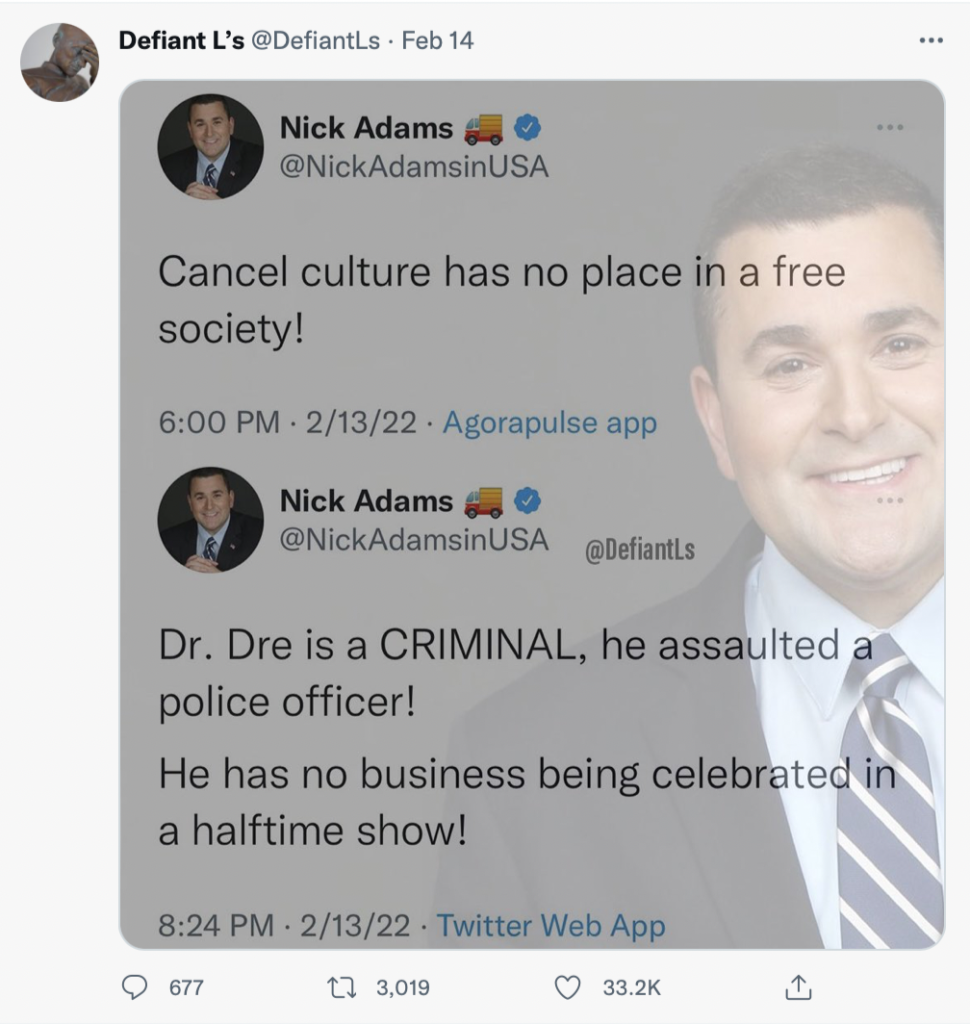
Twitter Suspends, then Reinstate’s “Defiant L,” Whose Quest is to Expose Hypocrisy

"Defiant L" has raised the exposing of hypocrisy to a high art, day after day. I don't think we will ever run out of hypocrisy based on the sheer volume of these posts. Note: Twitter recently suspended "Defiant L" with no explanation, but now the suspension has been lifted, after a massive outpouring against the suspension.

Continue ReadingTwitter Suspends, then Reinstate’s “Defiant L,” Whose Quest is to Expose Hypocrisy