The “Small” Things of the Past

I was minding my own business yesterday when a Swedish book publishing company asked whether it could use one of my photos (that it found on Flickr) on the cover of a new book. It's a photo I took at the Grand Canyon in 2014. The day I took this photo seems so long ago now. I have had a few other requests like this. I'm happy to make my photos available for small projects without payment, asking only for attribution. This delightful request reminded me an important principle: There is often a long time lag between the things we do and the moments where those little things gain greater meaning. Almost everything difficult that I do today would have been impossible without years or decades of cultivating friendships, work-relationships, skill-sets and hard-earned experience. That's because "compounding" is at play far outside of the financial realm. Compounding is one of the most important and least appreciated principles in our lives. Many of my recent happy occurrences are built off off dozens or hundreds of little things, many of them far in the past. It's not easy to see where the things we do today will lead. It might be worth our time to celebrate all the moments in our lives, including the small moments.

Continue ReadingThe “Small” Things of the Past

Kurt Vonnegut’s Advice to High School Students in 2006

Excellent advice and excellent story that I found on HiExistence:

"In 2006, a group of students at Xavier High School in New York City were given an interesting assignment: to write their favorite authors and try to persuade them to visit the school. Five students opted to write to none other than Kurt Vonnegut." Here is his response:"

November 5, 2006

Dear Xavier High School, and Ms. Lockwood, and Messrs Perin, McFeely, Batten, Maurer and Congiusta:

I thank you for your friendly letters. You sure know how to cheer up a really old geezer (84) in his sunset years. I don’t make public appearances any more because I now resemble nothing so much as an iguana.

What I had to say to you, moreover, would not take long, to wit: Practice any art, music, singing, dancing, acting, drawing, painting, sculpting, poetry, fiction, essays, reportage, no matter how well or badly, not to get money and fame, but to experience becoming, to find out what’s inside you, to make your soul grow.

Seriously! I mean starting right now, do art and do it for the rest of your lives. Draw a funny or nice picture of Ms. Lockwood, and give it to her. Dance home after school, and sing in the shower and on and on. Make a face in your mashed potatoes. Pretend you’re Count Dracula.

Here’s an assignment for tonight, and I hope Ms. Lockwood will flunk you if you don’t do it: Write a six line poem, about anything, but rhymed. No fair tennis without a net. Make it as good as you possibly can. But don’t tell anybody what you’re doing. Don’t show it or recite it to anybody, not even your girlfriend or parents or whatever, or Ms. Lockwood. OK?

Tear it up into teeny-weeny pieces, and discard them into widely separated trash recepticals. You will find that you have already been gloriously rewarded for your poem. You have experienced becoming, learned a lot more about what’s inside you, and you have made your soul grow.

God bless you all!

Kurt Vonnegut

Continue ReadingKurt Vonnegut’s Advice to High School Students in 2006

About Wabi-sabi

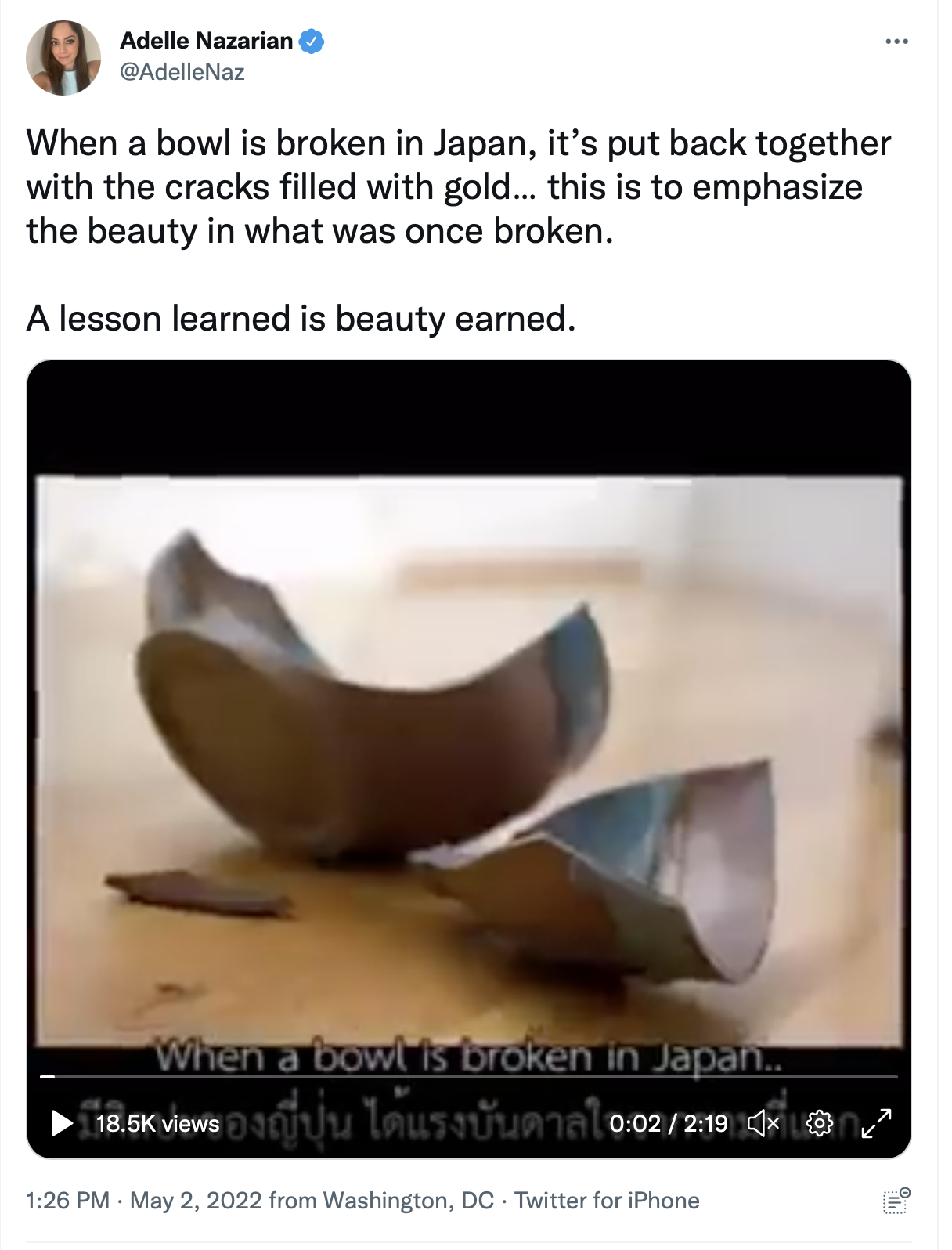
Such a beautiful concept: Wabi-sabi

In traditional Japanese aesthetics, wabi-sabi () is a world view centered on the acceptance of transience and imperfection.The aesthetic is sometimes described as one of appreciating beauty that is "imperfect, impermanent, and incomplete" in nature. It is prevalent throughout all forms of Japanese art.

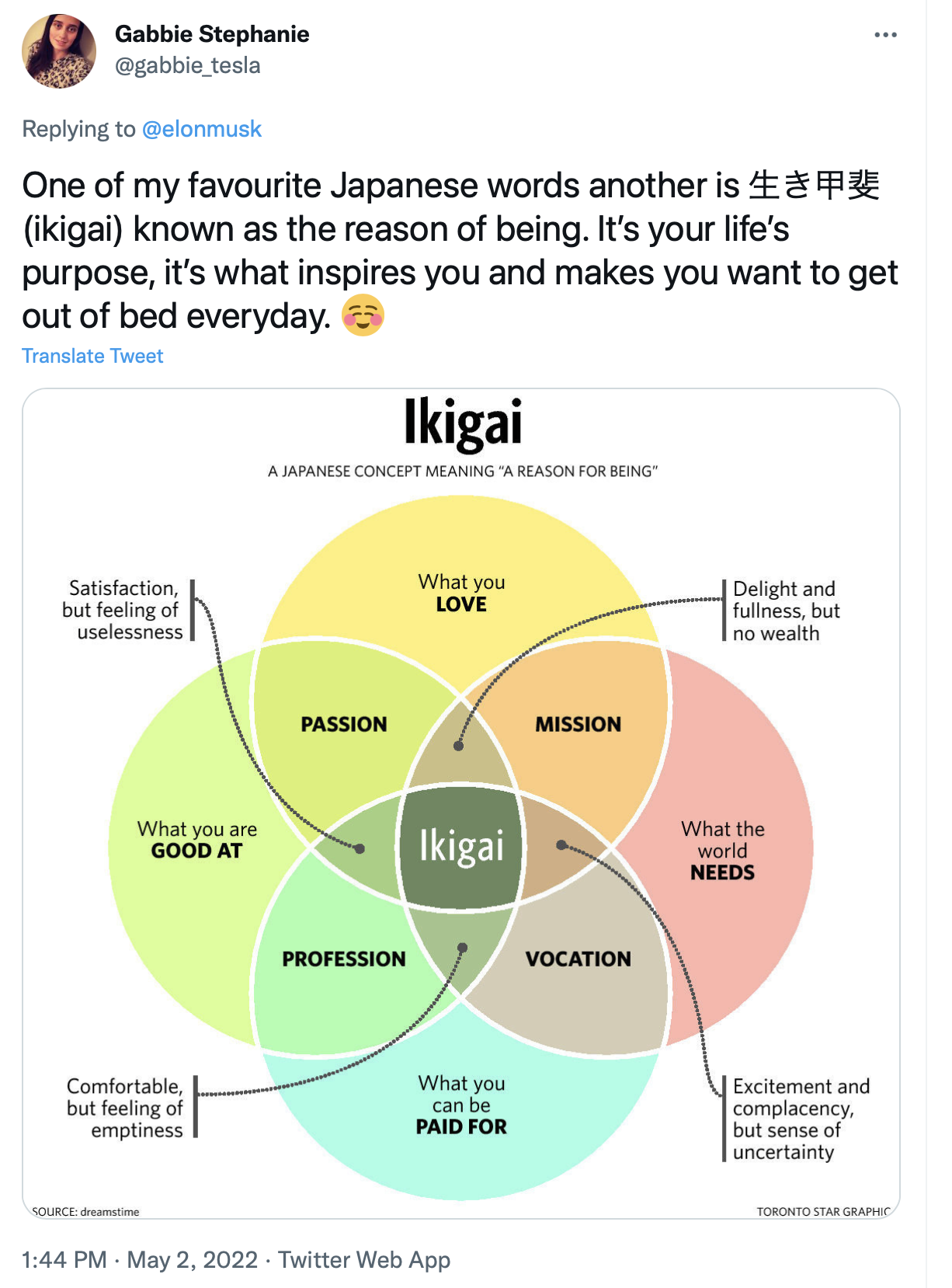
Oh, and one more concept from Japan: Ikigai.

One of my favourite Japanese words another is 生き甲斐 (ikigai) known as the reason of being. It’s your life’s purpose, it’s what inspires you and makes you want to get out of bed everyday.

Continue ReadingAbout Wabi-sabi

Lots of Advice I Wish I had Known When I Was Younger

I spotted a well considered list of advice on Common Sense - Bari Weiss' website. It's a list by Kevin Kelly (Founding Editor of Wired). I'm posting it because it offers lots of good advice that I wish I had known when I was younger. Further, I have not been able to write new chapters on "How to be a Human Animal" lately. My day job and other (mostly good) obligations are keeping me away from this project. I hope get back on track in a couple more weeks . . .

Here are a few excerpts from Kelly's list:

• Three things you need: The ability to not give up something till it works, the ability to give up something that does not work, and the trust in other people to help you distinguish between the two.

• When public speaking, pause frequently. Pause before you say something in a new way, pause after you have said something you believe is important, and pause as a relief to let listeners absorb details.

• There is no such thing as being “on time.” You are either late or you are early. Your choice.

• Ask anyone you admire: Their lucky breaks happened on a detour from their main goal. So embrace detours. Life is not a straight line for anyone.

• The best way to get a correct answer on the internet is to post an obviously wrong answer and wait for someone to correct you.

• You’ll get 10x better results by elevating good behavior rather than punishing bad behavior, especially in children and animals.

• Making art is not selfish; it’s for the rest of us. If you don’t do your thing, you are cheating us.

• Spend as much time crafting the subject line of an email as the message itself because the subject line is often the only thing people read.

• Don’t wait for the storm to pass; dance in the rain.

• When checking references for a job applicant, employers may be reluctant or prohibited from saying anything negative, so leave or send a message that says, “Get back to me if you highly recommend this applicant as super great.” If they don’t reply take that as a negative.

• Half the skill of being educated is learning what you can ignore.

Continue ReadingLots of Advice I Wish I had Known When I Was Younger

How to be a Human Animal, Chapter 28: Morality and What to Do Next?

This is Chapter 28 of my advice to a hypothetical baby. I'm using this website to act out my time-travel fantasy of going back give myself pointers on how to avoid some of Life’s potholes. If I only knew what I now know . . . All of these chapters (soon to be 100) can be found here.

Why do people do the things they do? How can we make sense of all of this talk about what is "moral," and what is "right" and "wrong." These are an extremely difficult topics. As we already discussed, however, we need to beware systematizers who scold you to based on their mono-rules of morality. That was the main take-away from the previous chapter.

In this chapter, I’ll briefly discuss three approaches to morality that don’t rely on such simplistic rules. The first of these thinkers is Aristotle, who still has so very much to offer to us almost 2,500 years after he lived. His view of what it means to be virtuous is a holistic set of skills that requires lifelong practice. What a change of pace from the mono-rules of other philosophers. I’ll quote from Nancy Sherman’s book, Fabric of Character pp. 2 - 6:

As a whole, the Aristotelian virtues comprise just and decent ways of living as a social being. Included will be the generosity of benefactor, the bravery of citizen, the goodwill and attentiveness of friends, the temperance of a non-lascivious life. But human perfection, on this view, ranges further, to excellences whose objects are less clearly the weal and woe of others, such as a healthy sense of humor and a wit that bites without malice or anger. In the common vernacular nowadays, the excellences of character cover a gamut that is more than merely moral. Good character--literally, what pertains to ethics—is thus more robust than a notion of goodwill or benevolence, common to many moral theories. The full constellation will also include the excellence of a divine-like contemplative activity, and the best sort of happiness will find a place for the pursuit of pure leisure, whose aim and purpose has little to do with social improvement or welfare. Human perfection thus pushes outwards at both limits to include both the more earthly and the more divine.

But even when we restrict ourselves to the so-called ‘moral’ virtues (e.g. temperance, generosity, and courage), their ultimate basis is considerably broader than that of many alternative conceptions of moral virtue. Emotions as well as reason ground the moral response, and these emotions include the wide sentiments of altruism as much as particular attachments to specific others. . .  Pursuing the ends of virtue does not begin with making choices, but with recognizing the circumstances relevant to specific ends. In this sense, character is expressed in what one sees as much as what one does. Knowing how to discern the particulars, Aristotle stresses, is a mark of virtue.

It is not possible to be fully good without having practical wisdom , nor practically wise without having excellence of character  . . . Virtuous agents conceive of their well-being as including the well-being of others. It is not simply that they benefit each other, though to do so is both morally appropriate and especially fine. It is that, in addition, they design together a common good. This expands outwards to the polis and to its civic friendships and contracts inwards to the more intimate friendships of one or two. In both cases, the ends of the life become shared, and similarly the resources for promoting it. Horizons are expanded by the point of view of others, arid in the case of intimate relationships, motives are probed, assessed, and redefined.

Aristotle is talking to those of us who live in the real world, recognizing the complexity of the real world and helping us to navigate as best we can. Again, what a change from the mono-rules!  This real-world applicability and appreciation of nuance is something Aristotle has in common with the Stoics, which we discussed in Chapter 21. 

Here’s another approach, this one from modern times. For a long time, I've been almost obsessed that what we think of as moral is, in a real sense, beautiful and what we think of as immoral is ugly. Based on our reactions to situations that are "moral" and "immoral," there is no possible way that these things are not connected. Such an approach also recognizes that morality is not dictated by any static set of commandments or imperatives. Rather, both morality and art are, at least to some extent, in the eye of the beholder.


Continue ReadingHow to be a Human Animal, Chapter 28: Morality and What to Do Next?