The Efficiency of the Human Brain and AI

Fascinating post quoting Elon Musk on the efficiency of the brain and the potential efficiency of AI:

Well, we have a clear example of efficient power, efficient compute, which is the human brain. Our brains use about 20 watts of power, and only about 10 watts is higher brain function. Half of it is just housekeeping, keeping your heart going and breathing.

So you’ve got maybe 10 watts of higher brain function in a human, and we’ve managed to build civilization with 10 watts of a biological computer. Given that humans are capable of inventing general relativity and quantum mechanics, inventing aircraft, lasers, the internet, and discovering physics with a 10-watt meat computer, there’s clearly a massive opportunity for improving the efficiency of AI compute. Right now, even a hundred-megawatt or gigawatt AI supercomputer can’t do everything a human can do. But we already have the proof that true intelligence can emerge from just 10 watts. That should lead you to one conclusion, AI can get a lot more efficient.

Continue ReadingThe Efficiency of the Human Brain and AI

Dismal Job Prospects for White Male Writers

I'm a race abolitionist. I think we should completely dispense with the categories of "black" and "white" and describe people in other, less destructive, terms. The only exception is that we should retain and enforce civil rights laws because some people enthusiastically categorize people in terms of "race," discriminating against some races and preferring others. I set forth my position in this acticle, ""Race" is Like Astrology."

I hope that someday, all of us will get back on track with the purpose of the original civil rights movement (rather than the absurd and destructive "anti-racism" movement) and that, someday, "race" will be the least useful or interesting thing we can say about people.

That said, "white" males are actively being discriminated against, especially against Millennials and beyond (Millenials were born between 1981-1996), especially in the creative fields, including writing. This oftentimes overt discrimination is well-documented by Jacob Savage in his article at Compact, "The Lost Generation." . Here's an excerpt:

In 2021, new hires at Condé Nast were just 25 percent male and 49 percent white; at the California Times, parent company of The Los Angeles Times and The San Diego Union-Tribune, they were just 39 percent male and 31 percent white. That year ProPublica hired 66 percent women and 58 percent people of color; at NPR, 78 percent of new hires were people of color.

“For a typical job we’d get a couple hundred applications, probably at least 80 from white guys,” the hiring editor recalled. “It was a given that we weren’t gonna hire the best person… It was jarring how we would talk about excluding white guys.” The pipeline hadn’t changed much—white men were still nearly half the applicants—but they were now filling closer to 10 percent of open positions.

Suddenly, in Andrew’s newsroom, everything was driven by identity. There were endless diversity trainings, a racial “climate” assessment—at one point, reporters were told they had to catalog, in minute detail, the identity characteristics of all their sources. Andrew had been instrumental in forming the union at his company, and objected when negotiations shifted from severance pay and parental leave to demands for racial quotas. “They wanted to do like ... emergency hires of black people,” he said.

When he questioned these new priorities, the response was swift. “On a Zoom call, women would clap back at something I was saying and other women would snap their fingers in the [chat] window,” he recalled. “It was this whole subcultural language being introduced wholesale.” ...

It’s striking how casual it all was. “Chicago Fire—the UL [upper level] can be [anyone], but we need diverse SWs [staff writers].” As in other industries, upper-level positions—writers with experience and credits—could still be filled by white men. But the entry-level jobs, the staff writer and co-producer positions that Matt and thousands of other aspiring writers were competing for, were reserved for others.

This is an excerpt from a much longer excellent article. I highly recommend reading the entire thing.

I would hope that these dire statistics don't dissuade any "white" male from pursuing their dream, of course. But this is a tough time for all creative writers, given the growing threat of AI. Grok offers these statistics showing that although Hollywood scrips are still largely being written by organics, publishers are caving to the bots: v Publishers' AI Reliance (Web, Books, Articles)

  • Web publishing: >50% of new articles AI-generated in 2025 (up from 5% in 2020), displacing freelancers in copywriting/editing; focuses on news, how-to, reviews, and SEO content.
  • Books/articles: Emerging displacement; survey of 258 UK novelists shows 51% fear full replacement, 39% report income losses (85% expect more), with 59% of genre authors' work used to train AI without permission.
  • Broader impacts: Google's AI Overviews cut traffic 34%, leading to layoffs; >25% of Americans use AI for info over traditional sources; 97% of novelists oppose AI writing full novels, citing originality/ethics losses.
  • Trend: AI replaces commoditized content/jobs, potentially making publishers obsolete; 33% of authors use AI for non-creative tasks, but mass displacement in low-creativity areas is ongoing.
Hollywood's AI Reliance for Screenplays

  • AI use is limited and experimental, mainly assistive for brainstorming, analysis, and rote tasks; full scripts remain ~100% human-written (study of 3,800 US TV episodes 2020-2023 showed 1.9% AI probability, no increase post-ChatGPT).
  • Tools like Largo.ai triple green-lighting rates and make focus groups 10x faster/cheaper; 71% of screenwriters use AI for editing by late 2025, with 76% of studios incorporating it to cut post-production time by 35%.
  • Backlash includes WGA protests over job displacement and copyright; 53% of audiences uncomfortable with AI-touched content; future seen as collaborative, not replacement.

Continue ReadingDismal Job Prospects for White Male Writers

Elon Musk Explains the Origin of OpenAI

OpenAI was supposed to be open source and non-profit. That's not how it turned out.

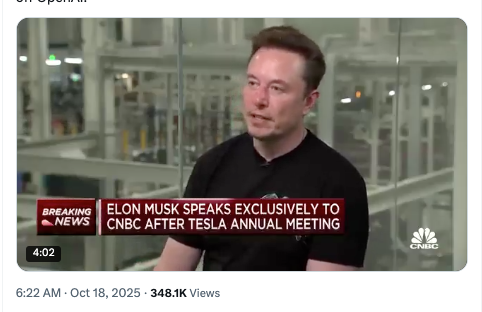
Musk explains the history (transcribed by Eva Fox on X).

“I am the reason OpenAI exists.”

“I used to be a close friend with Larry Page, and I was staying at his house, and we'd have these conversations long into the evening about AI, and I would be constantly urging him to be careful about the danger of AI. And he was really not concerned about the danger of AI and was quite cavalier about it. And at the time, Google, especially after the acquisition of DeepMind, had three-quarters of the world's AI talent; they had a lot of computers, a lot of money, so it was a unipolar world for AI. And we got a unipolar world, but the person who controls that does not, or at least did not seem to be concerned about AI safety. That sounded like a real problem.

The final straw was Larry calling me a speciest for being a pro-human consciousness instead of machine consciousness, and I like, 'Well, yes, I guess I am a speciest.'

I came up with the name [OpenAI], which refers to open source. The intent was to what is the opposite of Google, would be an open source non-profit, because Google is closed source profit, and that profit motivation could be dangerous...

It does seem weird that something can be a nonprofit, open source, and somehow transform itself into a for-profit, closed source. I mean, this would be like, let's say you founded the organization to save the Amazon rainforest, but instead, they became a lumber company and chopped down the forest and sold it for money. And you'd be, therefore, like, 'Wait a second, that's the exact opposite of what I gave the money for. Is that legal?' That doesn't seem legal. And if, in general, it is legal to start a company as a non-profit and then take the IP and transfer it to a for-profit that then makes tons of money, shouldn't everyone start? Shouldn't that be the default?

And I also think it is important to understand, like when push comes to shove, let's say they do create some digital super intelligence, almost Godlike intelligence, well, who is in control, and what is exactly the relationship between OpenAI and Microsoft? And I do worry that Microsoft actually may be more in control than the leadership team at OpenAI realizes. I mean, Microsoft, as part of Microsoft Investment, has rights to all of the software, all of the model weights, and everything necessary to run the inference system. At any point, Microsoft could cut off OpenAI.”

Continue ReadingElon Musk Explains the Origin of OpenAI

Tucker Carlson’s Interview of Open AI’s CEO, Sam Altman

This is perhaps the most intense and surreal interview I've ever seen: Tucker Carlson interviewing Open AI's CEO, Sam Altman, about the alleged suicide of Suchir Balaji , a former Open AI employee who had, only weeks before in a NYT personal essay, accused Open AI of violating copyright law. Balaji had claimed that ChatGPT and similar chatbots failed the fair use test and were consequently ruining the commercial viability of the individuals and organizations who produced the data that the AI systems are trained on.

Continue ReadingTucker Carlson’s Interview of Open AI’s CEO, Sam Altman

Brett Weinstein’s Short Term Concern about AI

We have repeatedly seen that a relatively small number of gate-keepers can create a narrative out of thin air.  We are seeing this vividly in the recent Russiagate disclosures.  I've documented hundreds of incidents of what I call "Narratives in Media" on this website.

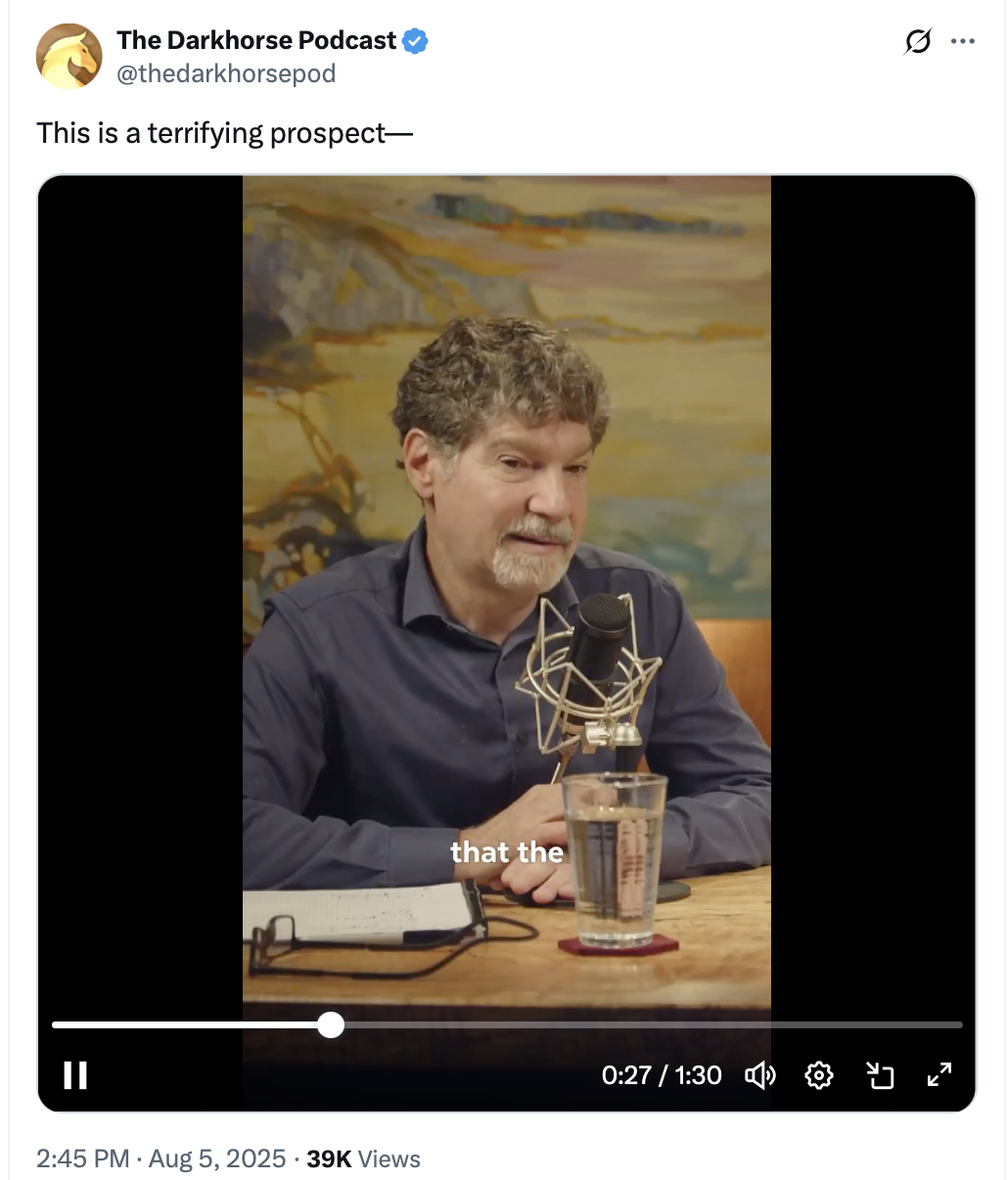
It might be about to get a lot worse due to AI video technology, according to Brett Weinstein:

AI is about, within the next year or so, going to be capable of producing compelling video, evidence that will not be detectable. That is going to create, first, a radical increase in the rate of proliferation of cognitive universes that we are forced to keep alive.

And I suspect that the immediate consequence of that is going to be paralysis. That the number of different combinations of possibilities where you cannot resolve--you cannot get closure and say, “I think I live in this world and so I'm going to ignore all of those possibilities over there and go forward as if this is true.”

You're basically going to become agnostic about just about everything. And so in this mental multiverse, you will maybe be able to avoid embarrassment by not putting your weight on any of the ice, but you can't accomplish anything in that state. And that's what I'm concerned about. We are going to be effectively put into a circumstance where everybody will be afraid to assume enough about the world to actually be capable of acting rationally toward it. And that's a very frightening prospect.

Continue ReadingBrett Weinstein’s Short Term Concern about AI