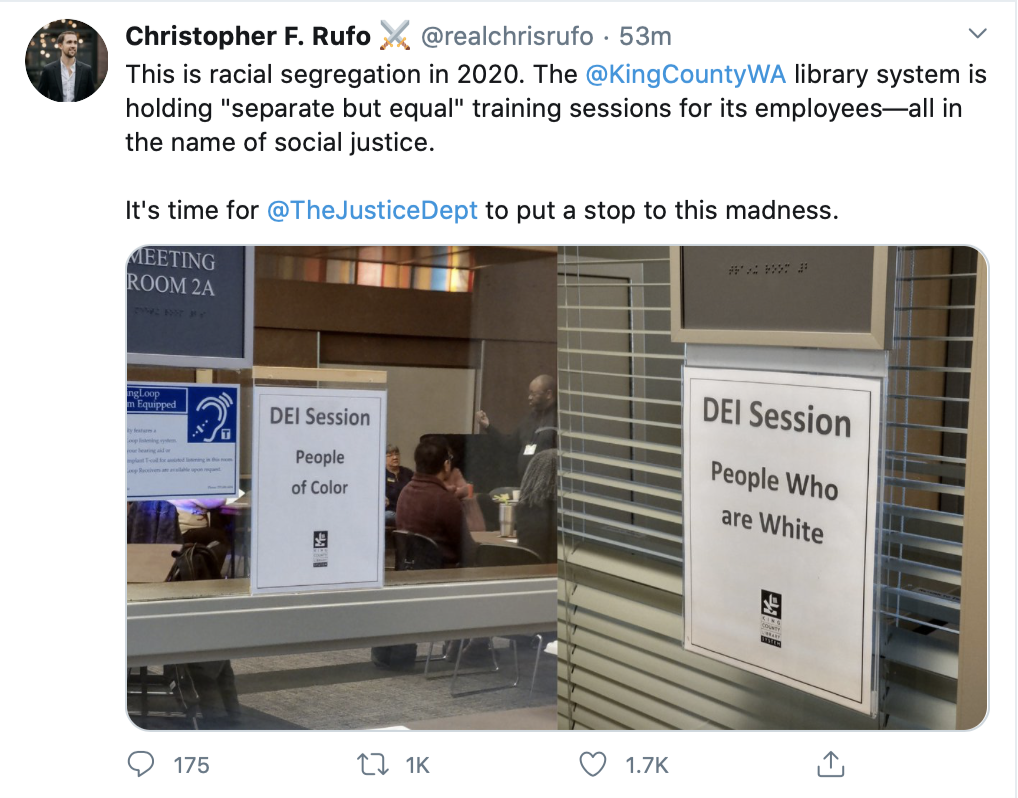
Back to Separate But Equal, and Other Recent Manifestations of Woke Culture

I hate to keep writing about Woke issues, but this ideology increasingly concerns me as the 2020 election approaches.  It is  an issue that mainstream Democrats ignore or downplay, yet the Republicans have recognized it for the cultural cancer that it is.  Woke ideology has successfully entrenched itself deeply into many of our meaning-making institutions and this has positioned it well to spread far, which is unfortunate. Here's a recent example:
Making things worse, far too many Woke advocates are willing to tap into authoritarian tactics.
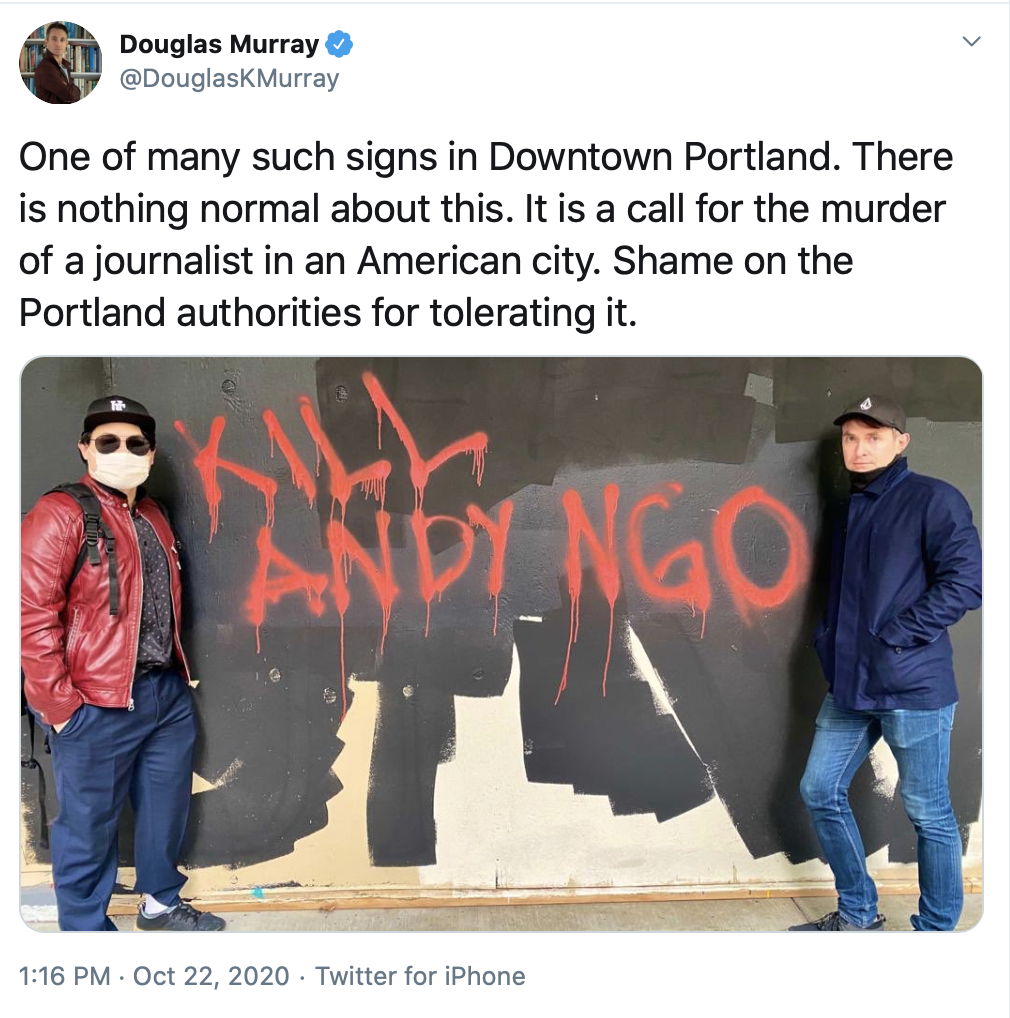
Andy Ngo's "crime" is that he is reporting on what he is seeing on the streets in Portland, including ongoing attempts to damage or destroy federal property.  The NYT thought this sort of thing was a worthy topic, even when it occurred in a much milder form, when right wing zealots merely occupied federal property for a month in 2016 (see here, for example), but "America's newspaper of record" has barely any interest in Portland or Seattle.  Because of this vacuum, these stories and concerns critical of Woke culture are being covered mostly by conservative media and without sufficient discussion or nuance. As I noted above, it is my concern that these issues are keeping the upcoming election close. This unwillingness by people on the political left to criticize "their own" is unfortunate.  Those relatively few socially brave traditional liberals who are willing to speak out, many of whom consider themselves well-entrenched on the political left, are often being accused of being conservatives/Republicans by others on the political left, merely because they are willing to speak out. This has left many traditional liberals (like me) feeling like we no longer have a political home.

One must usually seek out alternative news sources to find thoughtful discussion about the Woke movement. For those who are trying to get up to speed, consider visiting New Discourses (founded by James Lindsay) and Quillette.

Woke ideology is disproportionately affecting younger adults, people who are increasingly coming into positions of power.  This phenomenon was rather predictable based on The Coddling of the American Mind, by Greg Lukianoff and Jonathan Haidt. For another thoughtful discussion about the correlation of age and receptiveness to Woke ideology, see this Wiki letter exchange between Sarah Haider and Ayaan Hirsi Ali (the following excerpt was written by Sarah Haider):

Wokeism is, perhaps, an anti-ideology—a will to power that can be most concretely identified not by what it values or the future it envisions, but by what it seeks to destroy and the power it demands. This makes it especially disastrous. For, when an existing organizing structure is destroyed with no replacement, a more brutal force can exploit the resulting power vacuum. . . . Once liberal institutions have been delegitimized by the woke, what will replace them?

But while its philosophy is empty, the psychology of wokeism is deeply satisfying to our baser instincts. For the vicious, there is a thrill in playing the righteous inquisitor, in mobbing heretics and demanding deference—brutal tactics that keep the rest of us in line, lest we be targeted next. Meanwhile, the strict social hierarchies of the woke are reassuringly simple to navigate: one always knows one’s place.

By contrast, liberalism flies in the face of human nature. “I disapprove of what you say, but I will defend to the death your right to say it” is a phrase so often repeated that we have forgotten how deeply counterintuitive it is. We want to punch the Nazi (or gag him), not defend his right to march. Liberalism might ultimately be good, but it doesn’t feel good. And this is why it may find itself vulnerable to public abandonment, especially in times where it is most necessary. . . .

You rightly point out that liberalism has formidable champions in Sam Harris, Richard Dawkins, Christopher Hitchens and J. K. Rowling. Yet Hitchens is gone and all the others are over fifty. Likewise, this summer, when I co-signed an open letter in defense of free debate, I was disconcerted to see how few of the other signatories were even close to my age.

Bari Weiss recently noted that:

The civil war inside The New York Times between the (mostly young) wokes and the (mostly 40+) liberals is the same one raging inside other publications and companies across the country. The dynamic is always the same. The Old Guard lives by a set of principles we can broadly call civil libertarianism. They assumed they shared that worldview with the young people they hired who called themselves liberals and progressives. But it was an incorrect assumption.

This has been my experience too. Woke adherence can be predicted by generation - where true liberals exist, they exist primarily among the old guard. If the woke have won over the young, they have captured the future.

This ideology manifests in many other ways too.  For instance, insincere and dishonest debate about the unprecedented surge in (mostly) young girls who are being convinced that they were born in the wrong body, leading to permanent body-altering surgery, hormones and other treatments.  You won't find honest discussion about these issues in mainstream media--certainly not in the NYT. Instead of wide-open discussion based on a foundation of biology and medicine, you will only hear discussions where the "factual" foundation is ideology.  This is insane. There is a war going being waged to protect young girls (progress being made in Great Britain), yet many media outlets are afraid to cover the story. To learn young girls are being physically damaged by this ideology, you'll need to go to places like Joe Rogan's podcast. His recent episode featuring Abigail Shrier and her excellent book, Irreversible Damage: The Transgender Craze Seducing Our Daughters, resulted in an attempt by employees of Spotify to muzzle Rogan on this issue and other Woke issues. Refreshingly, Rogan counter-attacked by posting this video on Twitter, suggesting that he has carefully anchored his right to speak freely in his Spotify contract:

There are some bright spots--some well-placed people calling out Woke ideology for the illiberal, dysfunctional and mostly dishonest cult that it is. For instance, check out this recent discussion between Sam Harris and John McWhorter. That said, for each of these well-placed people willing to speak out, there are many other people who believe in a vigorous and open discussion, a willingness to consider dissenting speech and a dispassionate determination of the facts as the basis for conversation. Unfortunately, most of these people are lesser known than Joe Rogan (and J.K. Rowling) and more vulnerable to cancellation (see the comments here).

I could go on, but I won't do that here.  I'll try to move on to other topics for awhile . . .
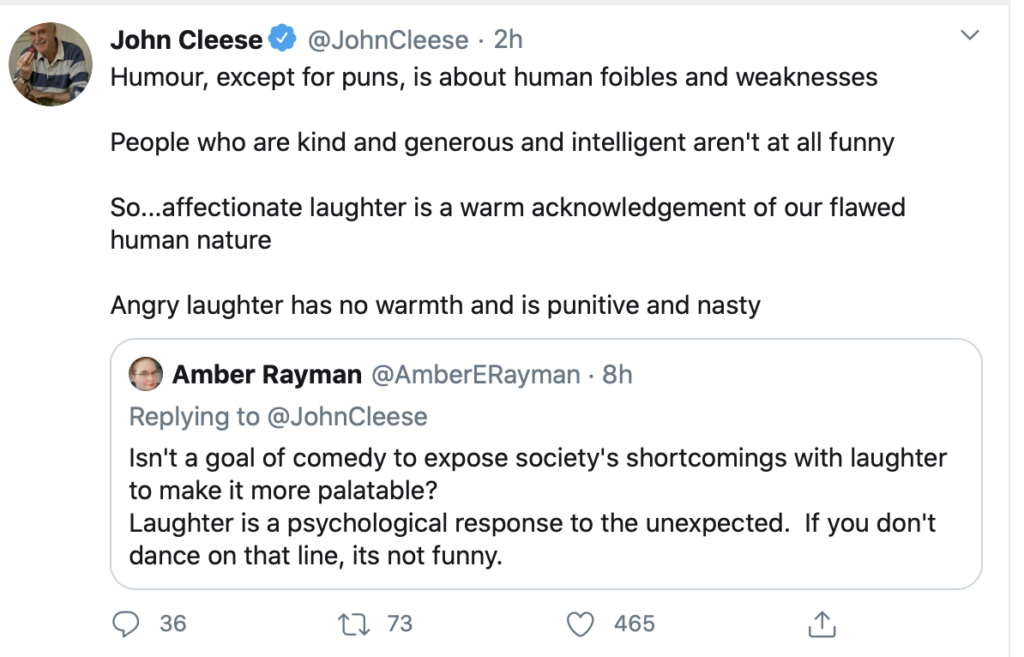
Continue ReadingBack to Separate But Equal, and Other Recent Manifestations of Woke Culture

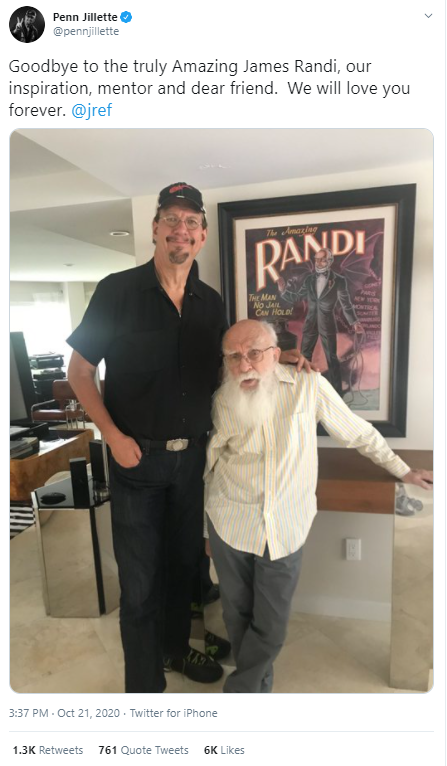
RIP James “The Amazing” Randi

James Randi was an inspiration to me. He was one of the many magicians (including Penn Jillette) who also turned their attention toward exposing many paranormal claims. He was a first-rate debunker of those who prey on fear, ignorance and superstition, as well as an entertaining communicator. I was fortunate to be able to see "The Amazing Randi" make a presentation in person at the CSICOP Conference in Buffalo, NY in 1983. It is awesome to see these charlatans fails so dramatically and so publicly

Continue ReadingRIP James “The Amazing” Randi

Eric Weinstein Offers Five Words About the So-Called News

Below, I've transcribed an excerpt from Eric Weinstein's essay preceding Episode 39 of his excellent podcast, "The Portal." His warnings reminded me of something I often heard when I attended national conventions of Free Press. At those conventions, it was often said that one of the biggest stories is how the press covers the news, but that the press rarely covers how it is covering the news.

Marshall McLuhan['s] famous five word adage, "the medium is the message" can be interpreted as saying that the vehicle of communications is actually likely to be the principal constituent of the payload it delivers . . .

In the news media business, many people think that there is always a search for the most eyeballs. Yet there also arose a concept called the "Friday News Dump," which sought to find the spot in the week where people would give the least attention for the dissemination of bad news. Likewise, print media writers learn to hide their true underlying stories by "burying the lede" when the main story had to be told, but was not favorable to the paper's way of thinking. This would sometimes be handled in what is internally called the "to be sure paragraph," where the author too often effectively confesses the mitigating truth that they had hoped to avoid, at least until the penultimate paragraph many layers deep.

Well, what happens when you can actually calculate where your audience will stop reading, listening, feeling or thinking? Studies have suggested that just over half of all people spend 15 seconds or less reading an article while digitally grazing. Likewise, nearly three out of five link-sharers have not so much as clicked on the headline that they're passing on. . . . This . . . creates a fantastic opportunity for those whose ethics are sufficiently flexible. A particular form of our five word law when applied to news media would be "the headline generates the story" or "the headline is the story." Once this has been discovered, we see that, increasingly, the purpose of the article in our era is not to inform, but to minimally support the desired headline for wide dissemination.

Other forms of this principle are that, at least in the eyes of the weak and the dim, "the slogan is the platform," "accusation generates its own conviction," "the indignation is the reputation," "swarms generate their own consensus," "the messenger is the message" and "the aspiration is the implementation." This also explains the underlying wisdom of the moronic phrase, "not a good look bro." It is often a warning that you're saying something in legacy reality without regard to the optical limits of the situation. Here the most important word may well be "bro." It's a corruption or shortening of brother, letting you know that you are now in an informal world where barely the first three letters will be read before the word becomes too cumbersome to complete.

In an attempt to sum up, then I will leave you with this. There is not only a market for your attention, but one for your inattention as well. Your smartphone may well put all the world's information at your fingertips as is so often remarked upon. But unlike the fabled Library of Alexandria, it puts all the world's disinformation, misinformation, noise and distraction, as well. And what our CEOs and technologists have learned is that your emotions are responsive to objects and not substance when there are cat and GoPro videos to be watched. Increasingly, there will be a war on anyone found to be attempting to traffic in higher recursion limits.

Continue ReadingEric Weinstein Offers Five Words About the So-Called News

Coleman Hughes Issues an Open Letter and a Stern Challenge to Ibram Kendi

In his analysis of Ibram Kendo's best-selling book, How to be an Anti-Racist, Coleman Hughes points to: 1) unsubstantiated claims, 2) misstated claims and 3) vague terms and 4) absurd claims from Kendi's earlier writings, such as Kendi's earlier belief that "white people are Aliens."

Here is a excerpt from Hughes' discussion:

Kendi says what they probably believe but are too afraid to say namely: "Racial discrimination is not inherently racist." He continues "the defining question is whether the discrimination is creating equity or inequity. If discrimination is creating equity, then it's anti-racist. If discrimination is creating inequity then it is racist. The only remedy to racist discrimination is anti-racist discrimination. The only remedy to pasT discrimination is present discrimination. The only remedy to present discrimination is future discrimination."

In so far as Kendi's book speaks for modern anti-racism then it should be praised for clarifying what the "anti" really means. Fundamentally, the modern anti-racist movement is not against discrimination. It's against inequity which, in many cases, makes it pro-discrimination. The problem with racial equity defined as numerically equal outcomes between races is that it's unachievable.

Without doubt, we have a long way to go in terms of maximizing opportunity for America's most disadvantaged citizens. Many public schools are subpar and some are atrocious. A sizable minority of black children grow up in neighborhoods replete with crime and abandoned buildings, while the majority grow up in single parent homes. Too many black people are behind bars.

All of this is true, yet none of it implies that equal outcomes are either possible or the proper goal. Kendi discusses inequity between ethnic groups, for example, which he views as identical to inequity between racial groups, as problems created by racist public policy.  This view commits him to some bizarre conclusions. For example, according to the 2017 census bureau data, the average Haitian American earned just 68 cents for every dollar earned by the average Nigerian American.  The average French American earned just 70 cents for every dollar earned by the average Russian American.  Similar examples abound, so ask yourself: "Is it more likely that our society imposes policies that discriminate against American descendants of Haiti and France but not Nigeria or Russia?  Or that disparities between racial and ethnic groups are normal even in the absence of racist policies?

Kendi's view puts him firmly in the first camp.  "To be anti-racist," he writes "is to view the inequities between all racialized ethnic groups," by which he means groups like Haitians and Nigerians, "as problems of policy."  Put bluntly, this assumption is indefensible. What would it take to achieve a world of racial equity top-down enforcement of racial quotas?  A constitutional amendment banning racial disparity? A department of anti-racism to pre-screen every policy for racially disparate impact? These ideas may sound like they were conjured up to caricature anti-racists as Orwellian super villain, but Kendi has actually suggested them as policy recommendations.

As Hughes explains at the end of his video, Kendi has actually proposed a vast bureaucracy, unaccountable to voters, charged with making sure that no national, state or local law is "racist."  This bureaucracy would also be empowered to investigate private businesses and to monitor the speech of public officials to make sure that "racism" (broadly defined by Kendi, to include a complete lack of numerical disparities in hiring) exist.

Hughes ends his video with the following:

How to be an anti-racist is the clearest and most jargon free articulation of modern anti-racism I've read and for that reason alone it's a useful contribution.  But the book is poorly argued, sloppily researched insufficiently fact-checked, and occasionally self-contradictory.  As a result, it fails to live up to its titular promise, ultimately teaching the reader less about how to be anti-racist than about how to be anti-intellectual.

[From Wikipedia]: Coleman Cruz Hughes (born 1996) is an American writer and opinion columnist on issues related to race and racism at the online magazine Quillette, a fellow and contributing editor at City Journal, and host of the podcast Conversations with Coleman. As Coleman Hughes comments: "What could possible go wrong?"

Continue ReadingColeman Hughes Issues an Open Letter and a Stern Challenge to Ibram Kendi