Two Flavors of Free Speech

Before we have a debate about a topic--here, "free speech"--we should decide exactly what we mean by "free speech," which encompasses far more than the First Amendment. Excellent point by Geoffrey Miller:

Constitutional free speech is grounded in clear rights, laws, precedents, & principles, centered around retraining gov't from meddling in public discourse. We should strongly protect constitutional free speech, and be very wary of gov't censorship -- whether directly, or through gov't collusion with Big Tech, social media, or AI companies.

However, cultural free speech is much more complicated, nuanced, and subject to renegotiation -- which is what we've been seeing over the last ten years, and especially in the last week.

Civilized people accept thousands of informal restraints on cultural free speech. For example, we use the power of informal social rewards and punishments to discourage

- kids from lying

- spouses from dissing each other

- journalists from acting like propagandists

- teachers from indoctrinating students

- companies from violating traditions and trust

- people from burning our flag

- sociopathic trolling on social media

- comedians from making false & incendiary claims

- politicians from demonizing their opponents to incite political violence among their supporters

All of these are restraints on 'cultural free speech', and they could be seen as micro-versions of 'cancel culture', but they're widely supported, and they're not directly related to gov't censorship or First Amendment law.

Yes, the First Amendment helps establish and reinforce the social norms around cultural free speech, and cultural free speech helps reinforce the willingness of citizens, politicians, & judges to protect our First Amendment rights.

But I see a lot of people, on both Left and Right, confusing the two forms of our civilization's commitment to free speech.
Continue ReadingTwo Flavors of Free Speech

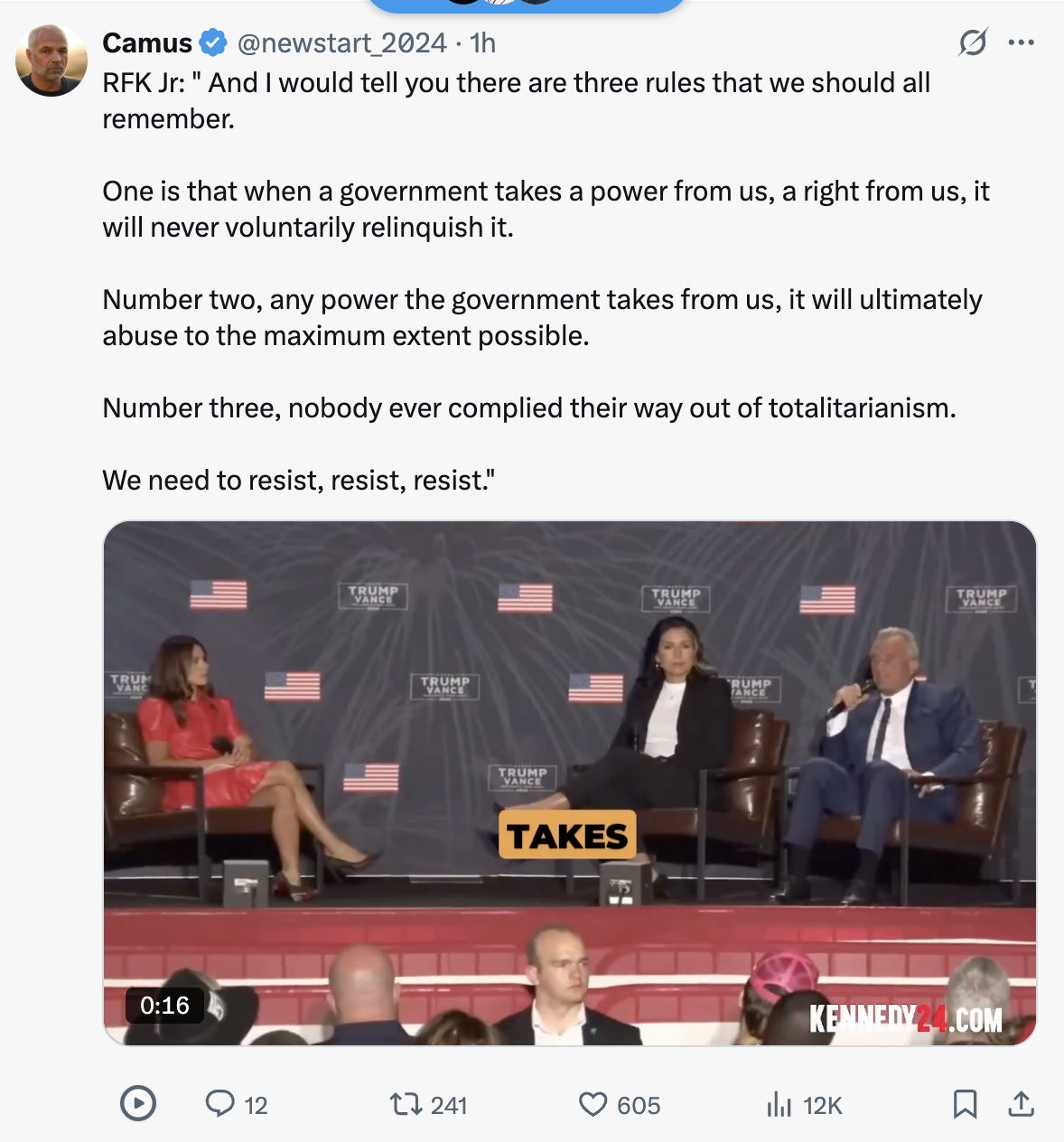
RFK, Jr.: Three Rules About Totalitarianism

[Transcription by Camus on X]

RFK Jr: " And I would tell you there are three rules that we should all remember.

One is that when a government takes a power from us, a right from us, it will never voluntarily relinquish it.

Number two, any power the government takes from us, it will ultimately abuse to the maximum extent possible.

Number three, nobody ever complied their way out of totalitarianism.

We need to resist, resist, resist."

Continue ReadingRFK, Jr.: Three Rules About Totalitarianism

The Function of “Words Are Violence”

Translation of “Words are Violence”: A) You need to shut up and let ME talk. B) I am the sole judge of what words you are permitted to speak. C) I’m so fragile that I can’t bear to talk with people I disagree with. D) I forbid you to use facts, logic and persuasion while we talk. E) If you say anything I don't like, it will be blasphemy and sacrilege and it proves that you are a bad person engaged in "hate speech." F) I am justified ending our relationship and/or inflicting violence on you if your words piss me off.

The above attitude does not invite meaningful debate of anything of importance. Thus:

In "Bury the ‘words are violence’ cliché," Greg Lukianoff reminds us that words are not like bullets:

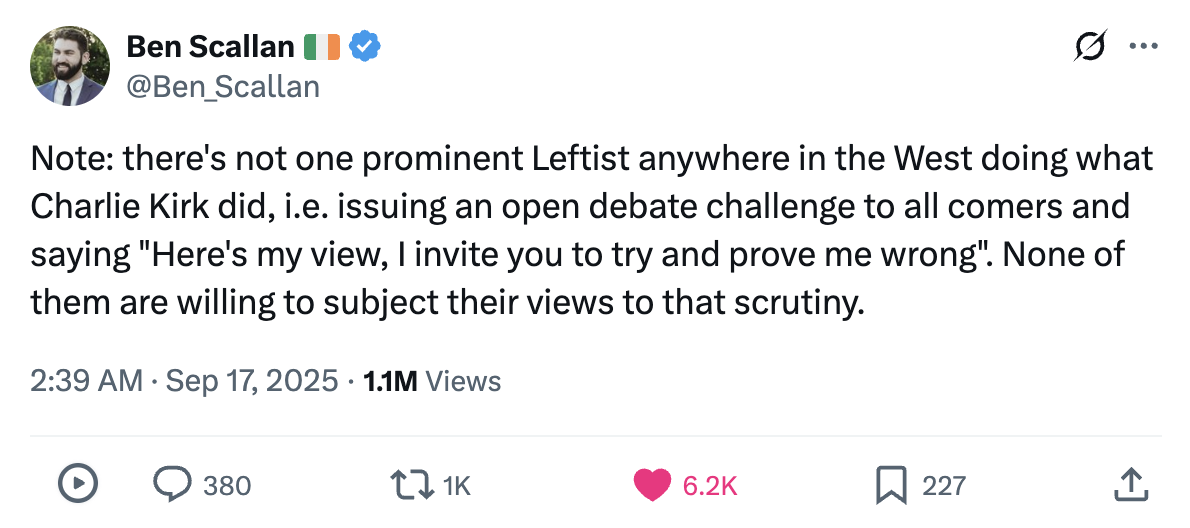
I had my disagreements with Charlie Kirk—sometimes sharp ones—but none of that matters right now. What I respected, and too many of his critics never noticed, was that he showed up. He stood in the quad, took hard questions, argued back, let students argue back at him. That takes time, patience, and courage. Our culture has been teaching young people to scorn that everyday civic courage and to treat contested speech as a kind of physical harm. On that Utah campus we received the final proof that “words are like bullets” is a poisonous and cruel metaphor.

In other words, what looks like a plea for civility is actually a threat. This pertains to both "Words are Violence" and claims of "Hate Speech."

Continue ReadingThe Function of “Words Are Violence”