No, I don't like that some people are innately more intelligent than others. It doesn't seem fair. If I were the creator of the universe, I would have given everyone the same tools for learning and achieving. That said, I often read and hear people disparage IQ as a measurement. Without any basis, they claim that it is a poor measure of intelligence when IQ is actually one of the most valid and reliable measurements in all of psychology. Next time I hear that it is a poor measure, I'll ask the person: "Assume that you are about to start a new for-profit company in a competitive industry. You need to hire 100 employees. You can either hire 100 people with IQs of 90 or 100 people with IQs of 130. Now choose."
BTW, I don't know my own IQ. Therefore, I'm not writing this article from any sort of perch. And I guarantee that whatever my IQ might be, there are many people out there with significantly higher IQs than me.
I don't know what drives this belief among teachers, but it does seem to be another instance of social contagion, much like "phonics is bad" and "gender affirming care for children is good and necessary." Just because it's taught in school by well-meaning teachers doesn't mean that it's true. There is also a vast literature disparaging IQ as an illegitimate measure. My first encounter with a strong attack on IQ was Stephen J. Gould's The Mismeasure of Man.
What's the truth about IQ? Steve Stewart-Williams Recently commented on Education's Elephant in the Room, by Russell T. Warne (at Quillette), offering these excerpts:
The differences among students’ educational achievement start early and increase as children grow. By 5th grade, the average American classroom has children whose achievement in mathematics and reading ranges from the 2nd grade level to the 8th grade level or higher. It is simply impossible for a single teacher to prepare lessons in every subject that allow every student to learn new information. Some sort of ability grouping, in which students at similar levels of achievement are taught together, is necessary...
What causes these individual differences in intelligence and achievement that educators are so determined to deny, downplay, or ignore? …
This is where educators get really nervous, because the major cause of individual differences in intelligence seems to be genetics. The heritability of IQ varies, but in wealthy, industrialised countries, it approaches .80 in adults, which indicates that eighty percent of individual differences in IQ are associated with individual genetic differences. In young children, heritability of IQ is lower, but it hits .50 at about age ten and continues to increase into adulthood before levelling off…
In a British survey, only 29 percent of teachers thought that genes were one of the top three factors affecting student achievement. In other words, the scientific research shows that genes are usually more important than every environmental cause combined, and yet most teachers don’t even believe that genes rank in the top three causes of educational achievement…
I subscribe to the website of Steve Stewart-Williams, The Nature-Nurture Nietzsche Newsletter. He offers lots of rigorous research along with citations and his own insightful commentary. I highly recommend his work, including his article, "12 Things Everyone Should Know About IQ: here's a lot of IQ misinformation out there." '' He comments:
But like many ideas in psychology, IQ is the subject of a lot of misunderstandings and misinformation. Some believe that IQ tests are basically meaningless - that they don’t measure intelligence in any real sense or tell us anything about IQ-test takers except how good they are at taking IQ tests. Others go further, arguing that IQ research is malign pseudoscience aimed only at justifying discrimination.
None of these claims is true! Psychologists studying IQ have learned a great deal about this form of intelligence over the last century, and have an excellent track record of replicating their results. They know how to measure IQ; they know how nature and nurture help shape IQ; and they know how IQ helps shape people’s lives.
In this post, I’ll outline twelve key findings from IQ research that everyone ought to know. Whether you’re a fan of IQ or a skeptic, I hope you’ll find something here to surprise and challenge you!
His first topic (of the 12) dovetails with Warne's article:
1. IQ is one of the most heritable psychological traits – that is, individual differences in IQ are strongly associated with individual differences in genes (at least in fairly typical modern environments). IQ is nearly as heritable as physical traits like height. And the only other psychological traits with similar heritability levels are psychiatric conditions like autism and schizophrenia.
Below I am setting out the other eleven topics, but I recommend the article in its entirety:
2. The heritability of IQ increases from childhood to adulthood.
3. IQ scores have been increasing steadily for the last century or so, a phenomenon known as the Flynn effect.
4. IQ predicts many important real-world outcomes
5. Higher IQ is associated with a lower risk of death from most causes
6. Higher IQ is associated with lower rates of most forms of mental illness.
7. More generally, IQ tests are among the most reliable, predictive measures in psychology – one of the field’s crowning achievements.
8. Despite its excellent psychometric properties, many people are allergic to the concept of IQ. Ironically, this includes many intellectuals.
9. Perhaps as a result of the academic allergy to IQ, there’s some evidence that researchers are less likely to publish studies showing a link between IQ and students’ grades: the reverse of the usual publication bias for positive findings.
10. The antipathy to IQ is unfortunate.
11. IQ tests have other potential benefits.
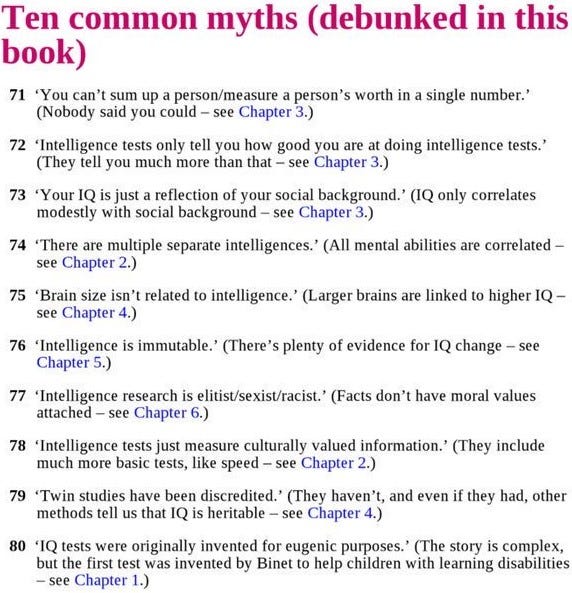
12. Last but not least, here’s a list of ten common myths about IQ, from Stuart Ritchie’s book Intelligence: All That Matters.