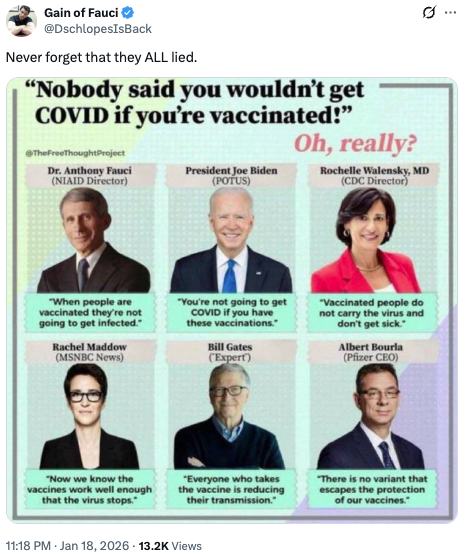
What is the Censorship Industrial Complex? The model isn’t that complicated to understand. The government chooses people whom they call “researchers” to serve as censors. These are government-funded individuals who often come from the intelligence community and foreign policy establishment. They work at non-governmental organizations funded by governments or at universities funded by governments. They conduct “fact checks” to serve as “trusted flaggers.” These “trusted flaggers” demand censorship by social media platforms. It’s all done in secret.
They’re looking to censor narratives. This is essential because, as decades of good cognitive science have shown, people understand and retain information through storytelling. We think in terms of stories, not bullet points. And so they were out to censor whole narratives. From the Stanford censorship project on COVID, the “Virality Project,” they said they wanted to censor “true stories” of vaccine side effects.
Why? Because it might “fuel hesitancy.” In other words, they want to control your behavior. They don’t want you to receive true information that might lead you to not get the vaccine.
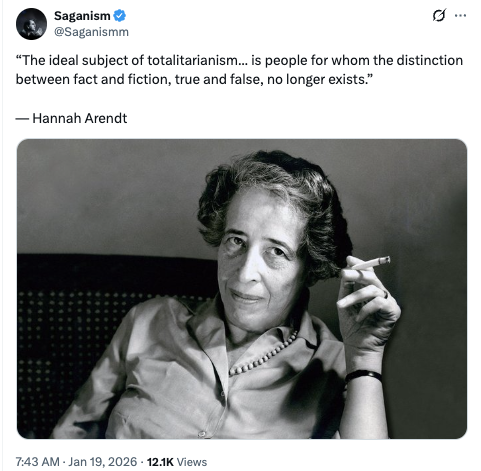
If that isn’t totalitarianism straight out of 1984, I don’t know what it. These people were on the verge of passing legislation in the United States that would’ve authorized the National Science Foundation to choose these “researcher” censors.
I’m presenting slides to Europeans and the world for situational awareness into what totalitarian politicians and bureaucrats have planned because this is still going strong.
Stanford helped the US government censor COVID dissidents, and then they lied about it. You might be detecting a pattern. They’re really not interested in censoring “misinformation.’ They’re very interested in censoring true information.
The censors flagged an Israeli preprint which came out in December, 2020 and found, lo and behold, that natural immunity is a real thing. In fact, it’s more protective than the vaccine.
But the censors flagged somebody’s Google Drive. “See the following Google Drive links being used to compile testimonies about vaccine shedding, Covid videos, showing side effects and whatnot.” Google then removed that content from that person’s Google Drive. You don’t control your Google Drive.
Contrary to Stanford’s claim that the project did not ask social media platforms to remove any content, they privately said they did. And we know that many hundreds of thousands of tweets and Facebook posts were removed, even though they were a hundred percent accurate. In fact, in 2021, Stanford’s “Virality Project” flagged accurate claims that the World Health Organization did not recommend vaccinating children.
The people who spread the misinformation are the people demanding the censorship. They claimed Covid couldn’t have come from a lab, that the Covid vaccine prevented infection, and that natural immunity didn’t exist.
The only solution to hate speech and misinformation is free speech. If you censor false information, how would anybody get the true information? The whole point is the debate.
They lied when they said false information travels faster than true information. It’s a completely bogus study and involved six seconds of content on Twitter.
Who are these people? As of 2020, there were so many former FBI employees at Twitter that they called them “Bu alumni.” They created their own private Slack channel and a crib sheet to onboard new FBI arrivals.
Intriguingly, we discovered that the general counsel of the FBI — arguably the second most powerful person of the FBI, or maybe the first, if you think, consider that what their actual job is to decide what the FBI can and can’t do — resigned from FBI in early 2020 and went to Twitter to take the deputy general counsel role.
Isn’t that interesting? Somebody in one of the most powerful legal positions in the world would take a junior legal role at a social media company. Why would that be? ...