In a U.K. Guardian article entitled, "The Paradox of Israel's Pursuit of Might," long-time admirer of Israel Max Hastings writes of his disillusionment regarding Israel's ambitions:
I was a correspondent there in October 1973, during the Yom Kippur war. It was an extraordinarily moving spectacle, to behold the people of Israel rallying to meet what they perceived as a threat to their national survival. One morning I stood on the Golan Heights and watched Israeli tanks duelling with the Syrians, amid pillars of smoke and flame . . .
For someone like me, who enjoyed a love affair with Israel 40 years ago, it is heart-breaking to see the story come to such a pass. It is because so many of us so much want to see Israel prosper in security and peace that we share a sense of tragedy that 61 years after the state was born amid such lofty ideals, it should be led by such a man as Bibi Netanyahu, committed to policies which can yield nothing honourable or lasting.
In an article titled "The Born Prophecy," published in the May, 2009 American Bar Association Journal, Richard Schmitt writes about a 1996 conversation between Brooksley E. Born (shortly after she was named to head the Commodity Futures Trading Commission) and Alan Greenspan, the Chairman of the Federal Reserve.
The influential Greenspan was an ardent proponent of unfettered markets. Born was a powerful Washington, DC lawyer with a track record for activist causes. Over lunch in his private dining room at the stately headquarters of the Fed in Washington, Greenspan probed their differences.
Well, Brooksley, I guess you and I will never agree about fraud," Born, in a recent interview, remembers Greenspan saying.
"What is there not to agree on?" Born says she replied.
"Well, you probably will always believe that there should be laws against fraud, and I don't think there is any need for a law against fraud," she recalls him saying. Greenspan, Born says, believed the market would take care of itself.
Further down in this same article Schmidt notes that, according to Greenspan, Born has mischaracterized the conversation and that the alleged conversation is "wholly at variance with my decades-long-held view."
Actions speak louder than words, of course, proving that Greenspan is largely responsible for ruining the economy of the United States, and that he is lying to attempt to deny a conversation that is wholly consistent with his lack of interest in regulating financial institutions during his tenure at the Fed.
Eliot Spitzer, recently appearing with Arianna Huffington on CNBC, makes one strong point after another. Stress test the banks now, he asks? Shouldn't they have been monitoring the banks all along? It's as if a doctor who, after ten years under your care, and after you've suffered a heart attack, finally decides to take a blood test. What the hell has he been doing for ten years, given that he wasn't doing anything meaningful to monitor your health.
According to Spitzer (see the ten-minute video here), Greenspan's approach was absolutely destructive to the life savings of middle class tax payers, who are now in the process of subsidizing the big banks "who are burning our money." He points out that not one CEO of a bank has been removed. To the extent that some of the banks look OK at the moment, it's only because the federal government recently handed them a trillion dollars; "the Fed is sliding the money to the banks" through a "flim-flam game." That's the money they are burning through. He sees more financial crises to come, because we haven't made any significant changes to the system. "We have leveraged the future of our kids." He seriously doubts that the bank "stress tests" are real. Rather, he suspects that they are based on fantasy numbers relating to jobs and debt. He further points out that the Fed is run by the CEO's of the very banks that got us into trouble.
Spitzer refers listeners to an article he recently wrote for Slate. The questions focus on whether we should trust the Fed, especially the New York Fed:
Given the power of the N.Y. Fed, it is time to ask some very hard questions about its recent performance. The first question to ask is: Who is the New York Fed? Who exactly has been running the show? Yes, we all know that Tim Geithner was the president and CEO of the N.Y. Fed from 2003 until his ascension as treasury secretary. But who chose him for that position, and to whom did he report? The N.Y. Fed president reports to, and is chosen by, the Fed board of directors.
Huffington points out that the money we're dealing with now is taxpayer money and that it makes the Enron problem look minuscule.
Economist Robert Shiller (see the separate video) also suggest that the stress tests are not really about objective data, but they are about "animal spirits." They are attempts to make the American investors feel confident.
More proof that the conservatives are intellectually bankrupt: Instead of using valuable air time to discuss one of the many critical issues of the day, they mock President Obama for his request for dijon mustard on his hamburger.
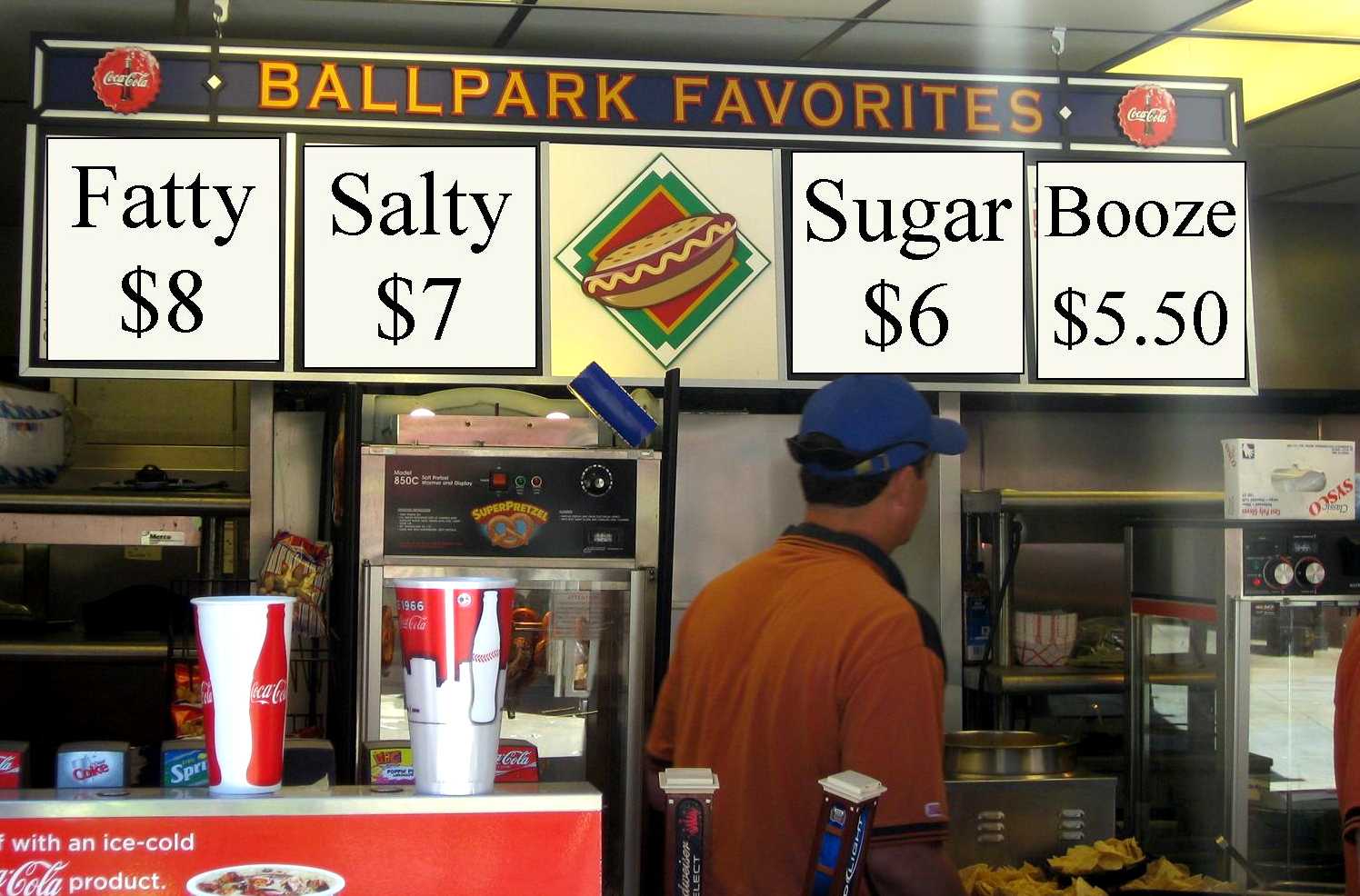
What is it about ballpark food that makes it so delicious? I think that these new truth-in-marketing signs at the ballpark pretty well sum it up.
These stadium food vendors truly excel in offering superstimuli for our not-ready-for-modern-times stomachs and eyes. What should we do about this mismatch between our pleistocene cravings and our modern abilities to pump out this life-shortening quality-of-life-diminishing fare? That's the question raised by Dr. David Kessler, former Commissioner of the FDA:
Fifty years ago, the tobacco industry, confronted with the evidence that smoking causes cancer, decided to deny the science and deceive the American public. Now, we know that highly palatable foods—sugar, fat, salt—are highly reinforcing and can activate the reward center of the brain. For many people, that activation is sustained when they're cued. They have such a hard time controlling their eating because they're constantly being bombarded—their brain is constantly being activated.
For decades the food industry was able to argue, "We're just giving consumers what they want." Now we know that giving them highly salient stimuli is activating their brains. The question becomes what do they do now?
When I say "superstimulus, I mean it. I can't believe how many obese people I recently saw at the stadium. Half of them wore Albert Pujols jerseys, but none of them looked like Albert Pujols.
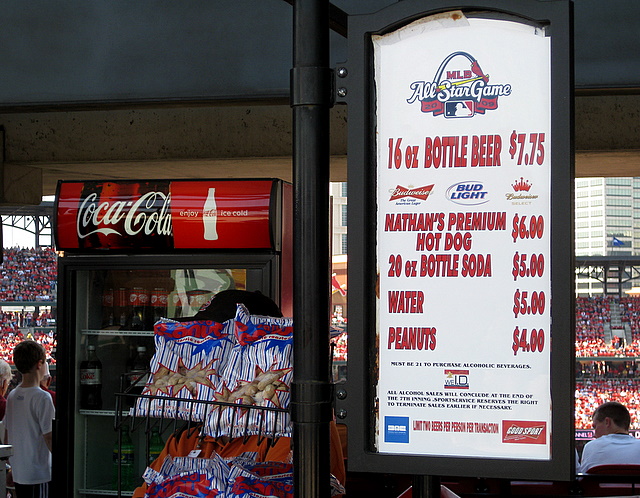
Now, while we're still discussing stadium food, here's an untouched photo clearly demonstrating that the world is almost out of fresh water. After all, there's no other explanation for why anyone would pay twice as much for 20 ounces of drinking water than for a gallon of refined gasoline.
I can just imagine the conversation:
Child: Daddy, can I have a few sips of water?
Father: Billy, how many times have I told you that we can't afford to drink water!
Hello, I invite you to subscribe to Dangerous Intersection by entering your email below. You will have the option to receive emails notifying you of new posts once per week or more often.