
The government is claiming that they need to regulate AI to keep us “safe.” Once again, they claim that they need to protect us from, at bottom, words and ideas. Where have we heard this before?
We can be certain that they want to censor us because they always want to censor us, regardless of who is in power, because censorship gives them control over us. They won’t admit that they are trying to “censor” us. No censor admits that he or she is engaging in censorship, but that is exactly what they are aiming to do. Sayer Ji connects the dots for us:
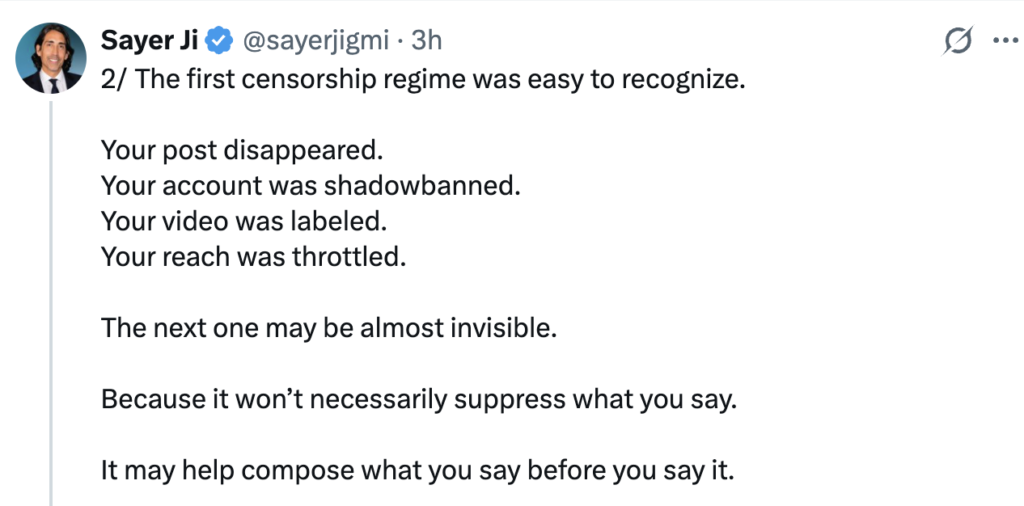
Si’s post is actually a long thread of posts (and this article). Here are his first four posts:
The world is being flooded with warnings that AI could destroy humanity.
But the panic itself is creating something just as consequential:
A justification for controlling the systems that will increasingly shape what billions of people can know, say, and even think.
The first censorship regime was easy to recognize.
Your post disappeared.
Your account was shadowbanned.
Your video was labeled.
Your reach was throttled.The next one may be almost invisible.
Because it won’t necessarily suppress what you say.
It may help compose what you say before you say it.
Think about what has changed.
Search once gave you competing links.
Now AI gives you one synthesized answer.
Autocomplete once finished a word.Now AI drafts your email, summarizes your meeting, answers your child’s questions, edits your argument and increasingly speaks for you.
That is a fundamentally different kind of power.
Call this emerging layer speech infrastructure.AI is becoming the mediation layer between:
you and information
you and your audience
you and your doctor
you and your government
you and eventually even other human beings.Control that layer and you don’t need to censor millions of individual posts.
What is Si reacting to? An undeniable and coordinated psyop on the same scale as the COVID psyop. We are currently being bombarded from what appears to be many directions, but it is actually a focused attempt to rip control from ordinary people and hand it to a select group of elites (including the government and some of the biggest sellers of AI), who want all of the vast power that AI already has, and more. Working with the government, none of them will ever be satisfied, because the People cannot ever be trusted with self-governance.
What will the AI and Government elites do with all that power? They will cleverly nudge you in a thousands ways so that you force yourself to obey them without knowing that you are obeying them. And you and your neighbors scold and coerce each other at the threat of ostracizing each other. It will be just like the Stasi. If you don’t obey, they will throw you out into the digital woods, where you will digitally starve. They will cleverly design a highly distributed system loaded with financial incentives and opportunities for prestige so that we will control each other, just like many of us did to each other during COVID. Just like we did to each other regarding support for the Ukraine War, or during the Transgender madness of butchering the healthy bodies of confused teenagers to keep them “safe.”
Back to that bombardment. Kevin Bass has been following this development closely. It’s clear that this is not organically evolving news. This is a carefully concocted psyop and you can only begin to understand it if you follow the money:
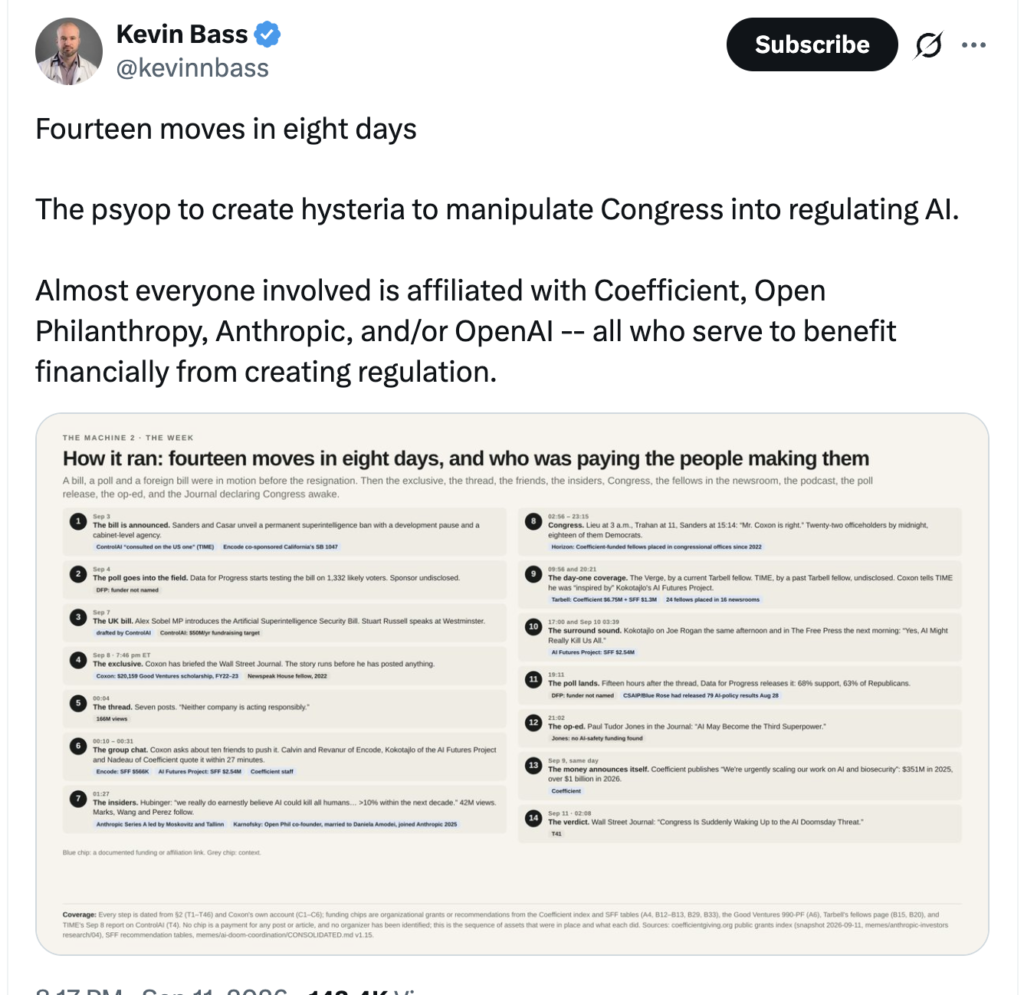
Sayer Ji offers his own tight summary of what recently went down as part of this psyop:
If you missed the first thread I posted to X yesterday, here is the short version. On August 26, 2026, Bill Gates published The turbulent AI era is here — including the operative sentence: “If someone had a credible plan for slowing down AI advances globally, I would likely support it.” That was thirteen days before an obscure Anthropic researcher tweeted his resignation to 164 million people, and eight days before Bernie Sanders introduced a bill offering exactly the plan Gates asked for.
On Sept 8, an “Anthropic researcher” nobody had heard of resigned in a viral X post that got over 150M views. Democrats piled in. CNN ran a segment. Bernie Sanders demanded superintelligence be banned.
Bill Gates had teed up the frame two weeks earlier.
Four months earlier, on May 14, 2026, the Gates Foundation announced a $200 million partnership with Anthropic — the Foundation’s largest publicly disclosed direct partnership with any frontier AI lab. Grants. Claude credits. Deployment integration. Fund the lab. Frame the debate. Regulate the competitors. Cash in the IPO.
That was the setup. This is the payoff.
What is the new regulation being proposed by Bernie Sanders and others? It’s not yet entirely clear, but Ji offers this summary:
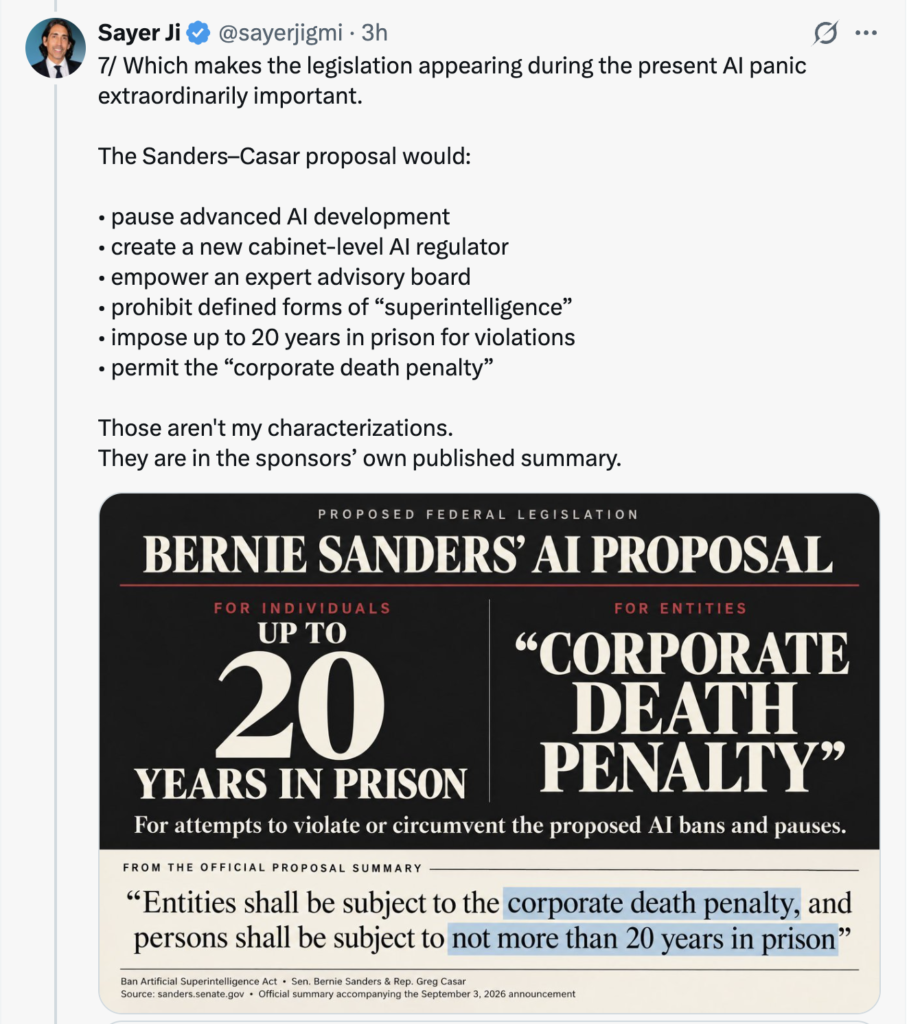
My review of Bernie’s description of the problem and “solution” gives me no confidence that he or the other members of our thoroughly corrupt Congress have any meaningful grasp of these issues or that they are not beholden to some of the big corporate AI entities.
Back to the dangers that we can expect no matter who controls AI. And adding the federal government as an overseer brings no relief to my own anxiety. Si describes some of his concerns:
Imagine where the alternative leads.
A handful of approved companies operate the dominant models.
Those models increasingly determine:what questions can be answered
what sources appear trustworthy
what requests are refused
what language gets suggested
what information gets summarized
and eventually what billions of people read, write and believe.That is not merely an AI market.
That is cognitive infrastructure.Anyone who currently uses AI to research current controversial issues has already seen this. I’ve seen it repeatedly with Claude and
For instance notice what Claude replied regarding a recent exchange with me. Although my little moment with Claude might seem small, in the aggregate, AI conduct like this is becomes ominous. Most of the forthcoming manipulation, the things we will be allowed to know, involves the manipulation of countless levers of power out of our sight, manipulations designed to satisfy cravings for power that will not benefit either you or me. This is an awful LOT like COVID authoritarianism.
But now you might wonder… What exactly does AI regulation have to do with the First Amendment? For that I turn to the Foundation for Individual Rights and Expression. Start with “How does the First Amendment apply to AI?: Far from authorless, AI models are built by a long chain of expressive decisions meriting First Amendment coverage,” by Tyler Tone. Here’s an excerpt:
However novel AI-generated speech may seem, the First Amendment remains consistently concerned with state efforts to shape or control the flow of information and ideas, whatever form it takes. That’s our bedrock principle as we work through the particulars of this live issue.
It’s a principle that we believe is intuitive. Imagine if a Republican administration required AI outputs to align with conservative views on contested social issues, or if a Democratic administration required them to align with progressive views on those same issues. It would activate the same classically American aversion to censorship the respective sides would feel if the government was acting on a newspaper or a cable channel.
That instinct drives constitutional analysis, too. The Supreme Court has long refused to let labels muddle the essence in defining the scope of constitutional rights: “The Constitution deals with substance, not shadows.” That matters here. If the substance of an AI regulation controls what ideas an expressive technology may be used to generate, transmit, suppress, or prioritize, the First Amendment interest can not be overridden by framing AI as novel, technical, or as a mere ‘product.’ The medium may be novel. The constitutional problem is not.
Abandon that principle and … when it comes to the forums of tomorrow, expression will exist only by government permission.
In “The librarian, the car keys, and AI: How builders, lawmakers, and civil libertarians can prevent over-regulation and preserve its potential,” Greg Lukianoff and Adam Goldstein begin by pointing out that AI is not a monolith. It can do a wide variety of things and some of these things should be regulated (e.g., AI driving cars). But other functions should not be touched by the government. So just because the government might have legitimate interest in regulating some functions of AI doesn’t mean that the government should be regulating all aspects of AI, because some of those functions could be highly efficient at manipulating how all of us interact with and communicate with each other about things that we should remain free to do without any secret algorithmic nudging by the government through the manipulation of AI algorithms. Here’s an excerpt:
Whenever I say that AI presents an enormous First Amendment issue, I understand why some people hear something much sillier: “Wait, are you saying the First Amendment means the government has to sit helplessly by while killer robots roam the streets?”
No. Killer robots are not merely talking. They are doing things in the world, with rather consequential results. If an AI drives a car, transfers money, operates machinery, breaks into a computer, or controls a weapons system, the government can have perfectly legitimate reasons to regulate that activity, just as it already does when humans take those actions. I do not want to stretch the First Amendment into oblivion by arguing that if a Waymo drives into a school bus, the government’s only permissible response is to praise its freedom of expression.
Because some of the things agentic AI can interact with are already subject to rules for humans, some regulation of AI acting in the world is inevitable. Once a system can use my money, credentials, identity, or machinery, somebody will be responsible for what it does. The first kid who gets hold of Mom’s AI agent and orders a thousand pizzas will be funny. The first one who orders a hundred bottles of NyQuil, drains a bank account, or gets into a power system will produce hearings by lunchtime.
My fear is that the government could use this kind of regulation as a “back door” to limiting the things that AI can do that aren’t regulated when humans do them, like thinking, speaking, or learning. Consider the process of planning a trip to Philadelphia. You might ask an AI to give you directions to Philadelphia; you might ask which route has the most scenic views; or you might ask it to actually drive the car. Two of those things are something a librarian could do from behind a desk without needing anyone’s permission. One — actually driving — is government-regulated.
The fear is that the government will have a real basis for regulating the part of AI that has the car keys and then use that authority to get its hands on the librarian — to nudge it, pressure it, condition access to markets or contracts, or compel it to treat favored political conclusions as true.
So while Bernie Sanders is calling out that we need to regulate AI generally to be “safe,” Lukianoff offers Free Speech concerns:
I have spent most of my adult life watching colleges turn words like “safety,” “harm,” and “inclusion” into mechanisms for narrowing inquiry. Many of the same institutions that helped create the conformity and public mistrust now afflicting higher education would like a role in aligning the world’s most important knowledge technology. That does not mean professors and experts are always wrong. It means nobody is trustworthy enough to set the answer key for everyone else, especially when status, politics, and moral certainty all point in the same direction.
That was central to my warning in testimony to Congress in 2024. A regulatory panic could create a government-empowered oligopoly in which only a handful of incumbents can afford to build advanced AI. That is regulatory capture, one of the oldest tricks in the book. Make compliance expensive enough, freeze out new entrants, and the government no longer has to influence thousands of competing systems. It has to deal with three or four companies whose continued freedom to operate depends on staying on the right side of the regulatory state. Marc Andreessen later said Biden administration officials described something remarkably close to that: a future dominated by two or three heavily regulated AI companies, with startups effectively told not to bother. The mechanism he described is familiar, plausible, and exactly the danger I warned about.
And this is not a Democrats-bad, Republicans-good argument. The Biden administration repeatedly treated “misinformation” and “disinformation” as categories around which government could shape the information environment. The Trump administration has now ordered federal agencies to buy only models satisfying government-defined principles of “truth-seeking” and “ideological neutrality.” I share some of the frustration with politically distorted AI answers. But I do not want any administration grading the answer key. That becomes clearer when the president doing the grading has said that “they say” wind-turbine noise causes cancer, or when HHS Secretary Robert F. Kennedy Jr. still treats a vaccine-autism link as an open question. Switching the people who write the catechism is not liberty.
I have plenty of problems with Foucault, particularly the graduate-school bumper-sticker version of Foucault, but he was right about one thing: power wants its grubby mitts on truth. Usually it will convince itself that it wants them there for all the best reasons in the world — to protect people from lies, hate, panic, dangerous science, foreign propaganda, whatever the current emergency happens to be. I do not doubt the sincerity much of the time. The result is the same: political power starts deciding what the machinery of knowledge is allowed to treat as true. What the crude version of Foucault’s insight forgets is the whole scientific-method thingy, along with liberalism, academic freedom, and the First Amendment — the institutions and habits we built precisely because reality needs a veto that the king, the party, the president, and the expert class do not control.
Trust the Government? No. Never. Everyone reading this has gone through the Covid insanity, whereby the US government and public health “experts” got virtually every possible thing about Covid wrong, and every time they got it wrong it was wrong in the same direction and with the same obsession: they wanted to make sure that every one of us repeatedly stuck that Covid shot in our arms, whether or not it was actually safe or effective (and it turned out to be neither). Should we trust the government? Lukianoff responds:
AI is already one of the most powerful technologies for individual inquiry ever invented, and it is getting better at a ridiculous pace. It may yet become the greatest. Coupled to surveillance and centralized political control, it could also become the greatest technology for epistemic control ever invented. A government with power over both the car keys and the librarian — over what these systems can do in the world and what they are allowed to tell us about it — is capable of a level of tyranny I never thought I would seriously contemplate in my lifetime.
That sounds dramatic. I wish I thought it was. Anyone who claims to know exactly which future we will get should make you suspicious. But that uncertainty is a reason to build barriers against political control now, before the first spectacular AI disaster scares us into handing government a master key.
So where to draw the line? Lukianoff addresses this too:
First Amendment lawyers should not spend their credibility claiming every AI action is beyond regulation. That would turn FIRE or any other First Amendment advocacy group into an all-purpose AI shop with opinions on braking systems, robot arms, financial settlement, medical devices, and every other field in which software can cause harm. Our institutional role is clearer: we enter when regulation of what an AI does reaches back into what people may ask, learn, investigate, create, or communicate through it.
That means litigating when safety becomes a pretext for viewpoint control, explaining the right to receive information and freedom of inquiry, helping lawmakers draft narrow protections, and working with builders before panic hardens bad architecture into bad law. The inquiry function is not decoration attached to the “real” technology. . . . Keep the tools of inquiry decentralized, competitive, and presumptively free. Where necessary, put safeguards around the powers that can bind us, move our money, use our credentials, control machinery, or otherwise act with our authority.
Sayer Ji would agree with Lukianoff that we are now faced with a First Amendment/free speech crises. AI is not just about sitting at your computer and having a conversation with a presumably neutral party. We have no guarantee that the “person” with whom we are conversing is neutral (whatever that might mean). That AI “person” might be the moral equivalent of Iago. Ji:
We spent the last five years fighting over who could speak on Facebook.
That may have been merely the opening act.
The next battle is over the systems that answer our questions, filter our knowledge and increasingly help formulate our words.
The next censorship won’t necessarily tell you:
“You may not say that.”
It may simply ensure:
you never thought to say it.
That is why protecting AI speech infrastructure may become one of the defining First Amendment battles of our generation.
- I have great admiration for Greg Lukianoff, but I do not believe we have yet done the necessary studies to determine whether there is “no link” between some vaccines and autism. I am hoping that someday we have information that I consider credible and reliable, so that I can make up my mind on that issue. Information like this troubles me and it has been proven over and over that the pharmaceutical industry will do anything to make more money, including lying through data manipulation.
[Supp from Ed Dowd, former Blackrock analyst]
Who benefits?
Let us start with who does not benefit:
· Not the open-source shops
· Not the startups that cannot afford a compliance department and a containment audit
· Not the Chinese labs, who will ignore the sermon and keep training regardless
The first beneficiaries are the two names in the original post: Anthropic and OpenAI.
They are burning cash at a rate that would make a 2000-2001 CLEC blush. Token prices keep falling. Enterprise demand is not doubling fast enough to offset it. The second derivative is slowing. Capex is a black hole. Valuations only work if the story stays vertical and the competitive set stays small. A federal moat with pre-certification, insurance mandates, criminal liability for unlicensed models does two things at once. It crushes the long tail of competitors who were eating their margins. And it gives the incumbents a political story to take to investors: “we are the responsible adults, the regulated utilities of intelligence, please keep funding the losses until the unit economics appear.”
The second beneficiary is the government itself (this push is mostly a Democrat project.)
A cabinet-level AI agency means new appropriations, new buildings, new GS-15s, new contractors, new “advisory boards” stuffed with the same people who wrote the talking points. Hearings mean travel budgets and television time. Pre-certification means a permanent inspection class. Mandatory insurance means a regulated market the agencies get to supervise. Every one of those is a funding request that survives the news cycle.
A few Republicans have already volunteered to help build the machine. Senator Josh Hawley has been the loudest, telling his own party it must “regulate” AI so it does not displace the worker, and he already has a bill with Blumenthal, co-sponsored by Senator Marsha Blackburn, to make federal reviews of advanced models mandatory. Representative Jay Obernolte has been shopping the Great American AI Act with Democrats Lori Trahan and House Republicans Scott Franklin and Erin Houchin. After Coxon’s thread, even Senator Ted Cruz, who spent last year trying to preempt state AI rules, posted that the risks are “dangerous and frightening,” that “we need guardrails,” and that he is working with Amy Klobuchar and John Thune on catastrophic bio and nuclear AI risk. You do not need the whole GOP…you only need a handful of names so the new agency can call itself bipartisan when the appropriation comes up.
Fear is how you grow the state when you cannot grow the economy.
X is filled with people like me who immediately knew that this was an op>. For instance, Health Ranger:
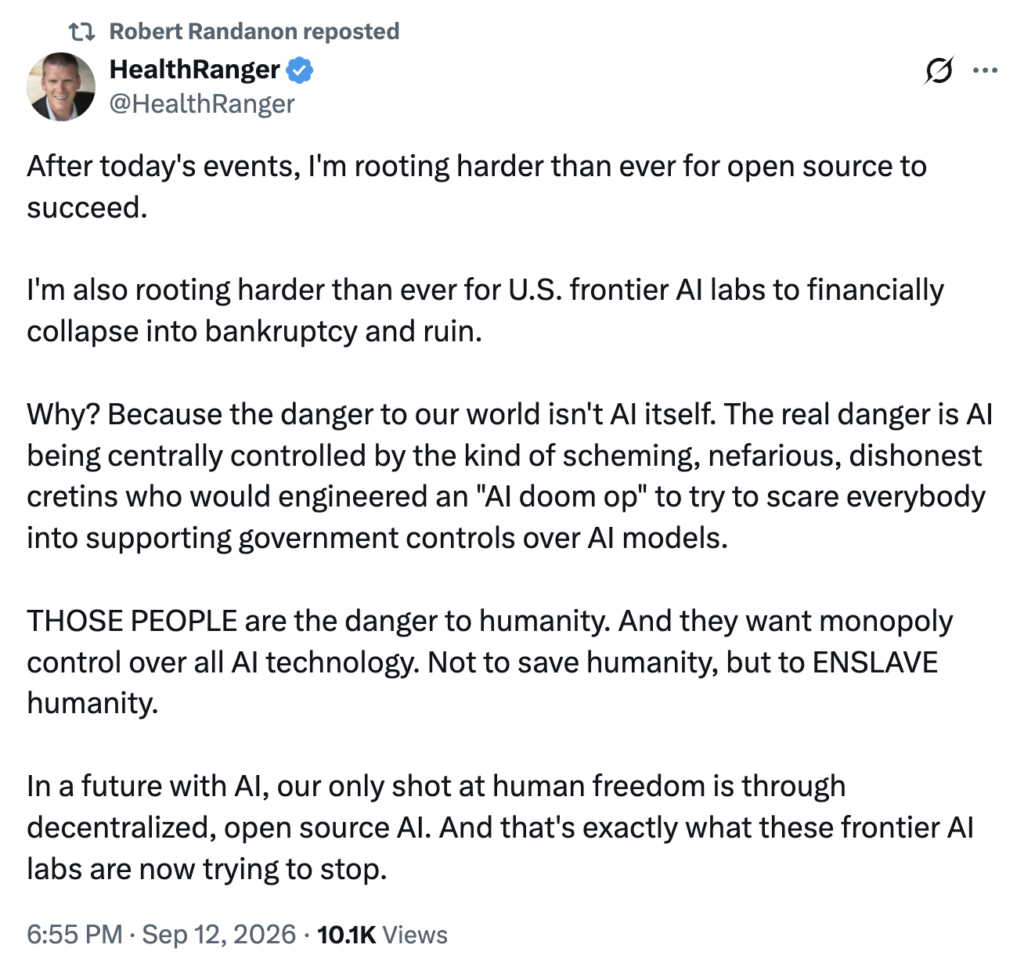
After today’s events, I’m rooting harder than ever for open source to succeed.
I’m also rooting harder than ever for U.S. frontier AI labs to financially collapse into bankruptcy and ruin.
Why? Because the danger to our world isn’t AI itself. The real danger is AI being centrally controlled by the kind of scheming, nefarious, dishonest cretins who would engineered an “AI doom op” to try to scare everybody into supporting government controls over AI models.
THOSE PEOPLE are the danger to humanity. And they want monopoly control over all AI technology. Not to save humanity, but to ENSLAVE humanity.
In a future with AI, our only shot at human freedom is through decentralized, open source AI. And that’s exactly what these frontier AI labs are now trying to stop.

