
Why have so many of our institutions have become so dysfunctional? Further, many of them have become Orwellian, which you can see when you compare their official mission statements with what they actually do. Dylan Ratigan offers this thoughtful analysis:
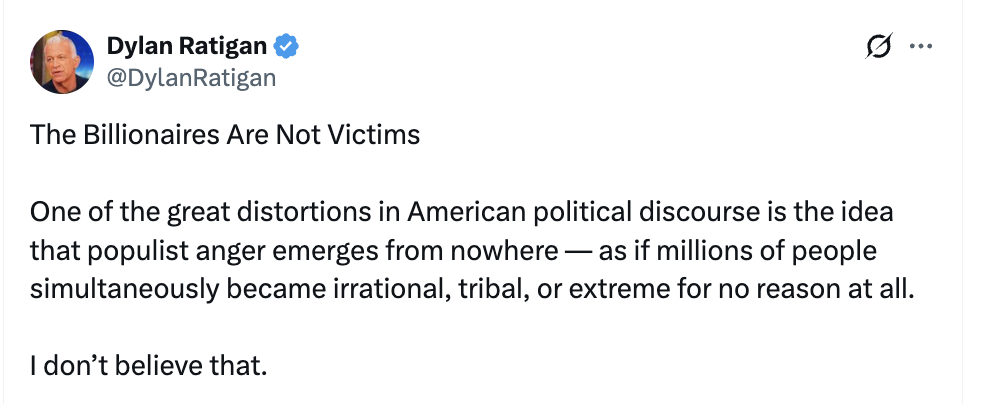
The Billionaires Are Not Victims
One of the great distortions in American political discourse is the idea that populist anger emerges from nowhere — as if millions of people simultaneously became irrational, tribal, or extreme for no reason at all.
I don’t believe that.
I think what we are witnessing across the United States — on both the political right and the political left — is the consequence of a society that increasingly understands, correctly, that its governing institutions are not primarily organized around the public interest.
They are organized around capital concentration.
And until that changes, populism will continue to grow.
Not because people are stupid.
Because people are responding rationally to a system that no longer appears accountable to them.
The immediate conversation that triggered this thought involved the reaction among certain elite circles to the rise of populist political figures and movements in places like New York.
Particularly interesting to me is the tendency among wealthy institutional actors to portray themselves as victims of instability while simultaneously benefiting from — and often helping design — the very incentive structures producing that instability.
Take the billionaire class broadly.
Modern capital is effectively transnational.
It is mobile.
Portable.
Adaptive.It can move to Miami.
Singapore.
London.
Dubai.It experiences countries less as civic projects and more as operating environments.
That is not a moral accusation.
It is a structural observation.The wealthiest people in the world are no longer deeply tethered to the fate of any single municipality, state, or even nation in the way prior industrial elites once were.
Their relationship to place has changed.
And that shift matters politically.
Meanwhile, ordinary citizens remain highly localized.
Their wages are local.
Their housing costs are local.
Their schools are local.
Their hospitals are local.
Their physical safety is local.They cannot arbitrage geography the way capital can.
So when people feel economic pressure, institutional distrust, or cultural instability, they experience it directly and personally.
And eventually they begin voting against the system itself.
This is where I think many establishment analysts misunderstand modern populism.
The people voting for populist candidates on the right and the people voting for populist candidates on the left are often responding to the same underlying sensation:
That the system is not designed for them anymore.
The language differs.
The aesthetics differ.
The villains differ.But the emotional root is remarkably similar.
Distrust.
Dislocation.
Extraction.
Humiliation.
Powerlessness.This is why attempts to reduce everything to “left versus right” increasingly feel inadequate.
The deeper divide may actually be between:
Those who still believe institutions fundamentally serve the public…
and those who believe institutions have become mechanisms for elite coordination and asset protection.
That is a very different political framework.
And once people adopt that framework, traditional partisan messaging begins to lose effectiveness.
None of this means billionaires are evil.
It does not mean markets are bad.
It does not mean success itself is illegitimate.It means incentives matter.
And if both political parties become financially dependent on the same narrow concentration of capital, the public will inevitably conclude — correctly or incorrectly — that meaningful accountability has disappeared.
When accountability disappears, populism fills the vacuum.
Always.
The irony is that many elite institutions now seem genuinely surprised by the instability surrounding them.
But instability is not random.
A society optimized primarily for asset appreciation and capital mobility while neglecting civic durability, public trust, and broad-based economic participation will eventually produce political volatility.

