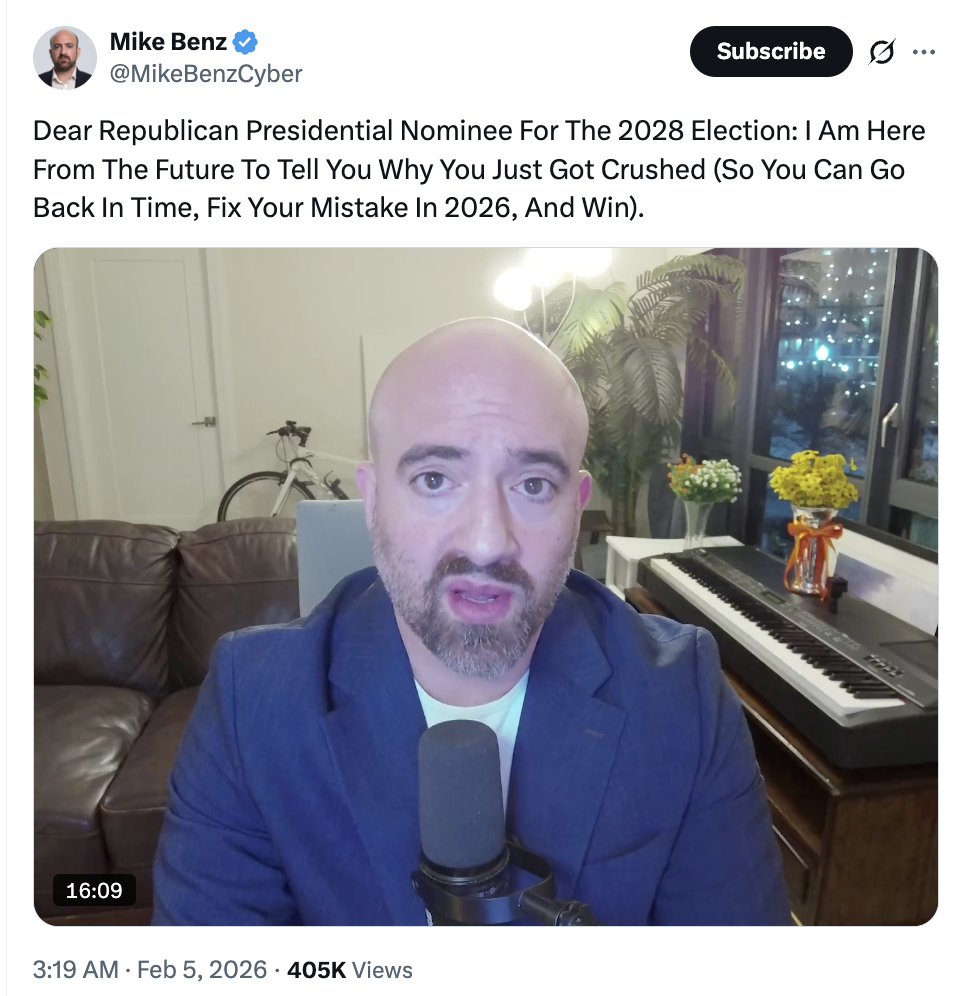
EU Wages Vast Censorship Attacks Against US

Under no circumstances, should we allow EU countries to determine what American citizens should and should not say by levying existential fines on social media companies. There are a lot of important things going on right now, but I consider this the most important. Michael Shellenberger has been reporting on this threat for many months.

Mike Benz elaborates on this threat:

This is an issue on which the two political parties fundamentally differ. On the conduct of the Biden administration, a president, Harris would have invited this censorship. We won't now see how strongly President Trump can fight it. Success is by no means guaranteed here, as Benz explains.

Continue ReadingEU Wages Vast Censorship Attacks Against US

New Position on Transgender Surgeries by the AMA and ASPS

It has long been my position that adults can and should be able to do anything they want with their own bodies. With exceptions that would need to be extraordinary, rare and carefully considered in light of a detailed psychological analysis, I have simultaneously opposed irreversible transgender medical surgeries and injections done to minors that will make them sterile, prevent them from ever achieving orgasm and a host of other harmful physical outcomes. This is my position even if these procedures are supposedly done with the "consent" of minors (who are prohibited by age from getting a tattoo or voting).

In light of new evidence of the dangers of these surgeries, two major medical organizations have now voiced their concerns.

Nicolas Hauser's article is titled "Major Medical Organizations Retreat on Irreversible Gender Surgeries for Minors: The American Medical Association and the American Society of Plastic Surgeons move to defer irreversible gender surgeries in minors days after $2 million malpractice verdict for teen detransitioner." Excerpt:

This week, the American Medical Association (AMA) endorsed delaying gender-affirming surgeries until adulthood, just one day after the American Society of Plastic Surgeons (ASPS) recommended postponing breast/chest, genital, and facial surgeries until at least age 19. While framed as recommendations rather than binding clinical guidelines, the signal is unmistakable: irreversible surgical alteration of minors is facing growing resistance.

Continue ReadingNew Position on Transgender Surgeries by the AMA and ASPS

Investigating Truth versus Speaking One’s Truth

Stephanie Tyler has written "The Problem with “Speaking Your Truth," pointing out a disconnect I see in many of the comments to my posts on Facebook. For many people on FB, it is not OK to consider competing perspectives, facts that run counter-narrative or even competing interpretations of facts, even when dealing with factually complex situations. Instead, one is expected to jump up and embrace tribally reinforced emotional reactions as though they are morally-infused self-evidence. Whenever someone who is careful and sincere fails to immediately take a knee, people who are decorated with enough credentials that they should know better launch barrages of ad hominems. They will loudly proclaim that they are "good" people you are not. In the end, there will be only heat, no light. Though there might be more words, there is no real conversation. Excerpt from Tyler's article:

"I spent years inside women’s and gender studies classrooms, where language like “lived experience,” “the personal is political,” and “my truth” wasn’t just common, it was foundational. These phrases weren’t offered as rhetorical flourishes, they were treated as epistemology, as a way of determining what counted as knowledge. Experience wasn’t something you brought into the room to be examined alongside evidence, history, or competing explanations. It was something closer to authority. And once it was invoked, questioning it wasn’t framed as inquiry, it was framed as harm.

At the time, I accepted this framework without much resistance. It felt humane, or corrective, like a long-overdue response to voices that had been ignored. Only later did I realize something important had been smuggled in along the way: the idea that subjective experience and shared reality belonged to the same category. They don’t.

Subjective experience is real and it matters. It shapes how people interpret the world and move through it, but it’s also internal, private, and non-transferable. It tells you how something felt to someone, not necessarily what happened, why it happened, or what it means at scale. Shared reality is different. It’s external, it’s negotiated, it’s the space where claims are tested, compared, revised, and sometimes rejected. It’s the reason disagreement exists at all. It’s the thing we argue over precisely because none of us owns it outright.

When those two domains collapse into one another, empathy starts doing work it was never meant to do. And when that collapse becomes moralized, conversation stops working altogether.

Empathy, properly understood, allows you to understand another person’s inner state without surrendering your capacity for judgment. It’s a bridge, not a verdict. But increasingly, empathy is treated as a moral command with only one acceptable conclusion. You aren’t being asked to understand someone else’s perspective, you’re being asked to adopt it fully, or risk being cast as deficient, cruel, or dangerous!

This is where Gad Saad’s idea of suicidal empathy becomes useful, not as a provocation, but as a diagnosis. The problem isn’t that people care too much, it’s that empathy has been detached from reality-testing and limits. When that happens, it stops functioning as a human skill and starts functioning as an epistemic shortcut. Emotional alignment replaces argument and becomes the standard for legitimacy, and feeling the right way becomes proof that you’re right.

Once empathy is used this way, disagreement no longer needs to be answered. It only needs to be pathologized."


Continue ReadingInvestigating Truth versus Speaking One’s Truth

Another Luxury Belief: Women Banned from Education by the Taliban

The banning of education beyond primary school for women by the Taliban in Afghanistan is an especially deplorable luxury belief. Post below by WDI.Afghanistan:

"In case you were wondering: the Taliban leaders send their daughters to fancy schools in Qatar and Pakistan.

“Just for the record, do your two daughters go to school?

Head of Taliban Office in Qatar - Of course they do.

This sums it all up. For their own daughters nothing is forbidden while for poor girls living in Afghanistan everything is forbidden."

Rob Henderson developed the concept of "Luxury beliefs." They are ideas and opinions that confer social status and the cheap signaling glow of "goodness" on the upper class, at little or no cost, while inflicting substantial burdens on the lower classes. Luxury beliefs are an especially destructive form of hypocrisy. Prominent U.S. examples of luxury beliefs:

1. Defund the police: Upper-class individuals advocate for reducing police funding, signaling progressive values, while living in safe communities (sometimes gated) or paying for private security, leaving lower-income neighborhoods more vulnerable to crime.

2. Abolishing standardized tests like the SAT: Affluent people advocate for eliminating such tests under the banner of "equity," yet their children benefit from expensive tutors and alternative admissions advantages, disadvantaging lower-class applicants who rely on merit-based scores.

3. Monogamy and marriage are outdated: Elite individuals publicly downplay the importance of traditional marriage and fidelity, but privately practice them to ensure family stability and success for their offspring.

4. Open borders or lax immigration policies: Upper-class advocates support unrestricted immigration, which doesn't threaten their high-skill jobs or neighborhoods, but increases competition and thus lowers wages for working-class Americans.

https://x.com/wdiafghanistan1/status/2017437051382075762?s=43

From Grok (link below):

Under Taliban rule in Afghanistan, as of February 2026, girls and women are permitted to attend primary school up to grade 6 (typically up to around age 12), but they face a complete ban on secondary education (grades 7-12) and higher education, including universities.

This policy, in place since the Taliban's return to power in 2021, has been extended over time: secondary schools were closed to girls in March 2022, universities in December 2022, and most recently, women and girls were barred from public and private medical institutes in December 2024, severely limiting the training of female healthcare workers in a country with acute medical needs.

Afghanistan remains the only country in the world enforcing such comprehensive restrictions on female education beyond the primary level.

The ban affects approximately 2.2 million girls who are denied secondary education, with projections indicating further increases if the policy persists. ...

These educational restrictions are part of a broader system of gender-based policies, often described as "gender apartheid," which also limit women's employment, movement, public participation, and access to healthcare."

From the NYT, NPR & MSNBC: No reporting on this abuse of women by the Taliban for at least the past year.

Continue ReadingAnother Luxury Belief: Women Banned from Education by the Taliban