
Elizabeth Warren discusses the real purpose of TARP

At Daily Kos, "HoundDog" reviews Elizabeth Warren's new book, A fighting Chance. Here's an excerpt:

[Warren] says when she asked Geithner about helping the homeowners struggling to save their homesh he admitted "[d]espite the way it was sold, TARP was about saving banks, pure and simple." ..He admitted that really was not the goal, she writes. [caption id="attachment_26775" align="alignright" width="300"]Elizabeth Warren (Photo by Erich Vieth) Elizabeth Warren (Photo by Erich Vieth)[/caption] "The banks could manage only so many foreclosures at a time, and Treasury wanted to slow down the pace so banks wouldn't be overwhelmed," Warren writes, recounting Geithner's explanation. "And this was where the new foreclosure program came in: it was just big enough to 'foam the runway' for them." "There it was," Warren writes. "The Treasury foreclosure program was intended to foam the runway to protect against a crash landing by the banks. Millions of people were getting tossed out on the street, but the secretary of the Treasury believed the government's most important job was to provide a soft landing for the tender fannies of the banks. ... "Oh Lord." She praises President Obama for supporting the Consumer Financial Protection Bureau, but always says he has to take responsibility for choosing the team he did.
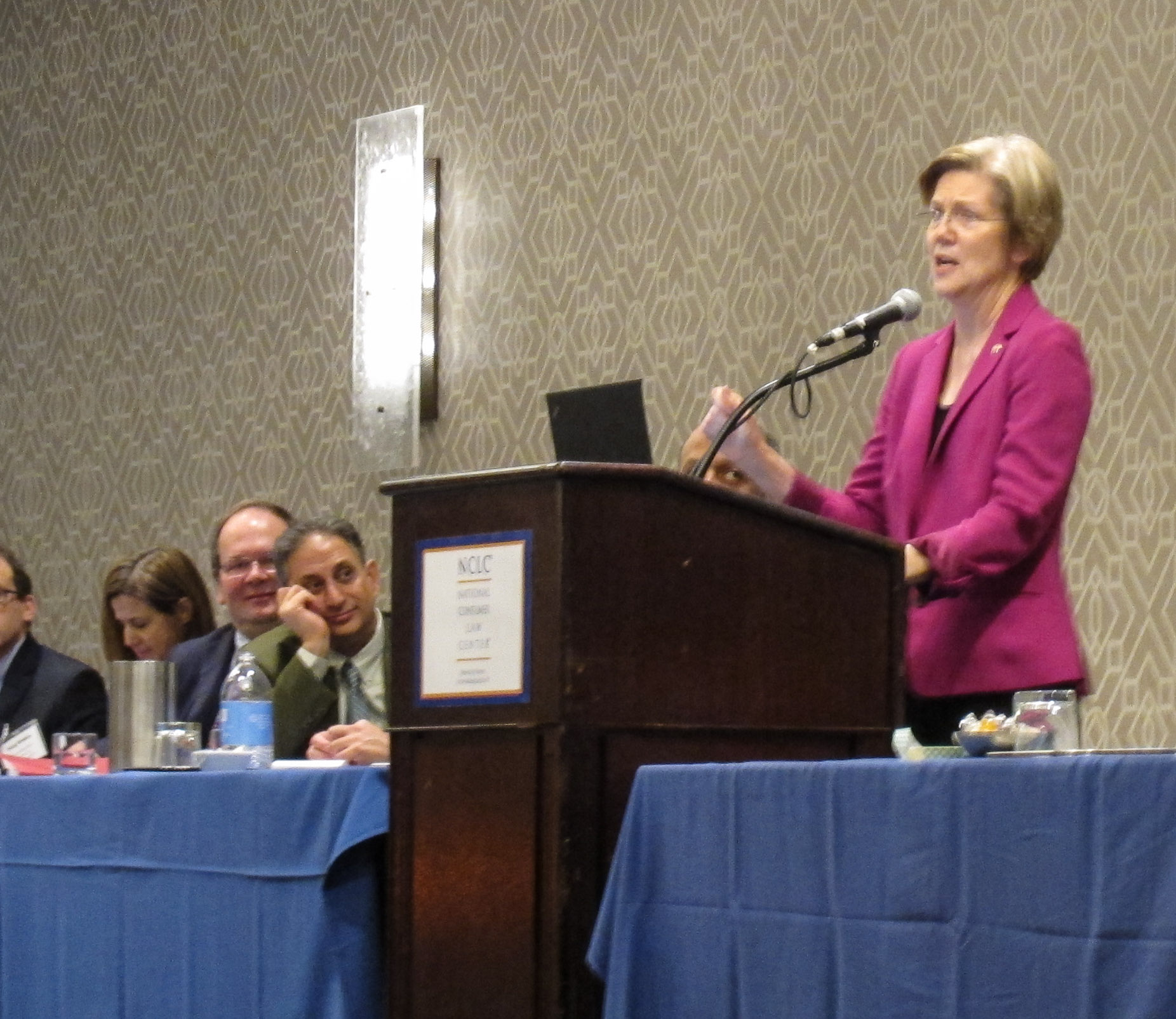
For more on Elizabeth Warren, see this post I wrote regarding her November, 2013 presentation to the National Association of Consumer Advocates.  The above quote by Warren confirms a similar statement by Neil Barofsky, who presented at an NCLC conference the previous year. Inside the White House, the TARP program was only about attending to the needs and wants of Wall Street banks.   I attended both of these, and the huge rooms filled with consumer advocates much appreciated hearing straight talk from these two exceptional people. [caption id="attachment_26774" align="alignright" width="150"]Neil Barofsky at NCLC Neil Barofsky at NCLC (Photo by Erich Vieth)[/caption]  

Continue ReadingElizabeth Warren discusses the real purpose of TARP

A simple Easter Challenge for Christians

Freedom From Religion Foundation has made a straightforward Challenge for those who consider themselves Christians:

My challenge is simply this: tell me what happened on Easter. I am not asking for proof. My straightforward request is merely that Christians tell me exactly what happened on the day that their most important doctrine was born. Believers should eagerly take up this challenge, since without the resurrection, there is no Christianity. Paul wrote, "And if Christ be not risen, then is our preaching vain, and your faith is also vain. Yea, and we are found false witnesses of God; because we have testified of God that he raised up Christ: whom he raised not up, if so be that the dead rise not." (I Corinthians 15:14-15) The conditions of the challenge are simple and reasonable. In each of the four Gospels, begin at Easter morning and read to the end of the book: Matthew 28, Mark 16, Luke 24, and John 20-21. Also read Acts 1:3-12 and Paul's tiny version of the story in I Corinthians 15:3-8. These 165 verses can be read in a few moments. Then, without omitting a single detail from these separate accounts, write a simple, chronological narrative of the events between the resurrection and the ascension: what happened first, second, and so on; who said what, when; and where these things happened.
The trick is that the Bible is riddled with contradictions on this alleged story. Many of those contradictions are outlined in the article. Here are a few: Who were the women? Matthew: Mary Magdalene and the other Mary (28:1) Mark: Mary Magdalene, the mother of James, and Salome (16:1) Luke: Mary Magdalene, Joanna, Mary the mother of James, and other women (24:10) John: Mary Magdalene (20:1) What was their purpose? Matthew: to see the tomb (28:1) Mark: had already seen the tomb (15:47), brought spices (16:1) Luke: had already seen the tomb (23:55), brought spices (24:1) John: the body had already been spiced before they arrived (19:39,40) Was the tomb open when they arrived? Matthew: No (28:2) Mark: Yes (16:4) Luke: Yes (24:2) John: Yes (20:1) Who was at the tomb when they arrived? Matthew: One angel (28:2-7) Mark: One young man (16:5) Luke: Two men (24:4) John: Two angels (20:12) - See more at: http://ffrf.org/news/blog/item/20393-leave-no-stone-unturned-an-easter-challenge-for-christians#sthash.sy6ke72V.dpuf

Continue ReadingA simple Easter Challenge for Christians

It’s official: The United States is an Oligarchy

We have no hope of fixing any problem in this county until we fix THIS problem, described by Zachary Davies Boren of the U.K. Guardian:

The US government does not represent the interests of the majority of the country's citizens, but is instead ruled by those of the rich and powerful, a new study from Princeton and Northwestern Universities has concluded. The report, entitled Testing Theories of American Politics: Elites, Interest Groups, and Average Citizens, used extensive policy data collected from between the years of 1981 and 2002 to empirically determine the state of the US political system. After sifting through nearly 1,800 US policies enacted in that period and comparing them to the expressed preferences of average Americans (50th percentile of income), affluent Americans (90th percentile) and large special interests groups, researchers concluded that the United States is dominated by its economic elite. The peer-reviewed study, which will be taught at these universities in September, says: "The central point that emerges from our research is that economic elites and organised groups representing business interests have substantial independent impacts on US government policy, while mass-based interest groups and average citizens have little or no independent influence. . . . "When a majority of citizens disagrees with economic elites and/or with organised interests, they generally lose. Moreover, because of the strong status quo bias built into the US political system, even when fairly large majorities of Americans favour policy change, they generally do not get it.""

Continue ReadingIt’s official: The United States is an Oligarchy

Matt Taibbi: Bush I and Bush II tougher on corporate crime than Obama

TPM reports on Taibbi's latest book, "The Divide," which explains that America's wealth gap has created injustice throughout the country's judicial system.

AMY GOODMAN: Who was tougher on corporate America, President Obama or President Bush? MATT TAIBBI: Oh, Bush, hands down. And this is an important point to make, because if you go back to the early 2000s, think about all these high-profile cases: Adelphia, Enron, Tyco, WorldCom, Arthur Andersen. All of these companies were swept up by the Bush Justice Department. And what’s interesting about this is that you can see a progression. If you go back to the savings and loan crisis in the late '80s, which was an enormous fraud problem, but it paled in comparison to the subprime mortgage crisis, we put about 800 people in jail during—in the aftermath of that crisis. You fast-forward 10 or 15 years to the accounting scandals, like Enron and Adelphia and Tyco, we went after the heads of some of those companies. It wasn't as vigorous as the S&L prosecutions, but we at least did it. At least George Bush recognized the symbolic importance of showing ordinary Americans that justice is blind, right? Fast-forward again to the next big crisis, and how many people have we got—have we actually put in jail? Zero. And this was a crisis that was much huger in scope than the S&L crisis or the accounting crisis. I mean, it wiped out 40 percent of the world’s wealth, and nobody went to jail, so that we’re now in a place where we don’t even recognize the importance of keeping up appearances when it comes to making things look equal.
An anti-poor person attitude permeates courtrooms: http://www.huffingtonpost.com/2014/04/16/matt-taibbi-the-divide_n_5159626.html
"If a poor person without means comes into a court room, the judge doesn't want to hear anything that the defense attorney has to say for that person," he explained. "Whereas when I went to watch these white-collar cases," Taibbi continued, "there's almost an admiration that you see when the judges talk to the lawyers of the white-collar defendants."

Continue ReadingMatt Taibbi: Bush I and Bush II tougher on corporate crime than Obama