
Reason as a Social Tool More than an Intellectual Tool

I've been trying to collect information on the idea that we over-estimate the ability of human reason to tell us what is true, and that is because reason highest function is social, not intellectual. Here are a few things I have found:

Douglas Murray:

When people with an incorrect view were introduced to the correct view, a vast proportion doubled down on their wrong opinion and thenceforth refused to budge. I am slightly haunted by this study because of how much it says about us human beings. We like to think of ourselves as reasonable, rational types. After all, you rarely meet someone who confesses to being unreasonable and irrational. But we do not really know ourselves, and if reason and rationalism alone drove us then we would be something else entirely. While we are sometimes motivated by reason, we are also fueled by pride, jealousy and much more.

In describing Enigma of Reason, by Hugo Mercier and Dan Sperber, this webpage indicates:

[R]eason is an adaptive mechanism designed to help humans better exploit their uniquely rich social environment – and that it has nothing to do with facts at all.

Reason, say Mercier and Sperber, evolved to help us justify ourselves and to convince others, which is essential for cooperation and communication. According to the two scientists, “the normal conditions for the use of reason are social, and more specifically dialogic. Outside of this environment, there is no guarantee that reasoning acts for the benefits of the reasoner.”

According Mercier and Sperber, habits of mind that seem irrational from an “intellectualist” point of view, prove shrewd when seen from a social “inter-actionist” perspective.

From Goodreads, which offers excerpts from The Enigma of Reason:

“The fact that people are good at evaluating others’ reasons is the nail in the coffin of the intellectualist approach. It means that people have the ability to reason objectively, rejecting weak arguments and accepting strong ones, but that they do not use these skills on the reasons they produce. The apparent weaknesses of reason production are not cognitive failures; they are cognitive features.”

“[T]wo major features of the production of reasons: it is biased— people overwhelmingly find reasons that support their previous beliefs— and it is lazy— people do not carefully scrutinize their own reasons. Combined, these two traits spell disaster for the lone reasoner. As she reasons, she finds more and more arguments for her views, most of them judged to be good enough. These reasons increase her confidence and lead her to extreme positions.”

“It is based, however, on a convenient fiction: most reasons are after-the-fact rationalizations. Still, this fictional use of reasons plays a central role in human interactions, from the most trivial to the most dramatic.”

“As Popper put it, “In searching for the truth, it may be our best plan to start by criticizing our most cherished beliefs.”

Whereas reason is commonly viewed as the use of logic, or at least some system of rules to expand and improve our knowledge and our decisions, we argue that reason is much more opportunistic and eclectic and is not bound to formal norms. The main role of logic in reasoning, we suggest, may well be a rhetorical one: logic helps simplify and schematize intuitive arguments, highlighting and often exaggerating their force. So, why did reason evolve? What does it provide, over and above what is provided by more ordinary forms of inference, that could have been of special value to humans and to humans alone? To answer, we adopt a much broader perspective. Reason, we argue, has two main functions: that of producing reasons for justifying oneself, and that of producing arguments to convince others. These two functions rely on the same kinds of reasons and are closely related.”

The human understanding when it has once adopted an opinion … draws all things else to support and agree with it. And though there be a greater number and weight of instances to be found on the other side, yet these it either neglects and despises, or else by some distinction sets aside and rejects; in order that by this great and pernicious predetermination the authority of its former conclusions may remain inviolate

Descartes was the most forceful of reason’s many advocates. Reason has also had many, often passionate, detractors. Its efficacy has been questioned. Its arrogance has been denounced. The religious reformer Martin Luther was particularly scathing: “Reason is by nature a harmful whore. But she shall not harm me, if only I resist her. Ah, but she is so comely and glittering.… See to it that you hold reason in check and do not follow her beautiful cogitations. Throw dirt in her face and make her ugly.”

We began this book with a double enigma, the second part of which was: How come humans are not better at reasoning, not able to come, through reasoning, to nearly universal agreement among themselves? It looks like now we might have overexplained why different people’s reasons should fail to converge on the same conclusion and ended up with the opposite problem: If the reason module is geared to the retrospective use of reasons for justification, how can it be used prospectively to reason? How come humans are capable of reasoning at all, and, at times, quite well?”

A speaker typically wants not only to be understood but also to be believed (or obeyed), to have, in other terms, some influence on her audience. A hearer typically wants not just to understand what the speaker means but, in so doing, to learn something about the world.”

Humans reason when they are trying to convince others or when others are trying to convince them. Solitary reasoning occurs, it seems, in anticipation or rehashing of discussions with others and perhaps also when one finds oneself holding incompatible ideas and engages in a kind of discussion with oneself.”

“When you have eliminated the impossible, whatever remains, however improbable, must be the truth”

Richard Nisbett and Lee Ross, who suggest that people are generally content with the first reason they stumble upon,5 or David Perkins, who asserts that many arguments make only “superficial sense.
Continue ReadingReason as a Social Tool More than an Intellectual Tool

FAIR Educates a University About Segregated “Listening Sessions”

Update from Foundation Against Intolerance and Racism's (FAIR) Legal Team. It's interested that the University thought it had to divide the students by "race" in order to have a "listening session":

On April 13th, our legal team sent a letter to Anderson University president, John Pistole, in response to a FAIR Transparency report about upcoming “listening sessions” segregated by skin color. We informed Pistole that this would violate Title VI of the Civil Rights Act.

The stated reason for these segregated sessions was to ensure “a safe space where students can voice their opinions freely,” but many other non-discriminatory alternatives are readily available, such as encouraging students to speak openly and freely, allowing equal time for each student who wishes to speak, the ability to speak anonymously, and articulating rules and expectations for respectful conduct and dialogue. The message that it is “unsafe” to be around those who do not share the same skin color stigmatizes everyone.

We are happy to report that Anderson University has recognized the divisive nature of this proposed practice, and has reconsidered its approach to providing an open and inviting environment for all.

Continue ReadingFAIR Educates a University About Segregated “Listening Sessions”

The Conflation Strategy of the Political Far Left

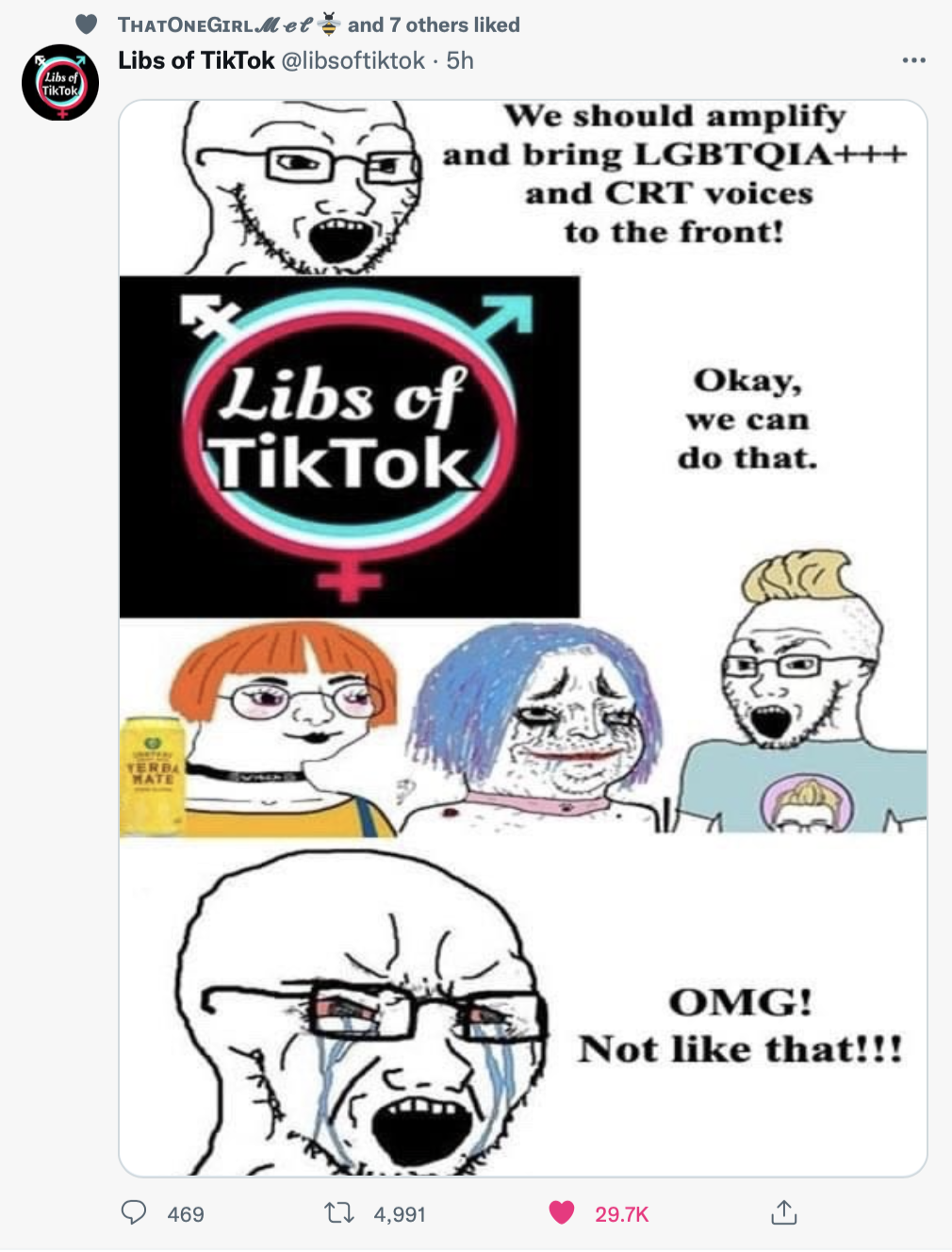
At Real Clear Politics, Batya Ungar-Sargon explains what really going on in the Washington Post's bizarre framing of the Twitter account @libsoftiktok. No, she explains, this is not about Americans trying to gang up on L's, G's, B's or most T's. Here is an excerpt.

The question is why. Why is the left folding in the issues of an extreme minority of transgender activists and teachers into the larger fight for gay rights – one that’s already been won?

It’s a similar case to what’s happened with the conversation of race. After winning the battle against real racism, the left moved the goalpost, redefining what counts as racism to the thing they most like to fight: the exposure of their own privilege.

That’s what’s happening here. A tiny elite that benefits politically and economically from portraying its opponents as bigots is using every tool at its disposal – social media, liberal legacy media, and executive action – to obfuscate the vast distance between their views and the vast majority of middle- and working-class Americans with normal views. Like the view that strangers shouldn’t teach toddlers how to masturbate.

Liberals had many major wins in the past 50 years. There was a time in the not-so-distant past when average Americans in either political party had little appetite for interracial marriage, let alone gay rights. But those days are long behind us. So why is the left pretending we are still in the midst of these fights? Because if you take away the issues that used to divide them from average Americans and no longer do, all you’re left with is what now divides them – the enormous economic, educational, and social capital that sustains the meritocratic liberal elite.

Here's what @libsoftiktok is actually doing: reposting bizarre tiktok videos made by teachers bragging about teaching things to children that are (rightfully) making many parents angry. These are simply completely undoctored reposts and not the tiktoc posters are being shamed for the things they are actually saying online. But they thought they would be left alone in their corner of the world, not thrust into the spotlight for all to see.

Continue ReadingThe Conflation Strategy of the Political Far Left

Keeping Your Company Out of the Culture Wars, Keep it Free to Pursue its Business Purpose

Jonathan Haidt and Greg Lukianoff wrote an article that offers real-world advice to corporations. They are addressing businesses that want to simply do business while avoiding moral dependency of the up and coming generation that includes many childlike adults who have been coddled all the way through life, including at their elite universities. Here are the first three suggestions list in How To Keep Your Corporation Out of the Culture War: Eight steps business leaders can take to prevent ideological pressure and political conformity in the workplace.

1. Expand your definition of diversity. While racial diversity and gender expression often dominate what people mean by diversity on campus, for a company trying to serve a diverse market in a fast-changing economic environment, having diversity of opinion, diversity of experience, and diversity of social class and geographic background can be even more important. In fact, the kind of diversity most often found to confer advantages on teams is not demographic diversity but rather diversity of perspectives on topics closely related to the task at hand. This includes both functional diversity (e.g., what roles people play in the company) and political diversity (at least when trying to find truth about politically controversial topics).

2. Reconsider what colleges you hire from. While elite colleges offer the promise of bright and hard-working employees, the problems we covered in our book are generally more severe at elite private colleges. You might want to consider hiring from large state schools, and ones from regions of the country other than the West Coast or Northeast. This will increase your diversity by social class and region, and it may help your organization avoid the elite college groupthink that seems to be damaging some organizations, potentially giving your organization a competitive advantage.

You might want to go still further and consider hiring people who have not attended college at all, if you can put in place standards that still guarantee hard-working employees with relevant skills. We believe that the numbers of bright, hard-working, and talented people choosing to skip college or to learn through a less traditional alternative will increase in the coming years, while the ability of elite college graduates to work well with those who do not share their beliefs will continue to decline.

3. Orientation: Be direct with candidates and new hires. If you decide that you want your organization to be politically neutral or self-consciously politically heterogeneous it’s a good idea to say so in job postings, and to introduce that idea to employees from their very first day. For example, you could state: “Our company’s culture is oriented toward success in our mission, which is [lay out business mission here]. We therefore do not take public stands on issues that are not central to our business mission. If you're not willing to work for such a company, or with people who disagree with you on some of your deepest beliefs, this might not be the right organization for you.”

Continue ReadingKeeping Your Company Out of the Culture Wars, Keep it Free to Pursue its Business Purpose