Never Forget How Many of them Told Lies about Covid Vax
Who lied to us about the Covid "vaccinations"? Everyone with a megaphone.
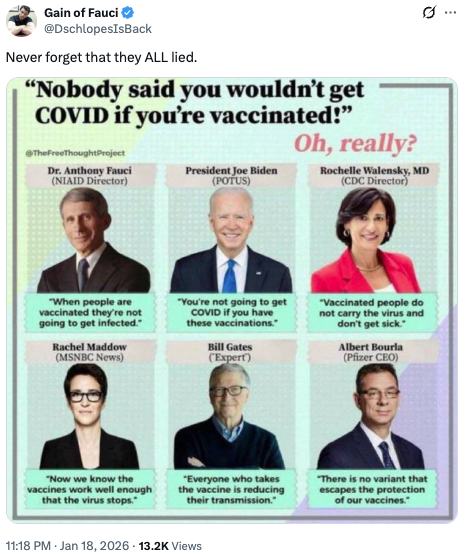

Who lied to us about the Covid "vaccinations"? Everyone with a megaphone.
Michael Shellenberger has warned European lawmakers about an effort by both Europeans and Americans to censor us all. I highly recommend his entire article and video. Excerpt from an article that is definitely not hyperbole: "Within Three Years, The Most Intolerant People On Earth Could Control The Internet."
What is the Censorship Industrial Complex? The model isn’t that complicated to understand. The government chooses people whom they call “researchers” to serve as censors. These are government-funded individuals who often come from the intelligence community and foreign policy establishment. They work at non-governmental organizations funded by governments or at universities funded by governments. They conduct “fact checks” to serve as “trusted flaggers.” These “trusted flaggers” demand censorship by social media platforms. It’s all done in secret.They’re looking to censor narratives. This is essential because, as decades of good cognitive science have shown, people understand and retain information through storytelling. We think in terms of stories, not bullet points. And so they were out to censor whole narratives. From the Stanford censorship project on COVID, the “Virality Project,” they said they wanted to censor “true stories” of vaccine side effects.
Why? Because it might “fuel hesitancy.” In other words, they want to control your behavior. They don’t want you to receive true information that might lead you to not get the vaccine.
If that isn’t totalitarianism straight out of 1984, I don’t know what it. These people were on the verge of passing legislation in the United States that would’ve authorized the National Science Foundation to choose these “researcher” censors.
I’m presenting slides to Europeans and the world for situational awareness into what totalitarian politicians and bureaucrats have planned because this is still going strong.
Stanford helped the US government censor COVID dissidents, and then they lied about it. You might be detecting a pattern. They’re really not interested in censoring “misinformation.’ They’re very interested in censoring true information.
The censors flagged an Israeli preprint which came out in December, 2020 and found, lo and behold, that natural immunity is a real thing. In fact, it’s more protective than the vaccine.
But the censors flagged somebody’s Google Drive. “See the following Google Drive links being used to compile testimonies about vaccine shedding, Covid videos, showing side effects and whatnot.” Google then removed that content from that person’s Google Drive. You don’t control your Google Drive.
Contrary to Stanford’s claim that the project did not ask social media platforms to remove any content, they privately said they did. And we know that many hundreds of thousands of tweets and Facebook posts were removed, even though they were a hundred percent accurate. In fact, in 2021, Stanford’s “Virality Project” flagged accurate claims that the World Health Organization did not recommend vaccinating children.
The people who spread the misinformation are the people demanding the censorship. They claimed Covid couldn’t have come from a lab, that the Covid vaccine prevented infection, and that natural immunity didn’t exist.
The only solution to hate speech and misinformation is free speech. If you censor false information, how would anybody get the true information? The whole point is the debate.
They lied when they said false information travels faster than true information. It’s a completely bogus study and involved six seconds of content on Twitter.
Who are these people? As of 2020, there were so many former FBI employees at Twitter that they called them “Bu alumni.” They created their own private Slack channel and a crib sheet to onboard new FBI arrivals.
Intriguingly, we discovered that the general counsel of the FBI — arguably the second most powerful person of the FBI, or maybe the first, if you think, consider that what their actual job is to decide what the FBI can and can’t do — resigned from FBI in early 2020 and went to Twitter to take the deputy general counsel role.
Isn’t that interesting? Somebody in one of the most powerful legal positions in the world would take a junior legal role at a social media company. Why would that be? ...
"It's easier to fool people than to convince them that they have been fooled."
[attributed to Mark Twain]
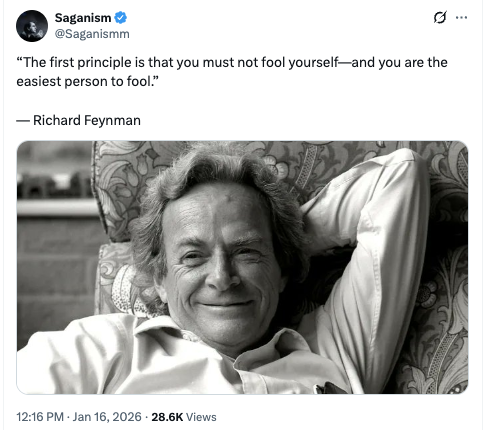
After seeing this quote by Richard Feynman, I posted the following on FB, where it seems like the great majority of people on my feed get aggravated with I post information that does not comport with mainstream news:
Many people on Facebook get their information primarily from corporate news (and from their friends who get their information primarily from corporate news). It is impossible to be a person with meaningful thoughts and opinions when all of one's information is pre-filtered by entities walking in lockstep. That is why many people on this site could not see with their own eyes and hear with their own ears that Joe Biden was mentally incompetent to run for president in 2024, at least not until corporate news and prominent Democrats did a sudden 180. This situation was long obvious to the rest of us, as was the fact that the DNC completely threw out its rulebook in anointing Kamala Harris (refusing to allow any democratic input). I could give hundreds of other shocking examples of these 180s over the past 5 years.
There is only one solution to this danger, this blindness: One needs to read and listen carefully to people with whom one disagrees, giving these "disagreeable" people their best foot forward. When you do this for awhile, your entire perspective will loosened up and you will understand that minority viewpoints are often worthwhile to inputs to understanding of the world. Only then will you be in charge of your own thoughts and beliefs. And only then will you see the extent to which earnestly expressing opinions against the grain requires some courage.
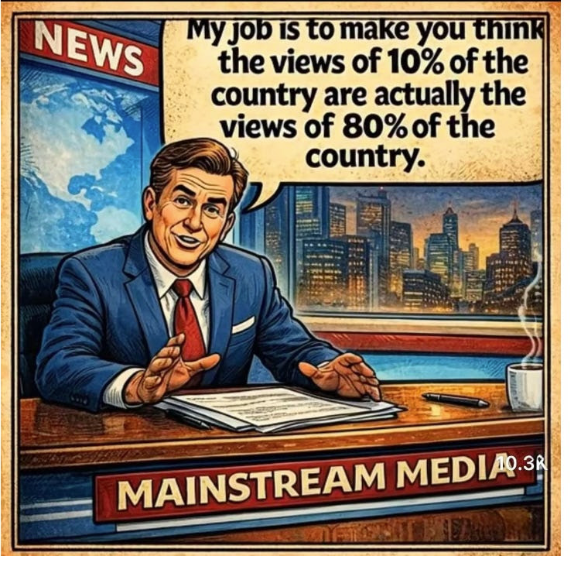
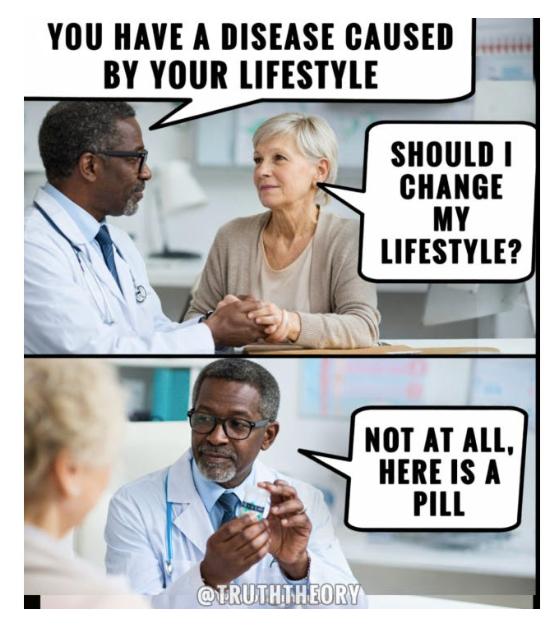
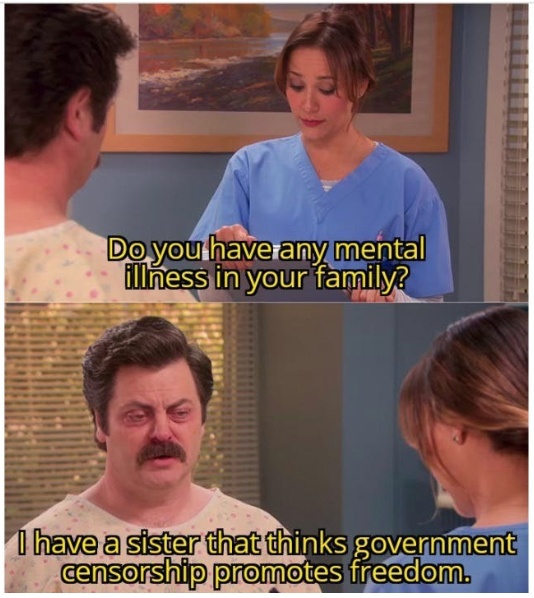
I subscribe to Robert Malone's Substack. I especially enjoy his cartoons/memes. Here's a few from today's newsletter.
What should Colleges teach? Steven Pinker offers this approach:
I don't think it's that difficult to outline a positive vision for higher education, something that neither legacy universities nor UATX have been able to do. Here's my own attempt (from my New Republic essay "The Trouble with Harvard https://newrepublic.com/article/119321/harvard-ivy-league-should-judge-students-standardized-tests):
"It seems to me that educated people should know something about the 13-billion-year prehistory of our species and the basic laws governing the physical and living world, including our bodies and brains. They should grasp the timeline of human history from the dawn of agriculture to the present. They should be exposed to the diversity of human cultures, and the major systems of belief and value with which they have made sense of their lives. They should know about the formative events in human history, including the blunders we can hope not to repeat. They should understand the principles behind democratic governance and the rule of law. They should know how to appreciate works of fiction and art as sources of aesthetic pleasure and as impetuses to reflect on the human condition.
On top of this knowledge, a liberal education should make certain habits of rationality second nature. Educated people should be able to express complex ideas in clear writing and speech. They should appreciate that objective knowledge is a precious commodity, and know how to distinguish vetted fact from superstition, rumor, and unexamined conventional wisdom. They should know how to reason logically and statistically, avoiding the fallacies and biases to which the untutored human mind is vulnerable. They should think causally rather than magically, and know what it takes to distinguish causation from correlation and coincidence. They should be acutely aware of human fallibility, most notably their own, and appreciate that people who disagree with them are not stupid or evil. Accordingly, they should appreciate the value of trying to change minds by persuasion rather than intimidation or demagoguery."