
The Woking Class

I know this sounds overbroad and over-ambitious, but I would like to know what the loudest members of the Woke have ever done in their lives to alleviate suffering of others. I know people who actually pour their life energies into helping desperate people survive. I don't see any such benefit resulting from Woke ideology. I see a lot of young people with lots of energy and frustration. How many of these idealistic people have ever worked a job where they need to fix something physical? How many have ever worked a job where they served a customer well? Yet they claim that they know how to burn down our entire political/economic system without any meaningful blueprint of what happens next.

Is that why so many of them spend so much time digitally grooming themselves on social media? And, BTW, the people who have spent a lot of time providing valuable goods and services to others are working class Americans who do seek community with other Americans, who value a hard day's work and who have been abandoned by the modern Democratic Party.
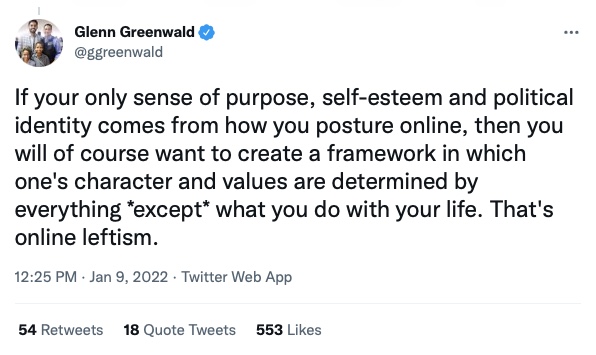
Glenn Greenwald:

If your only sense of purpose, self-esteem and political identity comes from how you posture online, then you will of course want to create a framework in which one's character and values are determined by everything *except* what you do with your life. That's online leftism.

Consider the recent work of Batya Ungar-Sargon:

We are hiding a class divide in America," she said. "We are hiding disgusting levels of income inequality in America. We are hiding the total dispossession of the working class of all races by focusing on a very highly specialized academic language about race.
Continue ReadingThe Woking Class

Richard Dawkins: Race is on a Spectrum, Sex is “Pretty Damn Binary.”

Richard Dawkins answers the "dangerous" question he asked in April 2021, the question that caused him to be disowned by the American Humanist Association. The title to his article at Areo: "Race Is a Spectrum. Sex Is Pretty Damn Binary."

Were race not a spectrum, Rachel Dolezal’s critics should have spotted that she wasn’t “really” black, simply by taking one look at her. It’s precisely because black Americans are a spectrum that it wasn’t obvious. With negligible exceptions, on the other hand, you can unwaveringly identify a person’s sex at a glance, especially if they remove their clothes. Sex is pretty damn binary.

If I chose to identify as a hippopotamus, you would rightly say I was being ridiculous. The claim is too facetiously at variance with reality. It’s marginally more ridiculous than the Church’s Aristotelian casuistry in identifying the “substance” of blood with wine and body with bread, while the “accidentals” safely remain an alcoholic beverage and a wafer. Not at all ridiculous, however, was James Morris’s choice to identify as a woman and his gruelling and costly transition to Jan Morris. Her explanation, in Conundrum, of how she always felt like a woman trapped in a man’s body is eloquent and moving. It rings agonizingly true and earns our deep sympathy. We rightly address her with feminine pronouns, and treat her as a woman in social interactions. We should do the same with others in her situation, honest and decent people who have wrestled all their lives with the distressing condition known as gender dysphoria.

Sex transition is an arduous revolution—physiological, anatomical, social, personal and familial—not to be undertaken lightly. I doubt that Jan Morris would have had much time for a man who simply flings on a frock and announces, “I am now a woman.” For Dr Morris, it was a ten-year odyssey. Prolonged hormone treatment, drastic surgery, readjustment of social conventions and personal relationships—those who take this plunge earn our deep respect for that very reason. And why is it so onerous and drastic, courageously worthy of such respect? Precisely because sex is so damn binary! Changing sex is a big deal. Changing the race by which you identify is a doddle in comparison, precisely because race is already a continuous spectrum, rendered so by widespread intermarriage over many generations.

Continue ReadingRichard Dawkins: Race is on a Spectrum, Sex is “Pretty Damn Binary.”

The Re-Emergence of Politically Correct Culture on Campus

Greg Lukianoff (President of FIRE and co-author with Jonathan Haidt of "The Coddling of the American Mind") is delivering the bad news: Politically Correct culture went underground where it gained substantial followings and it has now re-emerged, led by an army of college administrators, many of whom come from colleges of education.  His article includes a lot of doom and gloom, but also offers hope. The title to Lukianoff's article at Reason is "The Second Great Age of Political Correctness: The P.C. culture of the '80s and '90s didn't decline and fall. It just went underground. Now it's back."

Amid the Second Great Age of Political Correctness, American higher education has become too expensive, too illiberal, and too conformist. It has descended into a period of profound crisis wrought by shifts in hiring, student development, and politically charged speech codes developed during the Ignored Years, when too few were paying attention. American campuses should be bastions of free expression and academic freedom. Instead, both are in decline. We cannot afford to just give up on higher ed. College and university presidents can and should do the following five things:

1. Immediately dump all speech codes.

2. Adopt a statement specifically identifying free speech as essential to the core purpose of a university and committing the university to free speech values.

3. Defend the free speech rights of their students and faculty loudly, clearly, and early.

4. Teach free speech, the philosophy of free inquiry, and academic freedom from Day One.

5. Collect data and open their campuses to research on the climate for debate, discussion, and dissent.

Those who donate to colleges should refuse to do so without demanding these changes.

Continue ReadingThe Re-Emergence of Politically Correct Culture on Campus

What it Means to Identify as . . .

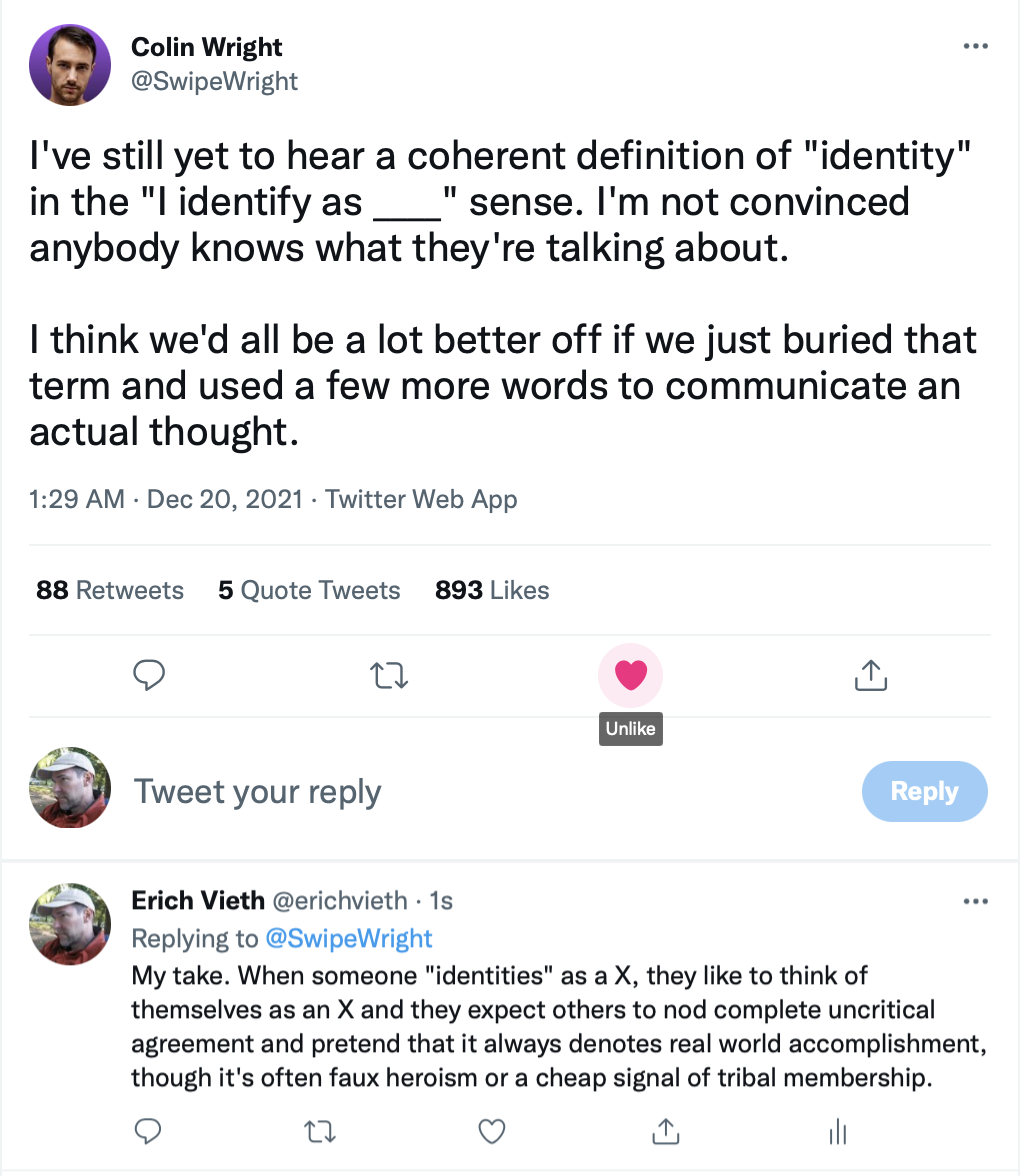
I'm trying to work through this concept of "Identify." What does it mean to "identify" as something? I noticed Colin Wright asking the same question:

Colin Wright:

I've still yet to hear a coherent definition of "identity" in the "I identify as ____" sense. I'm not convinced anybody knows what they're talking about. I think we'd all be a lot better off if we just buried that term and used a few more words to communicate an actual thought.

--

I'm an atheist. I don't "identify" as an atheist, I simply am one because I don't believe in God. I'm a biologist. I don't "identify" as a biologist, I simply am one because that's what I studied. I am straight. I don't "identify" as straight, I am simply attracted to females.

Where does "identity" come into it? Is it just the sum total of my experiences, behavioral tendencies, personality, beliefs, likes & dislikes? Well that seems infinitely complex and impossible to label.

"Identity" seems entirely meaningless and unnecessary. What am I missing?

Erich Vieth: [This is a work in progress.]

My take. When someone "identities" as a X, they like to think of themselves as an X and they expect others to nod complete uncritical agreement and pretend that it always denotes real world accomplishment, though it's often faux heroism or a cheap signal of tribal membership.

Continue ReadingWhat it Means to Identify as . . .

Violence Denialism Rampant in Philadelphia

Ray Arora reports the spiking numbers in Philadelphia crime and the urge to "fix" this problem by denying it. Arora's article appears at Glenn Loury's Substack:

Last week, Philadelphia district attorney Larry Krasner, a prominent criminal justice reform advocate, generated blistering backlash after explicitly dismissing the recent explosion of violent crime in his city:

“We don’t have a crisis of lawlessness, we don’t have a crisis of crime, we don’t have a crisis of violence,” the district attorney told reporters at a Monday press conference when asked if tourists are safe to travel to Philadelphia for the holidays. “It’s important that we don’t let this become mushy and bleed into the notion that there is some kind of big spike in crime.”

The crime stats tell a different story. As of Saturday night, the city tallied 535 homicides, shattering its record 500 homicides set in 1990, the height of the crack epidemic. This summer, the city reached another grim milestone: Philadelphia had the highest murder rate per capita of the country’s 10 largest cities.

Though progressive politicians dismiss growing crime concerns as right-wing “hysteria,” the homicide toll is nearly impossible to exaggerate. More people have died by homicide in Philadelphia in 2021 than in 2014 (248) and 2015 (280) combined. Moreover, the racial inequality in homicide victimization is striking: though black Americans comprise only 41.5% of Philadelphia’s population, they account for 85% of the city’s homicide victims.

Continue ReadingViolence Denialism Rampant in Philadelphia