About Personal Sovereignty

I found these ideas useful. There are about 8 frames here. Many of ideas boil down to making sure you don't put too much stock in what others think about you. Otherwise, you'll be controlled by others. There's a caveat, of course. If you are surrounded by people you highly respect and they are all telling you you're making a mistake, it's time to pause and consider the things they are telling you.

THE ARCHITECTURE OF IMMUNITY: 8 SIGNS YOU CANNOT BE CONTROLLED (THREAD)

The Illusion of Independence

You believe you are a free thinker. That delusion is precisely what makes you easy to conquer. The modern liberal apparatus does not need to force you into submission when it can simply trick you into believing their thoughts are your own. Influence does not announce itself. It operates in the shadows of your unchecked emotions. Most people spend their entire lives reacting to manipulation they mistake for their own thoughts. They believe they are independent, but independence is not a feeling. It is a structure. If you do not possess the psychological fortifications to repel the mob, you are already under their control. This is not about confidence. It is about dominance. There are eight specific markers that separate the sovereign mind from the useful idiot.


Continue ReadingAbout Personal Sovereignty

Why Do Western Liberals Ignore the Uprising in Iran?

Fardad Farahzad proposes this:

The Iranian uprising has become an awkward dilemma for much of the left. It is openly pro-Western, unapologetically secular, and explicitly hostile to political Islam. There is no favored “exotic victim” to romanticize, no anti-American slogans to recycle, no colonial guilt to put to use and for that very reason, exposes how selective so many proclaimed solidarities really are.

Continue ReadingWhy Do Western Liberals Ignore the Uprising in Iran?

Vaccines Arrived Only After the Massive Drop in Many Diseases

This chart should be mandatory viewing for anyone wanting to debate whether any vaccines should be mandatory.

Roman Bystrianyk, Coauthor of Dissolving Illusions alongside Suzanne Humphries, MD:

The common belief that the decline in infectious disease deaths is due to modern medicine, like antibiotics and vaccines, is incorrect. The vast majority of the decline, particularly in the early 19th and 20th centuries, preceded these medical ideas.

Three key developments drove the earlier progress:

1. The rise of robust public health infrastructure, including engineered sanitation and sewer systems, protected municipal water supplies with filtration and chlorination, systematic garbage collection, early measures to control water and industrial air pollution, food safety regulations (e.g., meat inspection), and vector control (e.g., mosquito reduction).

2. Profound improvements in personal and socioeconomic well-being, such as vastly improved nutrition and increased dietary diversity, rising wages, less crowded housing with better ventilation (which increased exposure to sunlight and thus vitamin D production), the enactment of protective child and adult labor laws, public education, and greater public personal hygiene.

3. The abandonment of harmful medical practices, including treatments with mercury, arsenic, and strychnine, bloodletting and purging, and the “hot regimen,” cleared the way for more supportive care. Data strongly support the pivotal role of public health infrastructure. Research indicates that nearly 90% of the decline in infectious disease mortality among American children occurred between 1900 and 1940, a period before the widespread availability of antibiotics and most vaccines. A parallel, even steeper decline—over 98%—was observed in England and Wales, underscoring that this was a widespread phenomenon driven by societal factors rather than specific medical interventions (and in fact far fewer medical interventions).

...nearly 90% of the decline in infectious disease mortality among US children occurred [from 1900] before 1940, when few antibiotics or vaccines were available.

[“Annual Summary of Vital Statistics: Trends in the Health of Americans During the 20th Century,” Pediatrics, December 2000, pp. 1307-1317.]

Continue ReadingVaccines Arrived Only After the Massive Drop in Many Diseases

Men’s Jobs and Women’s Jobs

Steve Stewart-Williams reports on a new study confirming what many of us intuit:

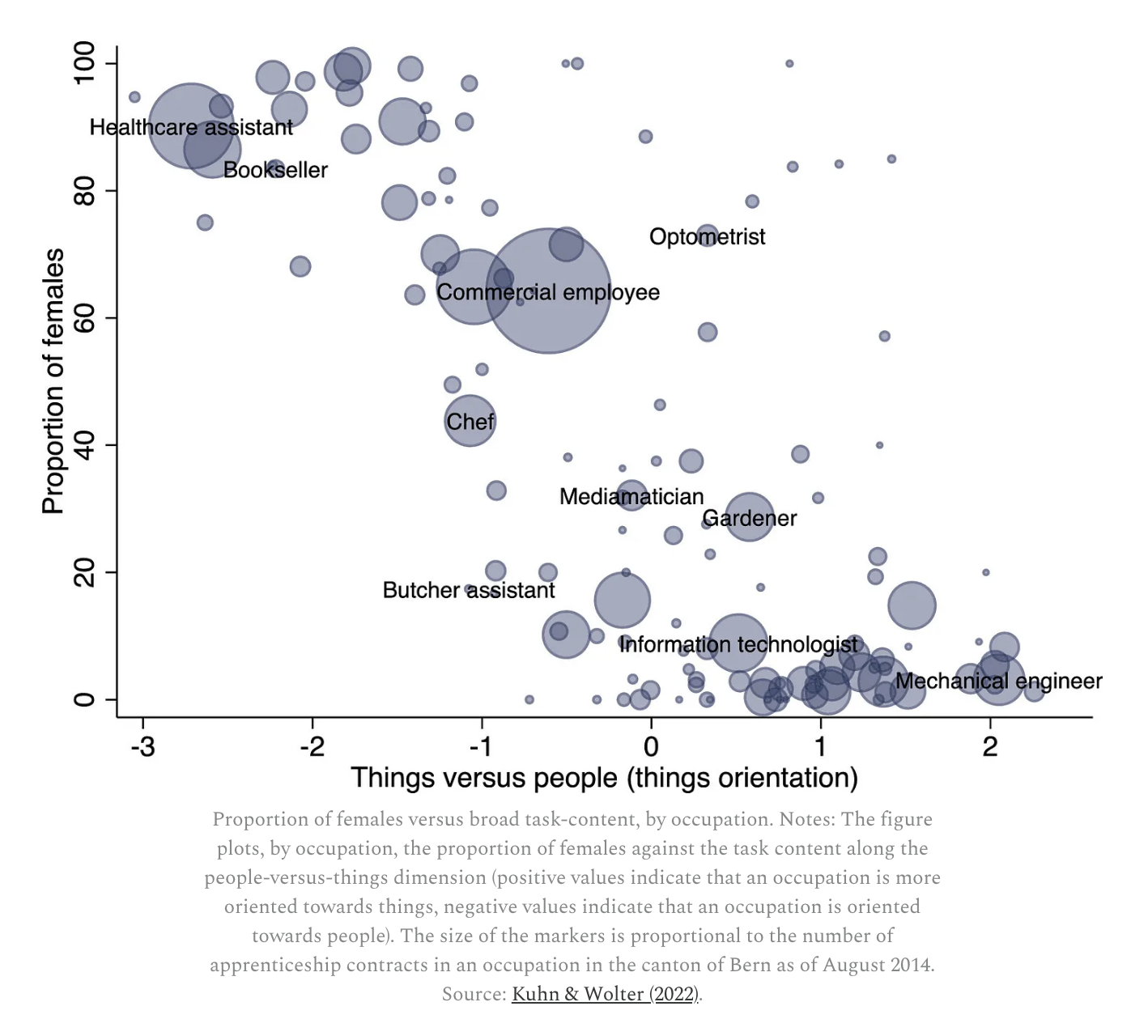
One of the most robust findings in psychology is that men and women have somewhat different career-related interests: On average, men are more interested in working with things, whereas women are more interested in working with people. A fascinating analysis of the apprenticeship system in Switzerland shows how these preferences help shape young people’s real-world occupational choices.

The study examined 130 apprentice occupations, dividing these into jobs involving machines, materials, and tools sat at one end; jobs involving care, communication, and social interaction sat at the other.

The results are shown in the graph below. As you can see, the more people-oriented a profession is, the more female-dominated it tends to be, and the more things-oriented it is, the more male-dominated. The effect is extremely strong, making the things-people dimension one of the most powerful known predictors of occupational sex differences.

I highly recommend Steve's "The Nature-Nurture-Nietzsche Newsletter." He is always responsibly reporting on scientifically-grounded topics that are highly relevant to issues of the day.

Continue ReadingMen’s Jobs and Women’s Jobs