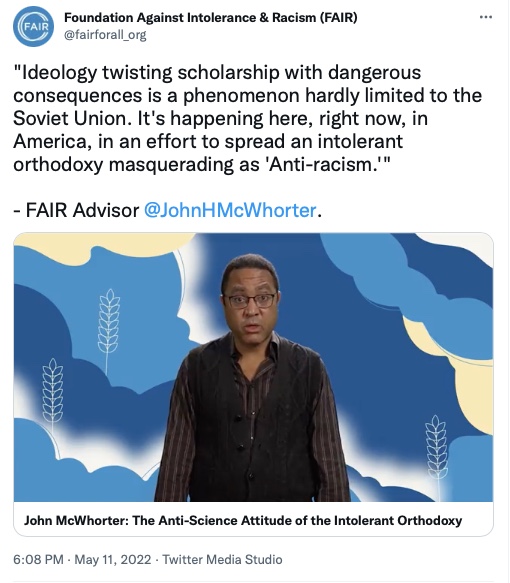
Woke Racism, Where Ideology Defeats Science

John McWhorter of the Foundation Against Intolerance and Racism (FAIR) warns us that four of the mainstays of Woke Anti-racism are long on ideology and short on scientific validity:

- Microaggressions - Diversity Equity & Inclusion Departments - Implicit Bias Testing - Systemic Racism

Ideology twisting scholarship with dangerous consequences is a phenomenon hardly limited to the Soviet Union. It's happening here, right now, in America, in an effort to spread an intolerant orthodoxy masquerading as 'Anti-racism.'

Continue ReadingWoke Racism, Where Ideology Defeats Science

Kathleen Stock Dissects “The Family Sex Show” and its Enablers

Kathleen Stock does a deep dive here. What is driving this behavior? Fascinating and disturbing on many levels. And yes, I also wondered whether any of these people have children. An excerpt:

This week a story broke in the UK about a forthcoming theatre production, to be aimed at five-year-olds and older. The somewhat surprising title of this venture was The Family Sex Show. The theatre company responsible had impeccable-looking credentials, with breathless reviews and several awards for earlier productions. This new project, originally commissioned under the auspices of a Leverhulme Arts Scholarship, had been funded to the tune of £82,784 via two separate project grants from Arts Council England, and was developed in a number of prestigious venues including Battersea Arts Centre, the National Theatre, the Southbank Centre, and Theatre Royal Bath. The show’s mission, as described on the associated website, was to provide:
a fun and silly performance about the painfully AWKWARD subject of sex, exploring names and functions, boundaries, consent, pleasure, queerness, sex, gender and relationships.

. . .

Back in reality, there’s only so long that progressives can carry on pretending that the only possible objections to things like The Family Sex Show must come from prudes who don’t like sex, or bigots who don’t like queer people. Supercharged by the internet, contemporary sexual culture is spiralling off a cliff and taking a lot of young people with it, and increasingly large numbers of ordinary parents and teachers are finding this objectionable for very good reason. Some of these even vote Labour - or would do, if they could get a clear sign from their party that it’s prepared to make a distinction in public between its own position and “what Owen Jones thinks is OK”. If it can’t do this, it faces problems at the ballot box. Meanwhile, since nobody votes Arts Council members in or out, for theatre-goers there are still many long evenings ahead, sitting on uncomfortable chairs and watching white people with interesting haircuts talk earnestly about squirting.

Continue ReadingKathleen Stock Dissects “The Family Sex Show” and its Enablers

Michael Lind: The Far Left is Brain Dead thanks to its Funders and Enablers

Excerpt from Michael Lind's new article at Tablet: "The End of Progressive Intellectual LifeHow the foundation-NGO complex quashed innovative thinking and open debate, first on the American right and now on the center left."

If you are an intelligent and thoughtful young American, you cannot be a progressive public intellectual today, any more than you can be a cavalry officer or a silent movie star. That’s because, in the third decade of the 21st century, intellectual life on the American center left is dead. Debate has been replaced by compulsory assent and ideas have been replaced by slogans that can be recited but not questioned: Black Lives Matter, Green Transition, Trans Women Are Women, 1619, Defund the Police. The space to the left-of-center that was once filled with magazines and organizations devoted to what Diana Trilling called the “life of significant contention” is now filled by the ritualized gobbledygook of foundation-funded, single-issue nonprofits like a pond choked by weeds. Having crowded out dissent and debate, the nonprofit industrial complex—Progressivism Inc.—taints the Democratic Party by association with its bizarre obsessions and contributes to Democratic electoral defeats, like the one that appears to be imminent this fall.

...

Unlike academics who recite the approved current center-left positions on all issues, genuine intellectuals, even if they happen to be employed by universities, are unpredictable. Often they are unpopular, because they criticize their own allies and appreciate what other schools of thought get right. They do not indulge in contrarianism for its own sake but tend to be controversial, because they put loyalty to what they consider to be truth above party or faction. Needless to say, such intellectual mavericks tend to perform quite poorly when it comes to the boot-licking, rote repetition of political slogans, acronym-juggling, groupthink, and “donor servicing” that constitute the forms of intellectual activity favored by big foundations and NGOs, whether of the right or of the left.

Continue ReadingMichael Lind: The Far Left is Brain Dead thanks to its Funders and Enablers

How to Be a Human Animal, Chapter 27: The Exaggerated Benefits of Moral Rules

This is Chapter 27 of my advice to a hypothetical baby. I'm using this website to act out my time-travel fantasy of going back give myself pointers on how to avoid some of Life’s potholes. If I only knew what I now know . . . All of these chapters (soon to be 100) can be found here.

Today I’m here to warn you to watch out for those who cast about moral rules when they try to get you to obey them. Our most popular moral rules include these:

  • The Golden Rule
  • Utilitarianism
  • The Categorical Imperative

These rules do a very bad job of telling you what to do with your life. They don't even do a good job of telling you what to do next.

Let’s assume that you are Hitler trying tact in accordance with any of these rules. Imagine Hitler hearing about the Golden Rule of “Do Unto Others” at the peak of his tyrannical reign. Sure, he would think. “If I were any other intelligent person, then I would want me to run Germany exactly how I am running Germany!” If you think that Hitler would be applying the rule incorrectly, he would disagree. Further, there are no rules on how to apply the Golden Rule.

Utilitarianism has the same problem. It rule requires you to maximize well being by doing the thing that is the greatest good for the greatest number. Hitler would say: “I’m doing everything I can to bring the greatest good to the greatest number! You won’t believe how good this empire will be when I’m finished building it.” Again, you might disagree with Hitler here, but the way you apply utilitarianism depends on how you define “good,” and even reasonable people disagree intensely about what is “good.” Even massively dysfunctional and dangerous people like Hitler think they know what it means to be "good."

Kant’s Categorical Imperative demands that we take the maxim by which we propose to act and ask ourselves whether we could make that maxim a universally applicable maxim. Hitler would say that he was doing great things for Germany so, absolutely yes, everyone should act in accordance Hitler’s personal maxims of conduct. BTW, Kant famously declared that a proper maxim is to refrain from lying. He concluded that if a madman with a weapon asked you to tell him where your friend was (so he could kill him), you should not lie.

I'm not done kicking around our simplistic moral rules. People cavalierly state that we need to properly “apply” our moral rules as though “applying is a simple action akin to "applying" a band aid to a paper cut. It's clearly not that simple. There are many ways for people to consciously (and unconsciously) interpret our simple moral rules. They must:

• Decide what particular words of rule means.

• Distinguish the connotation from the denotation.

• Decide whether to read the rule narrowly or broadly.

• Decide whether the rule is persuasive and thus applicable in this particular case.

The bottom line is that our moral rules are hopelessly vague. They would never pass Constitutional muster. “Your Honor, we have alleged that the Defendant failed to act in such a way to result in the greatest good for the greatest number.” Although such a rule would tell us that we shouldn't set a forest on fire because we are bored and cold, we already knew that without the rule. [More . . . ]

Continue ReadingHow to Be a Human Animal, Chapter 27: The Exaggerated Benefits of Moral Rules

How to Be a Human Animal, Chapter 15: The Danger of Empathy: Exhibit A: The Coddling of Children

Chapter 15: The Danger of Empathy: Exhibit A: The Coddling of Children.

I’m back again to preach to you ad nauseum today, hypothetical newborn baby! I'm here once again to teach you some of the many Life Lessons I was forced to learn at the School of Hard Knocks. My intentions are honorable. I’m here to spare you some suffering, but based on today’s topic I am concerned that you might be better off leaning these lessons on your own, much as I did. BTW, you can find all fifteen lessons in one easy link.

You were born into a complex adaptive system. Yes, you do have exquisite powers of perception and memory but they are often no match for the complexity of your environment. Hence, the law of unintended consequences: You will often find that your well-intended actions will result in outcomes that are not the ones you intended or foresaw. The result will often be disappointing. We have a saying, “No good deed goes unpunished.” Sometimes, though, you do something and it turns out wildly better than you could ever have hoped. When that happens, you might be tempted to claim that you knew it all along, but that would often be an illustration of the “hindsight bias.” https://en.wikipedia.org/wiki/Hindsight_bias

To illustrate how things can go unexpectedly awry, I will start by referring to the work of Paul Bloom, who wrote a 2016 book titled: Against Empathy: The Case for Rational Compassion. He defines “empathy” as follows: “Empathy is the act of coming to experience the world as you think someone else does." He further describes empathy as "a spotlight directing attention and aid to where it's needed."  According to Bloom, empathy is an emotion, not a good tool for moral decision-making. “Compassion,” on the other hand, is feeling concern or compassion for someone. Bloom contrasts empathy with "rational compassion," which can productively be used to “make decisions based on considerations of cost and benefits." Empathy, by contrast, has no such protective limitations, meaning that empathy often leads to ill-considered policies. [More . . . ]

Continue ReadingHow to Be a Human Animal, Chapter 15: The Danger of Empathy: Exhibit A: The Coddling of Children