How to Deal with Tantrums

And yes, I consider many of the claims of the Woke crowd to nothing more than tantrums. They certainly are not invitations for discussion, including a discussion focusing on the meaning of the terms used.
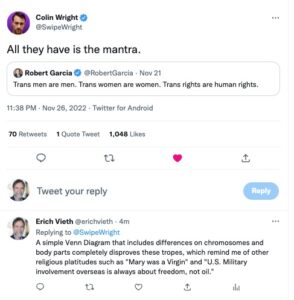

And yes, I consider many of the claims of the Woke crowd to nothing more than tantrums. They certainly are not invitations for discussion, including a discussion focusing on the meaning of the terms used.
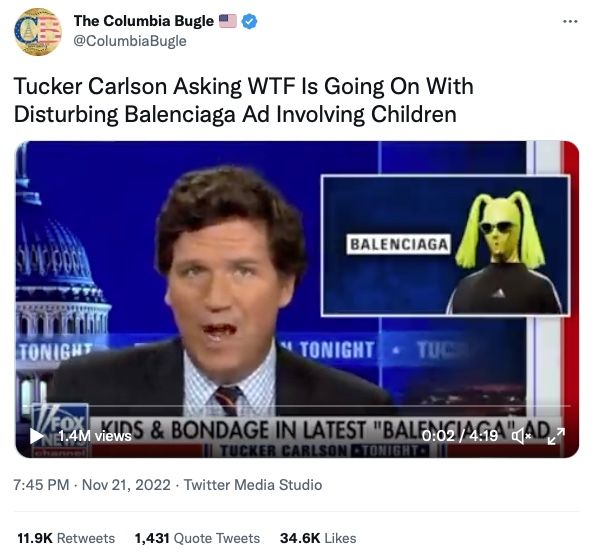
Consider first, Tucker Carlson's report on Balenciaga:
Now consider this thread by Shoe:

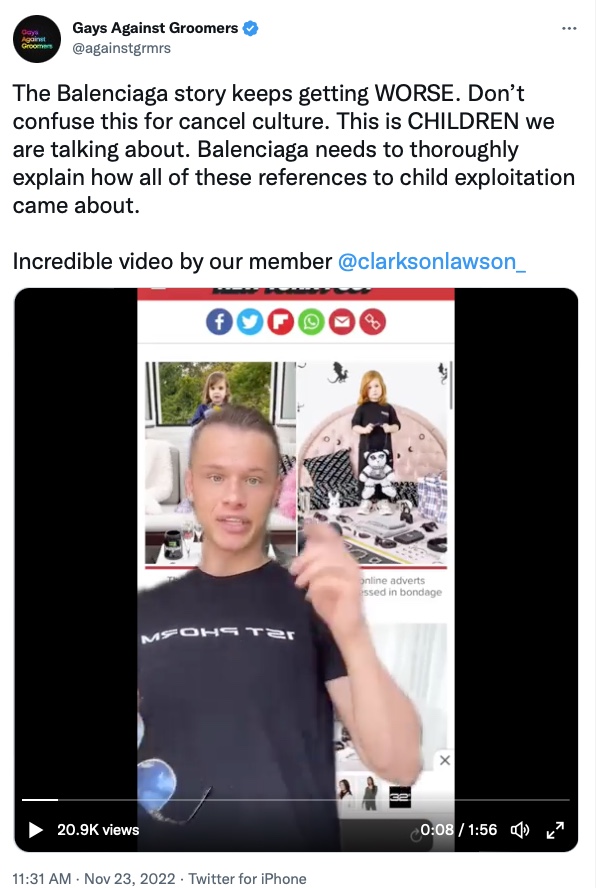
Gays Against Groomers adds this commentary.
There is only one conclusion to draw regarding Balenciaga.
Balenziaga's conduct is odious and I agree with Tucker Carlson that the left-leaning legacy media's silence is also odious. This is not a close call. I write this as the father of two daughters. I also write this as someone who has LONG been against the sexualization of children. And see here and here.
Billboard Chris recommends that we give up on the word "gender." I agree. At its worst, it is an invitation to engage in old and reprehensible stereotypes (because girls who like to play with trucks are 100% girls). At its best, it is a meaningless word. At one point it was a polite way to avoid saying "sex."
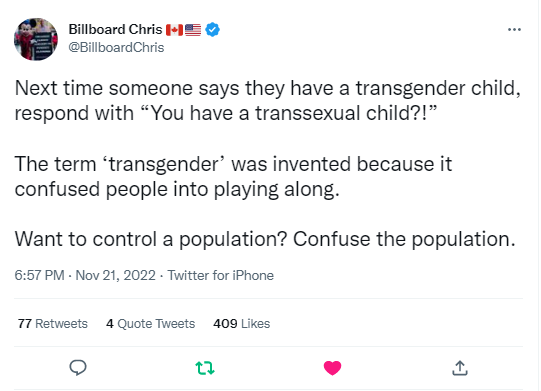
By returning to "transexual," we recognize that there are only two sexes and that a person of one sex is presenting as the other. It is not a pejorative. It is recognizing some basic fact. Everyone out there, including people with sexual dysphoria who present themselves as the opposite sex, deserve kindness, respect and full legal rights as a person. Therefore, using "transexual" is truly not an insult. The benefit of using "transexual" is that we are recognizing basic biology and avoiding massive confusion associated with gender ideology. What confusion, you might ask? How about this chart published by (believe it or not) Scientific American.
Two years ago I was scolded and told it was impolite, but I now disagree. I'm imagining the conversation when I start using transexual again. It will probably come down to a discussion (probably an argument) about who has the final say over how we use words. I'll see how it goes.
Zach Elliot is an author of two books on sex and gender and a producer of 20+ animated videos on sex differences. Here is the intro to his article: "What Are Sexes? There is much confusion in our current culture as to what sexes are and what they are not."
There is much confusion in our current culture as to what sexes are and what they are not. When biologists make a claim about the number of sexes in a species, they are not making a claim about chromosomes, body types, or personal identity; rather, they are making a claim about the number of distinct reproductive strategies in that species.
A reproductive strategy is an evolved system for propagating genes and forming a new individual. In sexually reproducing species, producing a new individual requires the combination of at least two distinct and complementary reproductive strategies. These strategies are fulfilled through the delivery of genetic material in sex cells called gametes, which have half the genetic material of the parent. When two gametes fuse, they form a genetically unique individual with a full set of chromosomes.
Some species reproduce through gametes of the same size (isogamy) and can have many unique reproductive strategies called mating types, which control what gametes can fuse with one another, but their differences do not go far beyond the molecular level. On the other hand, most species in the plant and animal kingdoms reproduce through gametes of differing size and form (anisogamy), where there is an asymmetry in size and behavior between the interacting gametes and often the individual organisms themselves.
When gamete sizes are differentiated (anisogamy), there are typically exactly two sexes, no more and no less. In such systems, the reproductive strategy that produces the smaller gametes is designated as male and the reproductive strategy that produces the larger gametes is designated as female. It is not the physical size of the gametes themselves that differentiates the male and female reproductive strategies, but rather what those size differences represent.
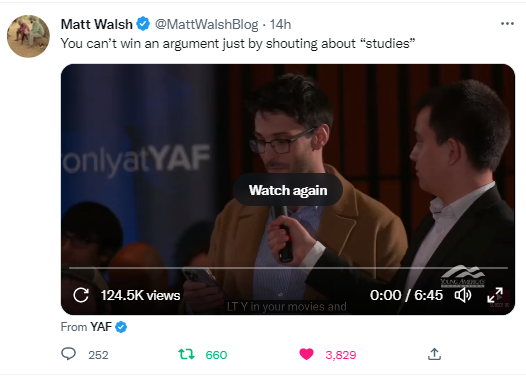
Matt Walsh discusses transgender "studies" with a member of the audience.