Implicit Bias Efficacy Meta-Analysis

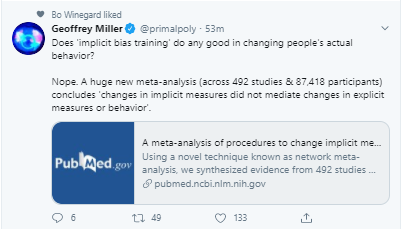
Here's the link to the journal article.  The abstract:

Using a novel technique known as network meta-analysis, we synthesized evidence from 492 studies (87,418 participants) to investigate the effectiveness of procedures in changing implicit measures, which we define as response biases on implicit tasks. We also evaluated these procedures' effects on explicit and behavioral measures. We found that implicit measures can be changed, but effects are often relatively weak (|ds| < .30). Most studies focused on producing short-term changes with brief, single-session manipulations. Procedures that associate sets of concepts, invoke goals or motivations, or tax mental resources changed implicit measures the most, whereas procedures that induced threat, affirmation, or specific moods/emotions changed implicit measures the least. Bias tests suggested that implicit effects could be inflated relative to their true population values. Procedures changed explicit measures less consistently and to a smaller degree than implicit measures and generally produced trivial changes in behavior. Finally, changes in implicit measures did not mediate changes in explicit measures or behavior. Our findings suggest that changes in implicit measures are possible, but those changes do not necessarily translate into changes in explicit measures or behavior. (PsycINFO Database Record (c) 2019 APA, all rights reserved).

Continue ReadingImplicit Bias Efficacy Meta-Analysis

Sam Harris Explores the Global Epidemic of Child Sexual Abuse

In his introduction to "The Worst Epidemic," Sam Harris warns that the subject matter might be difficult for listeners. The topic is the global epidemic of child sexual abuse involving children as young as one year old. Sam is joined by Gabriel Dance, a NYT reporter who has thoroughly investigated this issue. Until I forced myself to listen, I had assumed that this predatory behavior was relatively rare, but I was shocked to learn that sexual predators have exploited every corner of the Internet. To illustrate, Dance mentions that law enforcement experts estimate that of the 9 million citizens of New Jersey, 400,000 have been exposed to these highly illegal images and videos, some of this exposure being inadvertent, but much of it being intentional. It makes you wonder who we are, as a nation, that so many among us are willing to torture children. The tragedy is widespread, making the technical challenges and law enforcement needs overwhelming.

As a public service, Sam has put this episode in front of his paywall. The topic spirals in many directions, including the misleading concept of “child pornography,” the failure of governments and tech companies to grapple with the problem, the tradeoff between online privacy and protecting children, the National Center for Missing and Exploited Children, photo DNA, the roles played by specific tech companies, the ethics of encryption, “sextortion,” and the culture of pedophiles.

I am proud to say that I have been a paid subscriber of Making Sense for years. Sam Harris does a great job of exploring complex and oftentimes thorny issues unflinchingly, week after week.  From Sam's About Page:

His writing and public lectures cover a wide range of topics—neuroscience, moral philosophy, religion, meditation practice, human violence, rationality—but generally focus on how a growing understanding of ourselves and the world is changing our sense of how we should live.

If you are unfamiliar with the work of Sam Harris, I invite you to listen to this Episode, or any Episodes of Making Sense.

Continue ReadingSam Harris Explores the Global Epidemic of Child Sexual Abuse

Evolutionary Psychologist Diana Fleischman Begins a New Blog at Psychology Today: “How to Train Your Boyfriend”

I've followed Diana Fleischman's work for many months. She's smart and funny, but takes her evolutionary psychology seriously every step of the way. Diana has started writing a column on Psychology Today titled, "How to Train Your Boyfriend." Here an excerpt from her opening post:

You have two grandmothers, four great grandmothers, 512 great-great-great-great-great-great-great-great-grandmothers and millions of grandmas further in your past, before the word grandma even existed. These grandmas that scraped by, suffered, and survived long enough to reproduce, are only a fraction of all the women that existed. One important characteristic that set grandmas apart from the millions of non-grandmas was their ability to shape the behavior of others, especially children and grandpas. You probably have grandmas who lived on farms trying to get multiple children to cooperate with (and not kill) one another and in villages where they had to manage their reputations for the good of their families. But you definitely have grandmas who convinced men to take care of them and their children. Without any one of them, and their abilities you wouldn’t exist to read this blog. We evolved to be able to get other people to do what we want.

But, how do people get other people to do what they want?

Continue ReadingEvolutionary Psychologist Diana Fleischman Begins a New Blog at Psychology Today: “How to Train Your Boyfriend”

A Quadruple Whammy That Results in Facebook Barking

Here's the quadruple whammy:

A) Confirmation Bias, B) Availability Heuristic and C) the Focussing Illusion and D) In-group loyalties.

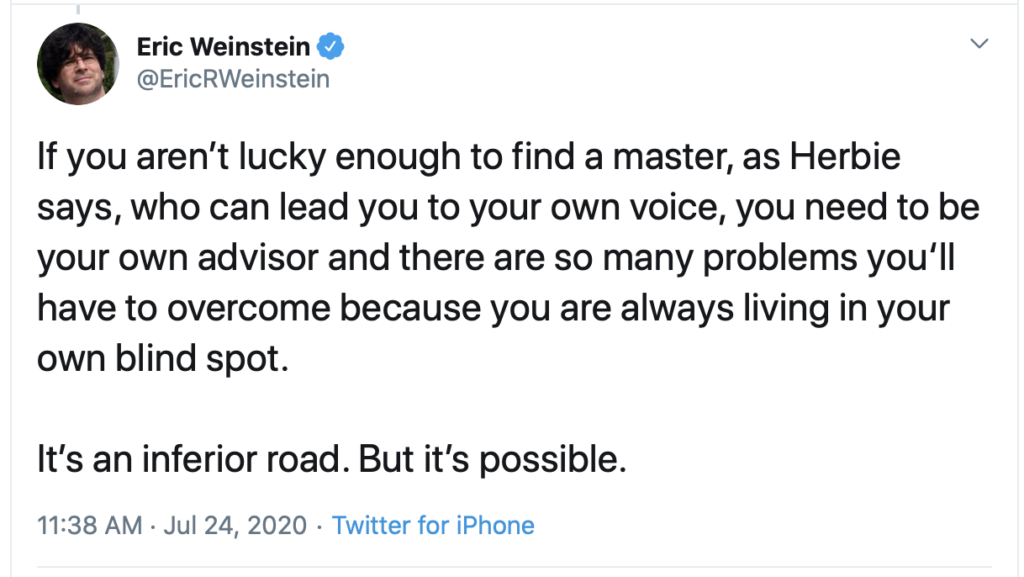
These add up to an extremely dangerous personal hubris that we have no blindspots, that we know everything we need to know, and that our ideas are fully tested whereas we have simply enshrined them in our own brains, surrounding them with mental electrified fences. We need THIS daily vitamin: Our ideas need to be repeatedly tested by numerous uninterested or antagonistic OTHERS. We often commit medical malpractice when we pretend we are world-class doctors who can adequately diagnose our own thought processes.

I am fatiguing from meeting people who never ever doubt their mental hygiene and never worry about the need to run meaningful real-world tests on their own ideas. I'm getting worn out watching people bark at each other on FB instead of showing humility and a willingness to learn from each other. I want to ask so many people on FB: "Why are you here? To learn something new or merely to strut around looking for fully cooked allies?"

Continue ReadingA Quadruple Whammy That Results in Facebook Barking