Would you let a five-year-old child make important decisions affecting your future? We all did this.

Over the years, I’ve often thought of the following quote: “The child is father of the man.”  These words often haunt me deeply.  They capture the absurd but true notion that each of us is nurtured and tutored (and sometimes damaged or destroyed) by younger versions of ourselves.

At one time, I thought the meaning of this quote was obvious, but now I see that it isn’t obvious at all. By the way, my interpretation has nothing to do with the fact that the quote is written in a masculine version.  The quote could and should be translated to cover both male and female.  Something like, “The Child is the parent of the Adult.”

The quote appears as part of a poem by Wordsworth:

“MY HEART LEAPS UP WHEN I BEHOLD”

My heart leaps up when I behold
A rainbow in the sky:
So was it when my life began;
So is it now I am a man;
So be it when I shall grow old,
Or let me die!
The Child is father of the Man;
I could wish my days to be
Bound each to each by natural piety.

What, then, is the meaning of “”The child is father of the man”? Here is my interpretation. Think of the person you are today. Think of the life that you are currently living.  Consider both the predicaments you are now in and the joys you are now experiencing. Much of that (or all of that) has been made …

Share

Continue ReadingWould you let a five-year-old child make important decisions affecting your future? We all did this.

The incessant allure of Republican morality and what Democrats can do about it.

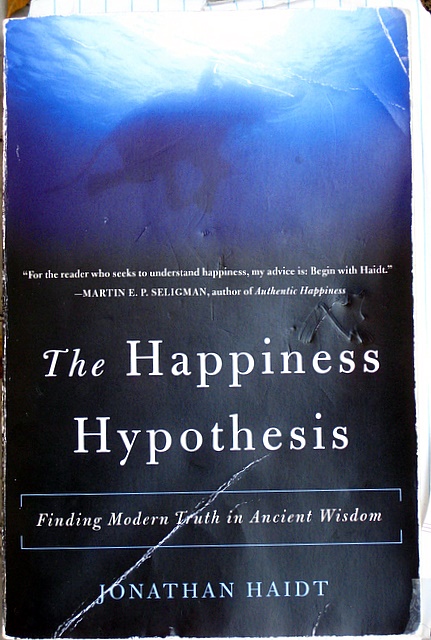
For the past few years, moral psychologist Jonathan Haidt has successfully injected a huge does of psychology into the study of morality. Along the way, he has gone a long way toward bridging the “is” with the “ought,” a chasm that many philosophers have insisted to be unbridgeable.  Haidt explores these moral-psychological issues in highly readable form in his 2006 book, The Happiness Hypothesis:  Finding Modern Truth in Ancient Wisdom. Here’s a photo of my personal well-worn copy of Haidt’s book:

haidt happiness hypothesis1

Based on his experiments, Haidt has been extraordinarily successful in describing the moral differences distinguishing conservatives and liberals.  Which group is more moral?  That isn’t the right question, according to Haidt.  Both of these groups sincerely strive to be “moral.”  Conservatives and liberals differ in the way they characterize morality because they base their differing moral senses on different measures. Based on Haidt’s research, there are the five separate measures (I think of them as tectonic plates) that underlie all moral systems.  Conservative morality substantially draws on all five of these five measures:

– harm/care
– fairness/reciprocity
– ingroup/loyalty
– authority/respect, and
– purity/sanctity

For liberals, however, the moral domain consists primarily (or only) of the first two of these five measures (harm/care and fairness/reciprocity).  For liberals, the other three measures (I’ll call them “conservative measures”) tend to fly under the liberal radar.  In fact, many liberals scoff at claims that the conservative measures (ingroup/loyalty, authority/respect and purity/sanctity) have anything at all to do with morality.  To avoid a …

Share

Continue ReadingThe incessant allure of Republican morality and what Democrats can do about it.

Andrew Sullivan sums up Palin – it’s really about McCain

Andrew Sullivan concludes that the choice of Palin should focus us sharply on McCain's poor judgment: To my mind, this pick is not about Palin's unreadiness to be president. It's about McCain's unreadiness to be president. This act of judgment - a blend of ignorance, gut, cynicism, and pure egotism…

Continue ReadingAndrew Sullivan sums up Palin – it’s really about McCain

What Eric Hoffer tells us about “true believers”

This weekend, a good friend (Thanks, Eddie!) reminded me to read a “classic” on mass movements, The True Believer (1951), by Eric Hoffer, an American social writer.  Hoffer was awarded the Presidential Medal of Freedom in February 1983 by President of the United States Ronald Reagan.

Hoffer begins his book by recognizing that all mass movements have much in common:

This book deals with some peculiarities common to all mass movements, be they religious movements, social revolutions or nationalist movements. It does not maintain that all movements are data call, but that they share certain essential care to restrict which give them a family likeness.

There is more to the similarities, according to Hoffer. All mass movements “demand blind faith and single hearted allegiance.” Although they differ in their doctrines, they all “draw their early adherents from the same types of humanity; they all appeal to the same types of mind.”  Hoffer speaks of the art of “religiofication, the art of turning practical purposes into holy causes.” (15)

Last night, I took a couple hours to read through The True Believer. I want to take this time to share a few quotes from Hoffer’s book:

There is in us a tendency to locate the shaping forces of our existence outside ourselves. (16)

Discontent by itself does not invariably create a desire for change. Other factors have to be present before discontent turns into disaffection. One of these is a sense of power. (17)

The differences between the conservatives and the …

Share

Continue ReadingWhat Eric Hoffer tells us about “true believers”

Carl Craver’s case for integrative neuroscience instead of reductionism

As I mentioned in two previous posts (here and here), I recently had the opportunity to attend several of the sessions of the “Future Directions in Genetic Studies” workshop at Washington University in St. Louis. One of the speakers was Carl Craver of Washington University. Craver's talk was titled, "The…

Continue ReadingCarl Craver’s case for integrative neuroscience instead of reductionism