
Greg Lukianoff Recommends Martin Gurri’s “The Revolt of the Masses”

I just spotted this review of The Revolt of the Masses by Greg Lukianoff." Greg's review has convinced me to order my own copy of The Revolt of the Masses.

Excerpts:

“The Revolt of the Public” explains that the shifts in media technologies that we believe accelerated American political polarization and played havoc with young people’s mental health were actually part of a much larger global transformation that Gurri calls “The Fifth Wave.” Essentially, the empowerment of vast multitudes of people to communicate directly with the world and with each other has genuinely transformed society. Unfortunately, in its current state, this media revolution has only been able to tear things down; institutions, ideas, and yes, even people (a.k.a. cancel culture). This idea is what Gurri calls “negation.”

. . . . Gurri shows how this manifested in the 2011 Arab Spring and how it has had ripple effects in Spain, Israel, and the American Occupy Wall Street movement. Gurri also argues that these movements generally were rich with targets: people, institutions, and ideas that needed to be torn down, but those same movements were often very hesitant to offer constructive solutions or realistic reforms. This hopeless point of view amounted to a kind of nihilism, according to Gurri—usually not the kind of nihilism of the philosophers, but a de facto nihilism in which nothing constructive is proposed to replace what needs to be torn down.

You can see this in American society in everything from “End the Fed,” to “abolish the police,” to cancel culture on both the right and the left, and to the absolute negation of all assumptions represented by the QAnon conspiracy.

One thing that must be said about the “crisis of authority” we find ourselves in due to the overwhelming power of negation is that very often what critics have discovered is that our existing “knowledge” was truly based on some pretty thin evidence, bad assumptions, and sometimes not much more than the pieties of some elites. Understanding the crisis of authority as only being wrongfully destructive of expertise is to miss that, frankly, we are often asking far too much of expertise and experts, and oversight itself has not been all that rigorous. Negation is indeed tearing things down that needed to be torn down; unfortunately, it seems to be taking everything else with it.
Continue ReadingGreg Lukianoff Recommends Martin Gurri’s “The Revolt of the Masses”

Why Are So Many People Voting for Donald Trump?

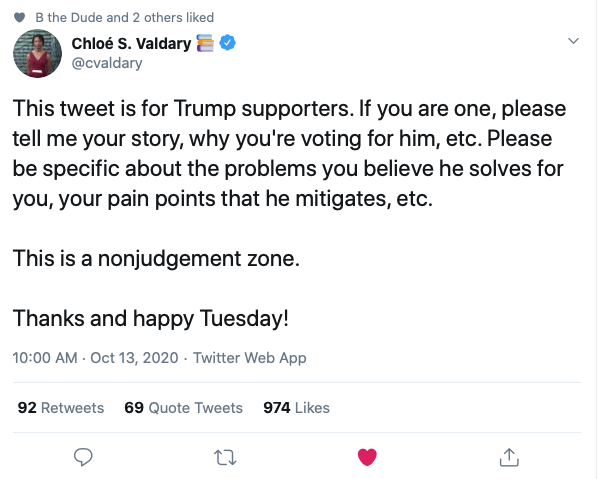
I won't be voting for Trump, but I'm still concerned he might win re-election. I think many people feel similarly -- otherwise, why do so many people keep talking about the election and the polling? I've often wondered why so many people will vote for Trump, despite his many cataclysmic negative personal qualities. I'm glad that Chloe Valdary asked Trump voters to respond to her Twitter account by stating why they support Trump. She has received more than 300 responses that I found interesting to review. These responses don't change my mind about Trump, but I do see many Trump supporters in a different light.

Continue ReadingWhy Are So Many People Voting for Donald Trump?

The Problem With Our Political Primaries

I will vote for Biden/Harris even though there is no rational way to justify how Biden should be the Democrat nominee. He is cognitively rickety and burdened with a long history of being on the wrong side of history (albeit with some notable positives). Today, Joe Biden is not among the best and brightest. I will vote for him anyway because Trump is much worse in terms of factual understanding, moral character and temperament. That said, what we're about to witness leading up to November is Kabuki Theater rather than a meaningful election because the corrupt primaries set the stage. But how did we get here, again? How dysfunctional were the primaries? Is there any expectation that the 2024 presidential primary will better reflect the will of the voters? No way, unless we dramatically reform the system from the bottom up.

Eric Weinstein nailed it on Episode 37 of his excellent podcast, "The Portal." I have taken the time to transcribe Eric's introduction to this episode. High school teachers should throw away their Civics coursebooks and start the court by making Eric's statement required reading:

Hello, it's Eric with a few thoughts this week on the coming US election before we introduce this episode's main conversation. Now, I should say upfront that this audio essay is not actually focused on the 2020 election, which is partially concluded, but on the election of 2024 instead. The reason I want to focus on that election is that precisely because it is four years away, we should know almost nothing about it. We shouldn't know almost anything about who is likely to be running or what the main issues will be. And we should be able to say almost nothing about the analysis of the election. Unfortunately, almost none of that is true. Now, obviously, we can't know all of the particulars. However, we still know a great deal more than we should. And that is because the ritual is not what many suppose it to be: a simple nationwide open contest to be held on a single day after several unrestricted long form debates with unbiased rules enforced by trusted referees.

What is most important is that prior to the 2024 election, there will have to be an appearance of a primary election. So what actually is a primary election and what function does it serve? It's hard to say, but if you think about it, this is really the awkward disingenuous and occasionally dangerous ritual by which a large and relatively unrestricted field of candidates needs to be narrowed to the subset that is acceptable to the insiders of the parties, their associated legacy media bosses in the party mega-donors. Now the goal of this process is to--in the famous words of Noam Chomsky--manufacture consent from us, the governed, so that we at least feel like we have selected the final candidates who, in truth, we would likely never have chosen in an open process. I've elsewhere compared this ritual to the related process referred to by professional illusionists as "magicians choice," whereby an audience member is made to feel that they've selected something like a card from a deck out of their own free will, but that the magician has actually chosen from a position of superior knowledge and control long before the trick has even begun.

In the modern era, of course, consent has become a much more interesting word, especially of late. And perhaps that fact is important in this context too. The constellation of issues carry over surprisingly well. To bring in more terminology from the national conversation on consent, the party rank and file are groomed, if you will, by the party-affiliated media as to who is viable and who should be ignored and laughed at through a process of what might be termed political negging. The candidates are also conditioned by being told that they can only appear in party-approved debates, which must be hosted exclusively by affiliated legacy media outlets, which emphasize soundbites and theatrical gotcha moments over substance, despite the internet's general move towards in-depth discussion made possible in large part by the advent of independent long-form podcasts like this one. Thus, both voters and candidates are prevented from giving informed and uncoerced consent by the very institutional structures most associated with democracy itself.

Continue ReadingThe Problem With Our Political Primaries

Why Trump Blames the Chinese for Creating Coronavirus

Why would Donald Trump and many of his acolytes want to blame Chinese people for creating COVID-19? Why make this claim where there is no evidence to support the claim and where the U.S. national intelligence director's office said it had determined Covid-19 "was not manmade or genetically modified." I would suggest the following three reasons:

1. Because Trump and Mike Pence are proudly ignorant of science. . Relatedly, Trump has expressed skepticism about the use of vaccines.  Pence is hostile to the scientific theory of evolution by natural selection. And see here.

2. Due to their hostility to science, Trump and Pence are not likely entertain the possibility that the coronavirus could have evolved naturally, despite the fact that viruses do evolve and coronavirus did, in fact, naturally evolve.

3. Because Trump and Pence have established themselves as xenophobes, they would be inclined to blame “outsiders,” i.e., the Chinese, for the coronavirus. .

Continue ReadingWhy Trump Blames the Chinese for Creating Coronavirus

Axiomatic Civic Responsibility

I’m looking at the “protesters” in Michigan and ruminating on the nature of civil disobedience versus civic aphasia. By that latter term I mean a condition wherein a blank space exists within the psyché where one would expect an appropriate recognition of responsible behavior ought to live.  A condition which seems to allow certain people to feel empowered to simply ignore—or fail to recognize—the point at which a reflexive rejection of authority should yield to a recognition of community responsibility.  That moment when the impulse to challenge, dismiss, or simply ignore what one is being told enlarges to the point of defiance and what ordinarily would be a responsible acceptance of correct behavior in the face of a public duty. It could be about anything from recycling to voting regularly to paying taxes to obeying directives meant to protect entire populations.

Fairly basic exercises in logic should suffice to define the difference between legitimate civil disobedience and civic aphasia. Questions like: “Who does this serve?” And if the answer is anything other than the community at large, discussion should occur to determine the next step.  The protesters in Michigan probably asked, if they asked at all, a related question that falls short of useful answer:  “How does this serve me?”  Depending on how much information they have in the first place, the answer to that question will be of limited utility, especially in cases of public health.

Another way to look at the difference is this:  is the action taken to defend privilege or to extend it? And to whom?

One factor involved in the current expression of misplaced disobedience has to do with weighing consequences. The governor of the state issues a lockdown in order to stem the rate of infection, person to person. It will last a limited time. When the emergency is over (and it will be over), what rights have been lost except a presumed right to be free of any restraint on personal whim?

There is no right to be free of inconvenience.  At best, we have a right to try to avoid it, diminish it, work around it.  Certainly be angry at it.  But there is no law, no agency, no institution that can enforce a freedom from inconvenience.  For one, it could never be made universal.  For another, “inconvenience” is a rather vague definition which is dependent on context.

And then there is the fact that some inconveniences simply have to be accepted and managed.

Continue ReadingAxiomatic Civic Responsibility