Comment: "There is no national conspiracy to buy elections and control America."
George Carlin: "You don't need a formal conspiracy, right? When interests converge, these people went to the same universities and fraternities are the same directors. They're in the same country clubs. They have like interest. They don't need to call a meeting. They know what's good for them. They're getting it. And there used to be seven oil companies. There are now three. It will soon be two. The things that matter in this country have been reduced. In choice. There are two political parties, there are a handful of insurance companies. There are about six or seven information [companies] but if you want a bagel, there are 23 flavors, because you have the illusion. You have the illusion of choice."
Lenin wasn’t “complicated.” He was evil. Full stop. We don’t say that enough in the United States because most people never actually learn what he did and others with “intellectual” mentors, parents or grandparents can’t let themselves admit they had a warm heart for the man who ushered in the new age of true totalitarianism quite intentionally. Instead we get at best a cartoon: czar bad, revolution messy, Stalin later goes too far. Lenin is treated like the grim (or for true elitists, heroic) but necessary prologue. That’s backwards.
This is a man who personally ordered people hanged in public “so that the people will see, tremble, and know.” Not generals on a battlefield—peasants labeled “kulaks,” defined as the wrong class of peasant, you know? Like my family. He didn’t reluctantly authorize force in a crisis. He theorized terror as a positive good. He wanted fear as a permanent feature of the system. If deliberately terrorizing civilians as a category isn’t evil, the word doesn’t mean anything.
And what he built was not run-of-the-mill authoritarianism. A normal dictator mostly wants you to shut up and not plot against him. Lenin’s party claimed a monopoly on TRUTH. Every independent center of life, churches, unions, rival socialist parties, the press, civil associations, had to be destroyed or absorbed. Violence wasn’t a last resort; it was a standing method; it was “cleansing”. Whole groups were pre-classified as enemies to be “liquidated” if necessary. He made the jump from dictatorship to totalitarianism.
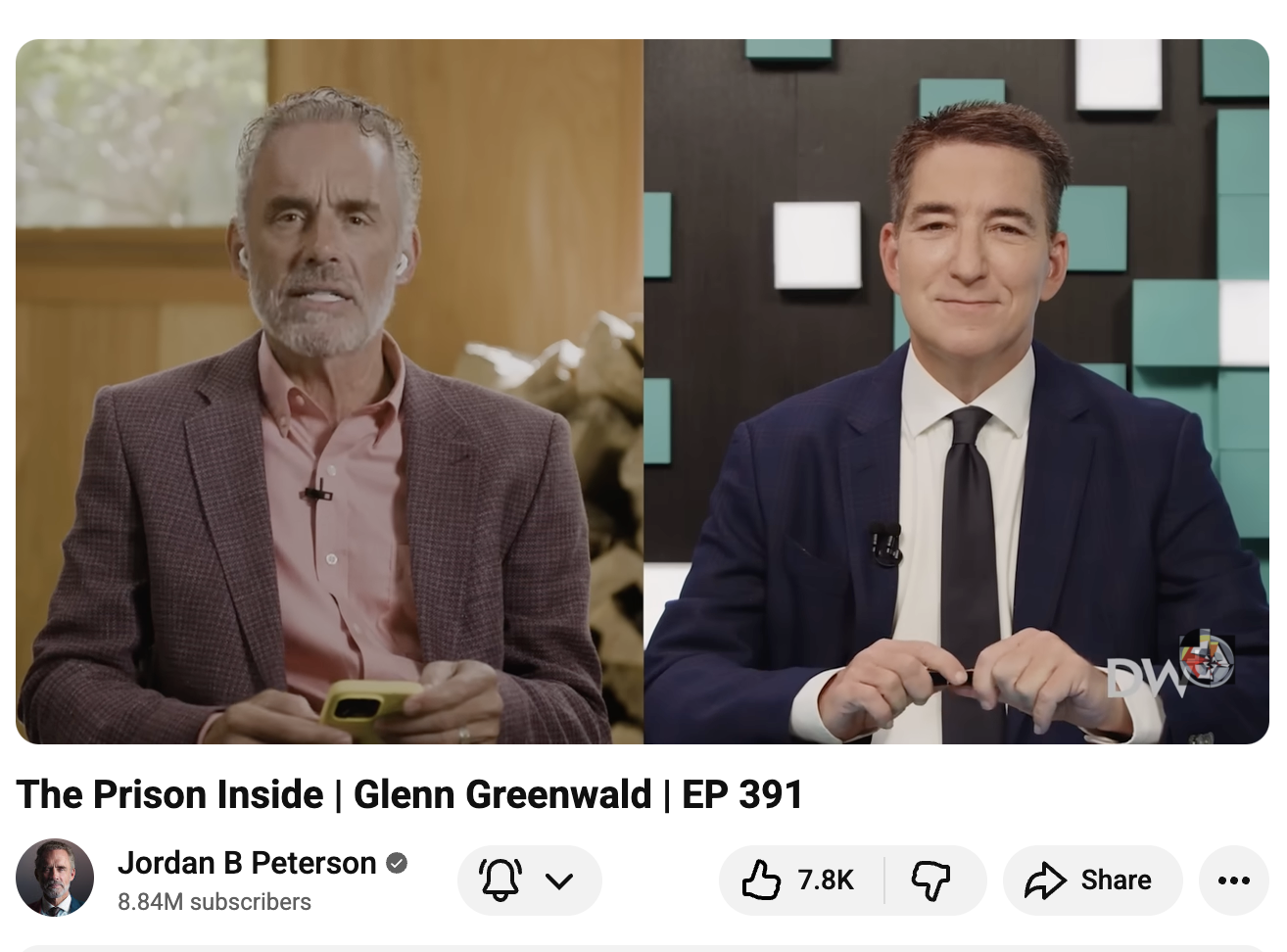
a href="https://www.youtube.com/watch?v=T3h7pmhyIwg">
I've listened to this podcast several times. It's long, but it is extremely thoughtful, engaging, disturbing, but also hopeful and celebratory of the human spirit. It involves Jordan Peterson and Glenn Greenwald. These are two of my most cherished thinkers. I am inspired and provoked by many of the topics that they explore here. Topics include censorship, propaganda, the history of these things in the United States. Also, the relationship between religion and politics, and what goes wrong when religion is absorbed into politics. And there's even some meaning of life moments. I took the time to transcribe a large chunk of this discussion, and I am sharing it with the hope that those of you who listen to it or read it will also find it worthwhile.
I asked Grok to crank out a basic table of contents to this interview:
Min 21:30
1. Censorship of RFK Jr. by Google and the tactic of starting with hated figures like Alex Jones
2. Expansion of censorship to mainstream voices, including Devin Nunes and Rand Paul
3. Reasons for increasing censorship: Generational shifts in values among Millennials and Gen Z, and the impact of Trump's election
4. Depiction of Trump as an existential evil justifying extreme measures, including the Hunter Biden laptop scandal and Sam Harris's views
5. Connection to post-9/11 clampdown on civil liberties, transformation of airports into authoritarian spaces
Min 27:35
6. Reflections on 9/11 trauma, the war on terror, and how airport security conditioned obedience to authority
7. Threats to liberty from fear rather than greed; free speech as equivalent to free thought and essential for adaptation
8. George Orwell on tyranny through mind control; the internet's shift from liberation to control, Snowden revelations
9. Biblical phrase "render unto Caesar"; collapse of religious domain into politics leading to unsophisticated good vs. evil wars
10. Personal background on religion; hubris in censorship; human need for spirituality, politics as a substitute for religion
11. Discussions with Douglas Murray on humanism needing a religious framework; Carl Jung on rationality bounded by the dream
12. Grappling with ethics and morality without religion; necessity of spirituality to avoid nihilism
13. Response to materialist atheists; human relationship with the larger whole; introduction to the story of Abraham
These excerpts start at Minute 21:30 of the above video.
Glenn Greenwald
20% of Democratic Party voters say they intend to vote for RFK, Jr. for president. And the most powerful corporations, or one of the richest and most powerful corporations ever to exist, Google sweeps in and says, This is something that you are not permitted to be heard.
Glenn Greenwald
And what happened was, what always is the tactic of sensors is they always pick a test case in the beginning that they believe is someone who is sufficiently hated or disliked so that everybody will acquiesce to the precedent, simply because their emotions for that person are so high. So the first person to really be deplatformed in this collusive effort by Silicon Valley was Alex Jones. And Peter Thiel was on the board of Facebook at the time. Mark Andreessen in Silicon Valley, and a few other people stood up at the time and said, no matter how much you hate Alex Jones, this precedent is going to work its way slowly, or maybe not even so slowly, to expand into the kinds of voices that you probably think shouldn't be censored. And by the point that you cheer the precedent in the first instance, because you allow your emotional dislike for this person to outweigh your rational capacities, it will be too late the precedent is already implemented, and then you're left to just bicker about its application, rather than the principle itself.
Glenn Greenwald
And that's precisely what has happened. They began quickly censoring mainstream conservative voices. Devin Nunes went to rumble in part to escape from Google censorship, and then a huge stream of people did as well. One of the most shocking things that happened along those lines, Rand Paul questioned a couple of epidemiologists, scientists who were testifying before the US Senate about the possible efficacy of ivermectin and other alternative medication for covid. It was a Senate hearing, a hearing in the United States Senate. Rand Paul put it on his YouTube channel as a excerpt of this hearing, and Google decided that was something that ought not to be heard as well.
Can a tiny sliver of people change society. Yes. 3.5% is often enough. That's one person out of 30. It's happened often, even if the 3.5% are non-violent, as long as they are a cohesive and disciplined vocal minority:
Why cling to the myth that real change needs majorities—when data spanning a century proves a committed, nonviolent 3.5% has never failed? Erica Chenoweth’s research: Hundreds of movements analyzed. Once sustained participation hits 3.5%—strategic, disciplined, peaceful—success is guaranteed. No exceptions. The Civil Rights Movement nailed it: The 1963 March drew ~250,000 (<0.2% of Americans), but the real power was the unseen network—carpools, sit-ins, daily courage—that turned moral force into unstoppable momentum. Margaret Mead was right: Only small, thoughtful groups ever change the world. Now it’s proven. Key insight: This works beyond activism—in business, innovation, personal growth. Stop chasing consensus. Build your aligned 3.5%. Which movement (or moment in your life) shows this rule in action? What could you shift by focusing on that core minority?
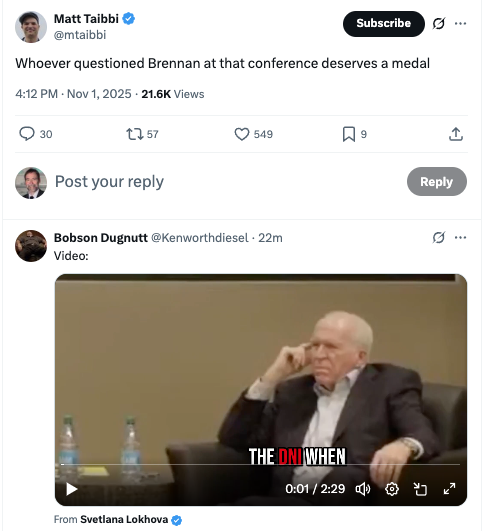
This is what happens when someone (I wish I knew who, because he DOES deserve a medal) puts a powerful corrupt deep state partisan on the spot in front of a live audience (with the cameras recording this for potential future criminal prosecution). Notice that John Brennan's go-to response is not to answer the spot-on question, but rather to quickly try to figure out how to smear the questioner.
On FB, I added this: "Those of you who inhabit only the corporate news ecosystem won't have any fucking idea why this video is critically important."
Hello, I invite you to subscribe to Dangerous Intersection by entering your email below. You will have the option to receive emails notifying you of new posts once per week or more often.