Sheldon Whitehouse on government’s subservience to corporate money

Sheldon Whitehouse points out that recent government regulatory failures are merely symptoms of deep and insidious corruption. The problems go well beyond MMS, as Whitehouse documents in this video. Written excerpts of his speech are here. Along the way, he makes it clear that Citizens United allows the tentacles of industry to reach even further into government, until government is only serving monied interests and not the public interest. He gives many examples along the way, and demonstrates that he absolutely understands the process by which government is being corrupted by corporate money. It's a process that inevitably culminates with the surrender of meaningful government. Whitehouse names names and gives lost of examples. At the four minute mark, he makes clear that the references to "walruses" in oil company reports is not a laughing matter. It is powerful evidence that MMS was a corporate captive. This is a brave and direct statement. Whitehouse makes it clear that, given the extent of the problem, our entire Constitution and our way of life are both at risk.

Continue ReadingSheldon Whitehouse on government’s subservience to corporate money

I’ve located a hero

I'm creating a new post category called "heroes" in honor of high school student Keith Wagner, who obviously did some homework before handing this lying sack-of-shit politician his own head on a platter. This is unbelievable poise for a high school student. And then the politician, State Senator John Huppenthal of Arizona blessed the interview with a magnificent denouement: his unexplained absence. Or perhaps he had to leave because he was in the middle of a unanticipated panic-inspired bowel movement. I can only hope that mainstream journalists will note the successful formula used by Keith Wagner: Do your homework, go set up the interview, then don't let up. For full enjoyment, take a look at the comments regarding this video at Huffpo.

Continue ReadingI’ve located a hero

Fool me once…

The events since the BP well exploded and began spewing oil and gas into the Gulf of Mexico have forced President Obama's hand. No politician wants to be the one to catch the Peak Oil hot potato, but it looks like it's landed right in Obama's lap. In his Oval Office speech the other night, he came the closest any president has yet to frankly discussing the challenges we face (emphasis mine):

So one of the lessons we’ve learned from this spill is that we need better regulations, better safety standards, and better enforcement when it comes to offshore drilling. But a larger lesson is that no matter how much we improve our regulation of the industry, drilling for oil these days entails greater risk. After all, oil is a finite resource. We consume more than 20 percent of the world’s oil, but have less than 2 percent of the world’s oil reserves. And that’s part of the reason oil companies are drilling a mile beneath the surface of the ocean -- because we’re running out of places to drill on land and in shallow water. For decades, we have known the days of cheap and easily accessible oil were numbered. For decades, we’ve talked and talked about the need to end America’s century-long addiction to fossil fuels. And for decades, we have failed to act with the sense of urgency that this challenge requires. Time and again, the path forward has been blocked -- not only by oil industry lobbyists, but also by a lack of political courage and candor. The consequences of our inaction are now in plain sight.

Continue ReadingFool me once…

The Norway Advantage

My 19-year old Norwegian niece ("Katja") just left town after visiting my family for four days. We had the opportunity to have several long conversations with her comparing Norway to the United States. I'm not going to suggest that Norway is perfect, but when you read the following list, it might make you wonder why the United States can't get its act together to be at least somewhat more like Norway. Here's what Norway offers to its citizens: - Single-payer healthcare ("The only requirement for receiving healthcare in Norway is that one be alive.") - Free schooling at the grade school and high school level. In fact free schooling at the university level as well. Competition can be fierce for getting into particular schools at the University level (my niece is keeping her fingers crossed that she gets into law school this fall), but anyone who can do the school work is allowed to go to school. - The average Norwegian has five weeks of vacation every year. - Generous maternity and paternity leave, with pay. Further, many businesses offer high-quality child care for their workers. The government offers subsidized child care. - A generous social security system

Continue ReadingThe Norway Advantage

How did democracy cease to be in Iran?

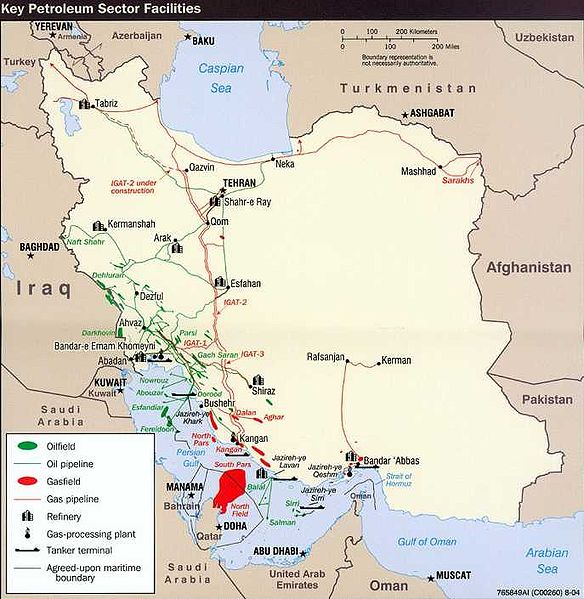
What happened to democracy in Iran? It didn't die a natural death. Iranian democracy was killed by well known actors that included British Petroleum and the United States. You can learn more by listening to Stephen Kinzer, former New York Times reporter, who was iran-oil-creative-commonsinterviewed by Amy Goodman of Democracy Now (video interview). From the 1920's through the 1940's Great Britain controlled all of the oil in Iran, thanks to "a corrupt deal that they had struck with a few representatives of the old declining Iranian monarchy, all of whom had been paid off." The troubles began when Iran began to assert ownership of its own oil:

[A]fter World War II, when the winds of nationalism and anti-colonialism were blowing throughout the developing world, Iranians developed this idea: we’ve got to take our oil back. And that was the general—the kind of national passion that brought to power Mohammad Mosaddegh, who was the most prominent figure in the democratic period of Iran during the late '40s and early ’50s. It was Mosaddegh's desire, supported by a unanimous vote of the democratically elected parliament of Iran, to nationalize what was then the Anglo-Iranian Oil Company. They carried out the nationalization. The British and their partners in the United States fiercely resisted this. And when they were unable to prevent it from happening, they organized the overthrow of Mosaddegh in 1953. So that overthrow not only produced the end of the Mosaddegh government, but the end of democracy in Iran, and that set off all these other following consequences. The Shah ruled for twenty-five years with increasing repression. His rule produced the explosion of the late '70s that produced the Islamic regime. So, it was to protect the interests of the oil company we now know as BP that the CIA and the British Secret Service joined together to overthrow the democratic government in Iran and produce all the consequences we've seen in Iran over the last half-century.img_0083

Why was the United States willing to get involved in this despicable overthrow? Kinzer suggests that the U.S. was more than willing to believe that there were "communists" in Iran, despite any supporting evidence. The British merely took advantage of this American paranoia. Therefore, the U.S. facilitated the overthrow of a sovereign Middle Eastern country without any justification.

Continue ReadingHow did democracy cease to be in Iran?