
Corporations are not people

Free Speech for People is another concerted effort to overturn Citizen's United.   Here's the problem:

A sharply divided Supreme Court decided that the American people are powerless to stop corporations from using corporate funds to influence state and federal elections. The 5-4 decision ruled that the restrictions on corporate expenditures in elections contained in the federal Bipartisan Campaign Reform Act (known as BCRA or “McCain-Feingold”) violated the First Amendment protections of free speech.

The solution:

The Free Speech for People Amendment will overrule the Citizens United v. FEC case and return the First Amendment to its longstanding purpose as a guarantee of the fullest rights of a free people and the press. The Free Speech for People Amendment will overrule the fabrication by activist judges of a “corporate rights doctrine” to defeat democratically enacted laws, and will restore the First Amendment to its meaning and intent for two centuries.  The Amendment will ensure that all people have the most robust freedom of conscience, speech and debate and that a vibrant, diverse press remains free and unfettered, thus strengthening, rather than weakening, democracy.

The Free Speech for People Amendment Campaign will work with others to develop specific language for the Free Speech for People Amendment. Here is one example of language for the Free Speech for People Amendment:

Amendment XXVIII Section 1.  The sovereign right of the people to govern being essential to a free democracy, the First Amendment shall not be construed to limit the authority of Congress and the States to define, regulate, and restrict the spending and other activity of any corporation, limited liability entity, or other corporate entity created by state or federal law or the law of another nation. Section 2.  Nothing contained in this Article shall be construed to abridge the freedom of the press.
[Addendum April 11, 2011] I have added a short speech by John Bonifaz, co-founder of Free Speech for People. He warns that Citizens United should not simply be seen as a campaign finance decision, but as announcing a radical new doctrine establishing corporate rights. Corporations should not be seen to have the same rights as people. Because of their powers to aggregate wealth, they should be carefully restrained. Unchecked corporate power is subverting our democracy. The BP disaster and the unrestrained consolidation of the media are examples. The solution is to amend the U.S. Constitution with the 28th Amendment. Bonifaz indicates that seven of the existing Amendments remedied egregious injustices. This effort will take immense energy and organizing, but the wholesomeness of the idea is on our side. Polling shows that 87% of Democrats, 85% of Independents and 68% of Republicans support the idea that corporations should not have the rights of people.
Continue ReadingCorporations are not people

Yes, Please Tax Us

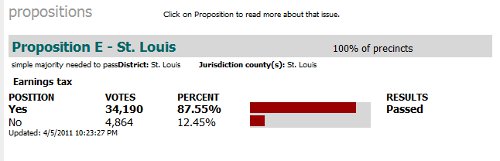
I live in an odd city. Back in 1876 the City of Saint Louis seceded from its otherwise rural county. Saint Louis was a major transportation hub (rail) and industrial center. The rural county was seen as sucking on this rich teat to enrich the farmers. So the city decided to shed its poor panhandling neighbors for its own greater glory. Then came the automobile, industrialized farming, suburbs, and ex-urbanization. Oops. By the mid 2oth century, the city had to enact an earnings tax to help cover the shortfall in revenue. At the end of the first decade of the 21st century, the Tea Party movement managed to put an odd law up for vote in Missouri. Thus the rural majority voted to forbid cities to have the ability to assess any new earnings taxes, ever. And furthermore to require a public vote every few years on whether the people would like to continue paying for the services they receive in this way in cities that already have such taxes. "Plunk," goes the bond rating in the only two cities for which this clause applies, Saint Louis and Kansas City. But we dutifully held that vote this week, only five months since that new law passed.Proposition E reads:

"Shall the earnings tax of 1%, imposed by the City of St. Louis, be continued for a period of five (5) years commencing January 1 immediately following the date of this election?"

How did we do? Passed by 7 to 1. Yay! We get to keep paying 1% of our income to support city services.

Continue ReadingYes, Please Tax Us

The U.S. Supreme Court’s trajectory on campaign cash

In the April 11, 2011 edition of The New Yorker, Jeffrey Toobin connects the dots and announces what the United States Supreme Court has in store for us. The latest evidence is the attitude displayed by a majority of the justices during an argument concerning the constitutionality of an Arizona clean-money level-the-playing field election law. All of this conservative activism is allegedly being done to make sure that the government won't "stifle debate," even though the Court's approach is drowning out non-monied natural people and inviting large monied corporations to rig elections.

The implications of the Court’s approach are now becoming more clear. In the Citizens United case, the majority decreed, in an opinion written by Justice Anthony M. Kennedy, that corporations and other organizations could bypass the old limits by giving unlimited amounts not to candidates but to nominally independent groups that support them. (Corporations, of course, traditionally give more to Republicans.) But the logic of the decision—and the views expressed by the majority at the argument last week—suggests that in the future the Court will allow corporations to skip the third parties and give money directly to the candidates. It also implies that any limit on the size of contributions, by individuals or corporations, may now be held to be unconstitutional. The Court did suggest that requirements calling for the public disclosure of contributions might pass constitutional muster, but Congress shows no inclination to enact any such rules. President Obama’s DISCLOSE Act, which would have bolstered disclosure requirements, died in Congress last year. (Clarence Thomas, the silent Justice during oral arguments, believes that even disclosure violates First Amendment rights.)
For a succinct and accurate rendition of Citizens United, check out this video by Annie Leonard.

Continue ReadingThe U.S. Supreme Court’s trajectory on campaign cash

Election Day Separation

Today was a local election day. We have a new polling place in our ward. Instead of the school to which we walked for years, it is now in a nearby church basement. It seems a good use of the space on an off day. But as I deposited my ballot, I had a creepy feeling. Suddenly Jesus was in my personal space, uninvited. How well does this mesh with the separation of church and state?

Continue ReadingElection Day Separation