How easy was it to hack the Ohio 2004 presidential election?
How easy was it to hack the Ohio 2004 presidential election? This easy.

How easy was it to hack the Ohio 2004 presidential election? This easy.
Seumas Milne of the U.K. Guardian puts things into perspective:
Murdoch's overweening political influence has long been recognised, from well before Tony Blair flew to Australia in 1995 to pay public homage at his corporate court. What has been less well understood is how close-up and personal the pressure exerted by his organisation has been throughout public life. The fear that those who crossed him would be given the full tabloid treatment over their personal misdemeanours, real or imagined, has proved to be a powerful Mafia-like racket. It was the warning that News International would target their personal lives that cowed members of the Commons culture and media committee over pressing their investigation into phone hacking too vigorously before the last election.
Glenn Greenwald sums up the problem at the U.K. Guardian:
The same Democratic president who supported the transfer of $700bn to bail out Wall Street banks, who earlier this year signed an extension of Bush's massive tax cuts for the wealthy, and who has escalated America's bankruptcy-inducing posture of Endless War, is now trying to reduce the debt by cutting benefits for America's most vulnerable – at the exact time that economic insecurity and income inequality are at all-time highs. Where is the "epic shitstorm" from the left which Black predicted? With a few exceptions – the liberal blog FiredogLake has assembled 50,000 Obama supporters vowing to withhold re-election support if he follows through, and a few other groups have begun organising as well – it's nowhere to be found. Therein lies one of the most enduring attributes of Obama's legacy: in many crucial areas, he has done more to subvert and weaken the left's political agenda than a GOP president could have dreamed of achieving. So potent, so overarching, are tribal loyalties in American politics that partisans will support, or at least tolerate, any and all policies their party's leader endorses – even if those policies are ones they long claimed to loathe.And that's just the beginning of the problem with Obama. Consider the damage he has done on other issues.
Obama has continued Bush/Cheney terrorism policies – once viciously denounced by Democrats – of indefinite detention, renditions, secret prisons by proxy, and sweeping secrecy doctrines.He has gone further than his predecessor by waging an unprecedented war on whistleblowers, seizing the power to assassinate U.S. citizens without due process far from any battlefield, massively escalating drone attacks in multiple nations, and asserting the authority to unilaterally prosecute a war (in Libya) even in defiance of a Congressional vote against authorising the war.Greenwald's article contains many links documenting Obama's abysmal record. Obama has destroyed the modicum of "hope" that I still had. I am now convinced that there is no solution to our biggest problems by using the system. On the national level, voting is a charade to trick ordinary folks into thinking that they have a voice in their government--they've been tricked into thinking that voting is adequate and responsible citizen participation. What we need, more than ever, is for people to turn off their TVs and to stop living in the fantasy world of sports teams and movie stars. We have a country to run, and we have President who does what loud and obnoxious people tell him to do. We need to become loud and obnoxious if we are to get Barack Obama to do the right thing, because he has proven himself to be, at best, a channeler, not a leader. We need to challenge him by calling him out and labeling him for what he is: Not-Leader! I write this as a person who financially supported Obama and voted for him. And I would still support him over McCain/Palin or any modern-day equivalents. The big question, then is how we get the voters to wake up from their fantasies, to become well-informed and to loudly demand that our elected representatives run the country in a responsible and sustainable way. How do we get citizens to express unrelenting outrage at the corrupting influence of the current system of financing campaigns with huge sums of private (mostly corporate) money? Anything less is nihilism. Perhaps that is what we need to start calling Americans who think that the mere act of reading their crappy local newspapers, watching the most popular versions of TV "news" and voting makes them responsible citizens: Nihilists! Perhaps I am able to see Obama for what he is because I am not very "tribal." I agree with Glenn Greenwald that "tribalism" is why progressives are not speaking out against the man they supported for President. It's time to stop being tribal. That would be the start of a solution.
Matt Taibbi thinks we should all be outraged about the growing talk about a corporate tax holiday. He's right.
It's almost the Fourth of July, the date that red-blooded Americans thank God that they are not British. And, increasingly, we give homage to our corporate sponsors. I was 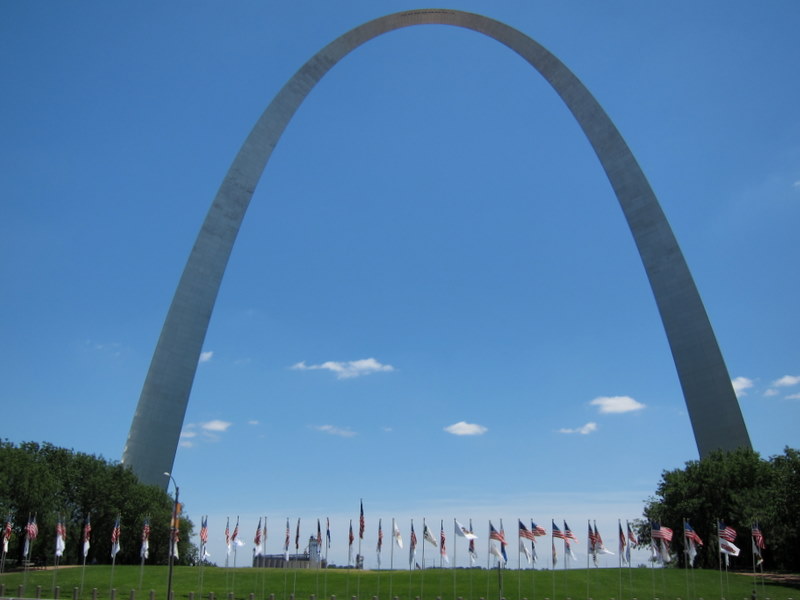 walking by the St. Louis Arch today, and noticed all of those American flags flapping in the wind in anticipation of the big St. Louis Independence Day Fair at the arch grounds.
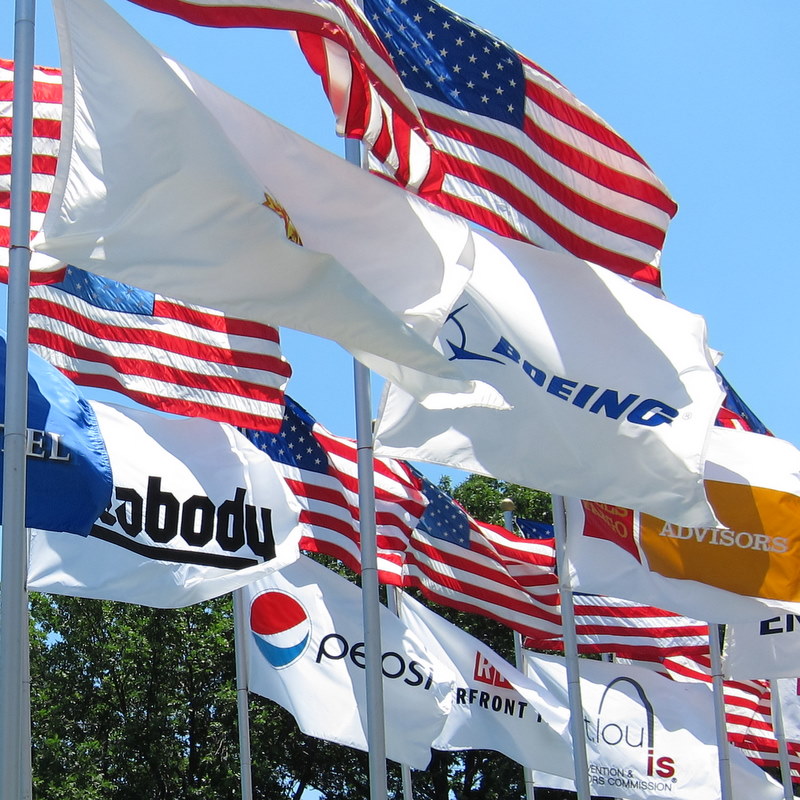
I looked more closely and noticed that flapping along with the American flags were the flags of a corporate who's who. AT&T, Pepsi, Boeing, Peabody Coal, InBev, U.S. Bank and many
walking by the St. Louis Arch today, and noticed all of those American flags flapping in the wind in anticipation of the big St. Louis Independence Day Fair at the arch grounds.
I looked more closely and noticed that flapping along with the American flags were the flags of a corporate who's who. AT&T, Pepsi, Boeing, Peabody Coal, InBev, U.S. Bank and many  others, letting us know how inter-twined government is with corporate America these days.
After they noticed that there were 50 stars, what would the founding fathers have thought had they seen those American flags touching the flags of corporations? They would probably have asked why those corporate flags were there, and we'd need to explain that corporations own Congress and control the elections. I doubt that that would satisfy them.
others, letting us know how inter-twined government is with corporate America these days.
After they noticed that there were 50 stars, what would the founding fathers have thought had they seen those American flags touching the flags of corporations? They would probably have asked why those corporate flags were there, and we'd need to explain that corporations own Congress and control the elections. I doubt that that would satisfy them.