Noteworthy entries.

How Do I Choose the Topics I Write About?

I have a day job and a lot of other things that I pursue other than my writing at this website. Thus, I am selective about the topics I write about. How do I choose my topics? One of my rules of thumb is to avoid writing about the things that are already getting lots of attention by corporate media. I often have nothing to add to that coverage.

I write about things that concern me, especially things that are not getting much widespread coverage. I gauge that lack of widespread coverage by talking with friends and acquaintances, many of whom are quite busy with their jobs and raising their families. They don't have much time to tap into the "news." They tend to get their "news" by browsing headlines of corporate media. Often, when I mention something I've learned from social media, they are surprised or confused. This brings to mind a quote from the Stoics:

A highly relevant warning from one of the Stoics from Ancient Rome:

If a person gave away your body to some passerby, you’d be furious. Yet you hand over your mind to anyone who comes along, so they may abuse you, leaving it disturbed and troubled—have you no shame in that?

—Epictetus, Enchiridion , 28

[We interrupt this article with a public service announcement]

Browsing headlines and articles from corporate media (on either the left or the right) is "handing over your mind" to people with an agenda. They are often acting as the paid PR department for the Democrats or Republicans. What is their main quest? To get re-elected. What's the best and most efficient way to get re-elected? To lie to the public. To claim that they are doing a GREAT job. To claim that the other party is evil. To argue that it is an existential imperative to vote for them. To divide us. To refuse to admit that on most issues (e.g., warmongering and being obeisant to their corporate masters and to Wall Street) they serve as a uni-party.

And they are very good at fooling us, especially when they strike up close partnerships with U.S. security state (FBI, CIA, DHS) and social media corporations to censor U.S. citizens, which the Democrats have excelled at. This censorship has been proven many times over by the Twitter Files.

Therefore, a gentle reminder: Resist the temptation to hand over your mind to enticing headlines. Read widely. Read the "enemy." Read independent media, reporters who are financially supported by their readers, not by the people they are purportedly reporting on.

[Now back to the article]

Why do I write about the things I write about rather than other things? Jesse Singal recently published an excellent post on this issue: “Why Do You Write About This Rather Than That?” Is Almost Always A Lazy And Unserious Derailing Tactic." An excerpt:

One of my main critiques of left-of-center intellectual life is that it feels like there’s been a surge of energy spent not on developing and debating specific arguments and counterarguments, but on developing derailing tactics — ways to avoid even having potentially edifying conversations in the first place.

Some derailing tactics involve simply responding not to the claim being made, but to another, much sillier claim. A says “Some dogs bite people,” and B responds “A is saying we should euthanize all dogs in case they bite people!” Yawn. B will always get 100 times the retweets, unfortunately.

Other forms of derailing involve impugning someone’s very interest in the subject they’re talking about. One very common, very annoying version of this is to accuse them of being interested in the wrong thing — basically a form of zoomed-out whataboutism. I’ve obviously encountered this and you’ll see a ton of it everywhere. Maybe the most common version is lobbed at individuals on the left who are concerned about illiberalism on the left, who are accused of ignoring the more pressing threat of right-wing illiberalism or fascism or whatever...

When I see this coming from academics or journalists, which I do a lot, I find it quite frustrating and anti-intellectual. To the extent this claim is undergirded by any actual thought — and I do think the point is to derail rather than to raise genuine questions — the theory seems to be that intellectual or journalistic inquiry should be guided by utilitarian calculations. You shouldn’t spend your time, or at least not much of it, on a particular beat or concern if there are more “important” concerns elsewhere.

Jesse then sets out some of the problems with common derailing strategies:

What you decide what to focus on as a writer is based on a complicated swirl of variables." I follow my interests each day and I often pick from a vast set of notes and ideas that I have accumulated over the years. On other occasions, I comment on something interesting I spotted on Twitter.

"Journalists and academics also are concerned with finding a niche."

"Journalists and academics are also allowed to get tired of things! I’m tired of Trump. I don’t want to write about him anymore."

"[I]t isn’t always clear which stories will and won’t turn out to be important until journalists actually take the time to look into them."

"“Only a small number of people are affected by this” is, more broadly, a frequently callous argument."

"[T]here is often a fundamental level of bullshit — or at least hypocrisy — to these arguments, because the people making them often have rather niche interests themselves."

All of these thoughts resonate with me. Jesse is an excellent writing and his article is a good read - I recommend you go to Jesse's website to read his entire article.

Continue ReadingHow Do I Choose the Topics I Write About?

No More COVID Boosters for Me. Here’s Why.

I have now seen enough to regret that that I had two COVID vaccines and a booster. I accepted these jabs because I trusted the public health authorities. I will not accept any more boosters. I am not alone. In the past six months, I have spoken to at least six friends who vote Democrat--all but one of them told me that they will not accept any more boosters and that they are concerned about risks associated with the vaccines.

I follow about ten well credentialed doctors online, including Dr. Aseem Malhotra, Dr. Robert Malone and Dr. Peter McCoullough, who raise these concerns and many others. I've seen highly disturbing evidence that many smart doctors have been shut out of the conversation for three years (and they continue to be kept out of the conversation on legacy news outlets). We did not have a real or meaningful national conversation on the risks of these vaccines compared to the risks of COVID regarding many age groups. I saw the Great Barrington Declaration disparaged for mere political reasons, not medical. Our public health authorities told us that the vaccines were extremely safe, but now I'm not convinced of that.

Our public health authorities told us many things with the utmost confidence that have now been proven untrue. And although this is anecdotal, I've seen far too many videos of young healthy people collapsing, many of them dying. Over the past several years, I saw many numbers regarding the COVID risk of death that failed to break out the numbers of those who were obese, elderly and with comorbidities, failing to separate those from those of us who are healthy or young. I found out that many hospitals were conflating death with COVID with death from COVID, thereby inflating COVID death numbers.

Prior to vaccination, I was in very good health prior to getting vaccinated, very unlikely to die of COVID, even unvaccinated. I had an adverse reaction after my 2nd vaccination and it continues to affect me (inflamed toes). I know that I was also at some risk of harm from COVID, but as I write this, I believe we have been manipulated and lied to in many ways and that I have no meaningful way to be assured whether I was at more risk of harm from the vaccine than from the disease. Maybe someday we will know for sure.

The historically wretched track record of Big Pharma for lying to us in order to make $ multiplies my concern and frustration. Everyone will have their own opinion on this topic. I'm not suggesting to anyone else what they should do, but no more boosters for me.

--

Bonus Concerns: See Steve Kirsch' "Pfizer's secret guide for how to make a vaccine "safe and effective," including these three tips:

Here’s Pfizer’s secret playbook for how to make a “safe and effective” vaccine:

Require full liability protection

Contracts require that the government isn’t allowed to reveal any adverse safety information without Pfizer’s express consent

Get the US government to agree that there will not be any ICD10 codes for:

Death of a fully vaxxed person from COVID Death from the COVID vaccine Injury from the COVID vaccine
--

See also, this brand new article in the Australian Spectator: "Breaking the silence: do mRNA vaccine harms outweigh benefits?". An excerpt:

The evidence comes from the original double-blind, randomised control trials, that led to the approval of both Pfizer and Moderna by regulators worldwide. Malhotra explains, ‘In a reanalysis of the original trials with the Wuhan strain, eminent scientists essentially found you were more likely to suffer a serious adverse event – for example hospitalisation, disability, or a life-changing event – than you were to be hospitalised with Covid. That means, in essence, the mRNA vaccine should likely never, ever have been approved for anybody in the first place.’

Continue ReadingNo More COVID Boosters for Me. Here’s Why.

Amazing Everyday Things

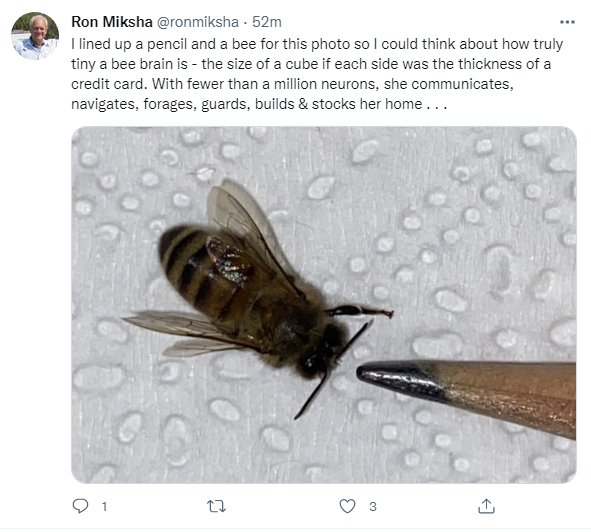
Some of the most amazing things are everyday things. Such as bee anatomy:

[Sorry, I can no longer find the link to Mishka's Tweet]

Equally amazing: We can insert things like bananas, corn bread and butchered chickens into that big hole on the front of our head and it gives us the energy to do things like read Shakespeare, clean out our garages and create new human animals. If this happened only once, it would be the most amazing things ever, but it happens all the time, which means that we take it for granted and we turn our attention to far less amazing things.

Continue ReadingAmazing Everyday Things

The “Small” Things of the Past

I was minding my own business yesterday when a Swedish book publishing company asked whether it could use one of my photos (that it found on Flickr) on the cover of a new book. It's a photo I took at the Grand Canyon in 2014. The day I took this photo seems so long ago now. I have had a few other requests like this. I'm happy to make my photos available for small projects without payment, asking only for attribution. This delightful request reminded me an important principle: There is often a long time lag between the things we do and the moments where those little things gain greater meaning. Almost everything difficult that I do today would have been impossible without years or decades of cultivating friendships, work-relationships, skill-sets and hard-earned experience. That's because "compounding" is at play far outside of the financial realm. Compounding is one of the most important and least appreciated principles in our lives. Many of my recent happy occurrences are built off off dozens or hundreds of little things, many of them far in the past. It's not easy to see where the things we do today will lead. It might be worth our time to celebrate all the moments in our lives, including the small moments.

Continue ReadingThe “Small” Things of the Past