
Christopher Hitchens: Where is Bernard Law?

In this lecture, Christopher Hitchens asks about the whereabouts of Cardinal Bernard Law, who is guilty of crimes "too hideous to describe." The undeniable fact is that Law is currently a powerful member of the Catholic clergy in Rome--he is one of the people held in high enough esteem that he has the power and privilege of voting to choose Popes. Any organization whose leaders have basic moral decency would have put such a man into handcuffs and delivered him to the police. Hitchens has many more questions for the Catholic Church too, and not an unfair attack among them, in my opinion. Examples include forbidding condom usage in Africa, where AIDs is an epidemic. This is not an academic issue--it is killing thousands of people. I also know many thinking Catholics who are driven to distraction by the official church teachings in regard to gays and birth control. Here's what Hitchens has to say about the need for the Catholic Church to apologize: I do not post this video to condemn lay Catholics, many of whom are good-hearted people who do inspiring works of kindness in the name of the church. Instead, I've posted this video because I have become weary of seeing the Church automatically and publicly presented as a font of moral judgment just because it is a church (or, in some circles, The Church). I am wondering if we will ever see a day when the Catholic Church (and every other church) is not judged favorably merely because it is a church. I'm wondering whether we will ever see the day when, in response to a claim that we should follow rule because "It is a rule of a church," people will generally ask: "What kind of church?" or "What is the track record of that church?" In any regard, we should never assume that a church is wise or moral just because it is a church. The current job title of Bernard Law compels this. Bottom line: No more free passes for churches. Or for any entity or any person, for that matter.
Continue ReadingChristopher Hitchens: Where is Bernard Law?

The Charter for Compassion: simple kind-hearted affirmation of others

Karen Armstrong's "Charter for Compassion" is a new and eloquent re-affirmation of the golden rule. Her Charter is not based upon any particular religious tradition. Rather, it is based on the recognition that compassion (the golden rule) is the centerpiece for all worthy moral systems. Armstrong, formerly a nun was recently interviewed by Bill Moyers, and had this to say:

[T]his is the beginning of something. We're writing a charter which we hope will be sort of like the charter of human rights, two pages only. Saying that compassion is far more important than belief. That it is the essence of religion. All the traditions teach that it is the practice of compassion and honoring the sacred in the other that brings us into the presence of what we call God, Nirvana, Raman, or Tao. And people are remarkably uneducated about compassion these days. So we want to bring it back to the center of attention. But then, it's got to be incarnated into practical action. . . . Compassion doesn't mean feeling sorry for people. It doesn't mean pity. It means putting yourself in the position of the other, learning about the other. Learning what's motivating the other, learning about their grievances. So the Charter of Compassion was to recall compassion from the sidelines, to which it's often put in religious discourse and put it back there.
I do believe that this type of approach is sorely needed in the modern world. We need an approach that can be embraced by every good-hearted person, religious or not. This Charter is something simple enough and powerful enough to combat the egoism, arrogant intellectualism, arrogant religions, consumerism and xenophobia that are screwing up so many of us.

Continue ReadingThe Charter for Compassion: simple kind-hearted affirmation of others

Welcome to our store! . . . sort of . . .

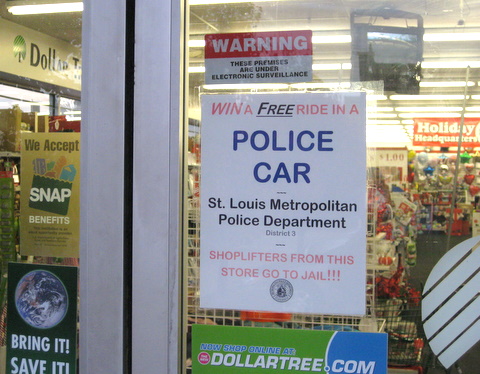
Customers of this Dollar Tree store in St. Louis are greeted with the following signs located on the main entry door: img_0210 Here's how I interpret the above: Welcome, honored guests, but it you rip us off, we'll throw your ass in the slammer before you can even utter "Merry Christmas."

Continue ReadingWelcome to our store! . . . sort of . . .

Church To State: “Do What We Want Or Else.”

The divide between church and state seems on the one hand to be growing but on the other narrowing, especially when you consider how intrusive established religions have been. Representatives of the Catholic Church sat in Nanci Pelosi's office of late while negotiations for the health care bill were ongoing, overseeing what she would do about abortion. Now this. Any way one reads this, it comes out as a threat. The quid pro quo is explicit. "If you don't bend to our will on this, we will stop services your city relies on." I have in the past believed that the tax exempt status of religions was a necessary work-around to preserve the fiction of separation. In the past, there have been instances of state intrusion directly into religions in, for one example, state funding for programs in parochial schools. There was always a quid pro quo in such offers and practices. But never has a representative of the state sat in the office of a minister while he drafted a sermon to be sure certain details got left out or included. Never, despite massive abuses by religious institutions in real estate and related financial areas, has the state moved to revoke 501(c)(3) status. It may be that any state official who tried it would be booted out of office summarily, but nevertheless that has been the unspoken law of the land. Seems the courtesy doesn't go both ways. If that's the case, I think it is time to revisit the whole issue. If the Catholic Church sees itself as providing services as an arm of the civil service sector and allows itself the conceit that it may use that service as a lever to influence political decisions, then they have implicitly given up due consideration as an inviolate institution, free from state requirements of taxation and regulation. Seems fairly clear cut to me. Obviously, there will be those who disagree. But it's time, I think, to seriously reconsider the state relationship to so-called "nonprofit" "apolitical" tax exempt institutions.

Continue ReadingChurch To State: “Do What We Want Or Else.”