
Ripped off because we don’t do well at math

I'm in the process of reading Stopped Getting Ripped off: Why Consumers Get Screwed, and How You Can Always Get a Fair Deal, by Bob Sullivan (2009). He starts off by asking you to pretend that you are in a restaurant and you are presented with a menu that he illustrates on page 5 of his book. You are asked to assume that you ordered the onion soup (the price is clearly listed on the menu as $.60) and the "Lancaster Special Sandwich" (the price is clearly listed on the menu for $1.95). The question he asks is this: "How much should you leave for a 10% tip? I'll wait for a bit while you do your calculation in your head. No calculators, please. What did you come up with? [more . . . ] The answer is 25.5 cents, so either 25 cents or 26 cents would be an acceptable answer. What Sullivan next states is shocking:

If you answer this question correctly, consider yourself part of an elite group, because when the US Department of education asked US adults to answer it as part of a nationwide study, only 42% answered correctly. Less than half of American adults were able to pick two numbers from the list, add them, then perform the most basic of all percentage calculations--simply moving the decimal point one column to the left to calculate 10%.

Innumeracy is literally killing us. Try to think of a major issue facing our country that does not require a basic proficiency in mathematics that most of us don't seem to have. Think of the environment, energy, national budget, climate, health care, evolution being taught in public schools, space exploration, public health issues (e.g., the importance of vaccinations), the true cost of the "war on drugs," reform of financial institutions or taxation policy. Since most Americans cannot understand how to calculate a 10% tip, there is little chance that they could meaningfully participate regarding most of the big issues facing our country. These are truly painful words to write. Just think of the many math-related claims that got math-ignorant voters excited during the last presidential election, including Sarah Palin's claim that American could live long and prosperously on Alaskan oil (when straight-forward calculations based on known reserves showed that there is only enough Alaskan oil to supply America's current rate of use for six months). Imagine how different things would be if most Americans could actually calculate the minimal chance that they would be affected by an act of terrorism, and if they were able to compare that risk to the immense numbers of lives that could be saved by much more modest expenditures. But it's not even clear whether most Americans can benefit from further training regarding statistics. It's certainly true that many health care professionals don't adequately understand basic problems involving risk. The reasons so many of us are innumerate are not easily addressed. We desperately need proficient math skills to tamp down our fears. I know it has been tried (and abused) before, but a sinister thought enters my mind. The information presented by Sullivan makes me wonder whether we should make voters take and pass a rudimentary math test before allowing them to vote. How indignant could a rejected voter be if he/she can't figure out a ten percent tip? Understanding the many math-based claims asserted by candidates is sometimes the only way to see past their slick acting abilities. I'm not seriously suggesting a poll quiz, though I'm sure that my frustration is showing through. What we really need to do is provide better math education all the way through school. It appears that we are paying dearly for the many grade schools that fail at math education, individually and as a country.

Continue ReadingRipped off because we don’t do well at math

Google, China, and hypocrisy

You've probably heard the stories in the news. A superpower has been shamed, a totalitarian state has been outed. A tyrannical government has been spying on the private communications of its citizens, including that of activists and journalists. What they plan to do with the fruits of their techno-espionage is not well understood, but given their history they can hardly be up to any good. What is clear is that this government is fanatical about crushing any challenge to their perceived supremacy, whether those challenges are internal or external. They even demand that private companies aid them in censoring unfavorable news (with a stunning degree of success), and these private companies (mostly based in the United States) may even have helped them spy on their citizenry. You could be forgiven for thinking that this was just another blog posting about Google and China. It's actually a post about hypocrisy. First, if you haven't heard, Google is re-evaluating their decision to do business in China, ostensibly as a result of some cyber-attacks directed at the Gmail accounts of some human-rights activists. The U.S. State Department is planning to lodge a formal protest on the alleged attacks. Plenty of others have already analyzed this story. As usual, the real story is behind the headlines. The San Francisco Chronicle reported last week:

The Google-China flap has already reignited the debate over global censorship, reinvigorating human rights groups drawing attention to abuses in the country and prompting U.S. politicians to take a hard look at trade relations. The Obama administration issued statements of support for Google, and members of Congress are pushing to revive a bill banning U.S. tech companies from working with governments that digitally spy on their citizens.
To prevent United States businesses from cooperating with repressive governments in transforming the Internet into a tool of censorship and surveillance, to fulfill the responsibility of the United States Government to promote freedom of expression on the Internet, to restore public confidence in the integrity of United States businesses...
So far, so good. Restoring public confidence in the integrity of U.S. businesses might be a tall order for any bill, but whatever. The rest are all noble goals: preventing repressive governments from using the internet as a tool of censorship and surveillance, promoting freedom of expression, and so on. Just one problem: none of these provisions apply to the U.S. Government. You see, the U.S. Government is the tyrannical superpower from the first paragraph of this blog post. You might have asked yourself why it is that the Chinese people put up with having their private communications read by their government. The real question is this: Why do you put up with it? [More . . . ]

Continue ReadingGoogle, China, and hypocrisy

Niece in Africa

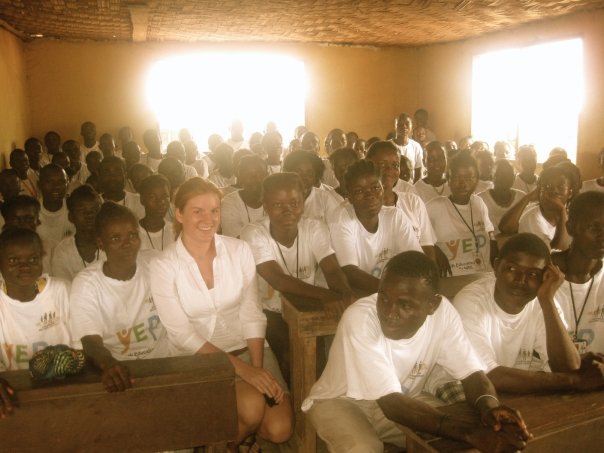
I have a charming niece named Katja Boye. She and her family are currently traveling, working and studying in various parts of West Africa. Katja recently sent my family some of her digital images; I really enjoyed the many scenes and textures and colors of Africa. I also enjoyed the contrast of seeing images of my very light-skinned relatives (they are Norwegian, with their permanent home in Norway) mingling with the many dark-skinned Africans. katja-in-class I asked Katja if she would grant me permission to share some of her photos on this website and she gave the go-ahead. I don't actually know these specific locations within West Africa yet - - perhaps Katja will write a comment and provide some further information. Katja (she stands out in the photo to the right) is the daughter of Alida Jay Boye (my wife's sister), who you can see at the left side of the sand dune photo below. Alida is the co-author of a beautifully written and photographed book describing the people and the ancient manuscripts of Timbuktu, located in the African country of Mali. Yes, Timbuktu is a real place, it is surrounded by sand dunes, and here is an aerial shot of of the city. The title Alida's book is The Hidden Treasures of Timbuktu: Rediscovering Africa's Literary Culture. For many years, Alida has been "commuting" from Norway to Mali work on these manuscripts under the auspices of the United Nations. Here's more information about Alida's work. alida-and-familyI don't claim to be able to read any of these manuscripts, but I do enjoy their physical beauty, which you can see here. Those who can read the manuscripts recognize them to be a vast literary treasure created by Africans and collected by various people and institutions in Timbuktu, which for centuries served as a commercial crossroads in Africa. For more on Timbuktu and its famous manuscripts, consider this informative video. Katja's father Thorvaldt (who works in a diplomatic capacity for the Norwegian government regarding several west African countries) and her sister Ebba (a student) have also spent considerable time working and studying in various parts of Africa. As you can see, the members of this family are quite comfortable traveling far from their cold homeland of Norway to warm Africa. Click on the title to this post for the permalink version, which will allow you to see all 18 images. Katja - thanks for letting me share these photos!

Continue ReadingNiece in Africa

The craving for beer as the cause of civilization

According to archaeologist Patrick McGovern, the craving for beer might have caused people to decide to start farming. Humans turned from hunting and gathering to agriculture because of "our ancestors’ simple urge for alcoholic beverages." He points to evidence that humans were making beer as far back as 9,000 years ago.

Continue ReadingThe craving for beer as the cause of civilization

Avatar

Okay, so I contributed to the James Cameron Self Love Fund and saw AVATAR. Yesterday we went to the 3-D showing (no way I would spend money on the normal view, I can wait for the DVD the way I do with 99% of the movies I see anymore). I’ve had a day to think about it now and I’ve come to some conclusions, which are hardly profound, but I think worth saying. Let me say up front that I wasn’t bored. Visually, this is a stunning achievement. But that’s what everyone is saying. It is, in fact, the best 3-D I’ve ever seen. Often in the past the effect is minimal and the cost in headache high. This was neither. And it fully supported the visuals rather than masking mundane or poor image elements. Pandora, the planet involved, is magnificently realized. Cool stuff. Real gosh wow. The biology is problematic. You have a wide mix of lifeforms analogous to Earth. Some big lumbering critters like hippos or rhinoceri that also have features of a dinosaur, and some small things that are clearly wolves, and one big nasty cat-like thing that’s like a sabertooth tiger. It’s unclear if any of these creatures are mammalian, but it doesn’t matter much. Dinosaur analogs. Most of them apparently four-legged. But the “horses” the natives ride are six-legged, reminiscent of Edgar Rice Burroughs’ thoats. How does that play out in evolutionary terms? Well, maybe that’s a quibble. How then do you evolve humanoids out of this? Well, maybe that’s a quibble, too. This film is not about science on any level, regardless of the few bits of dialogue suggesting there are, you know, scientists, and that there is a studyable cause to any of this. Because the story, basically, is hackneyed, cynical, and cliched. [more . . . ]

Continue ReadingAvatar