Watergate Inverted

Over the last five years, I have come to understand dozens of major events completely differently than they have been portrayed by corporate media. I don't pretend to know much about the following stary about Watergate, as told by Tucker Carlson, but Watergate 2.0 intrigues me.
Will there ever be a day when I have any confidence in the truth of any nationally significant story?

Post by conspiracybot:

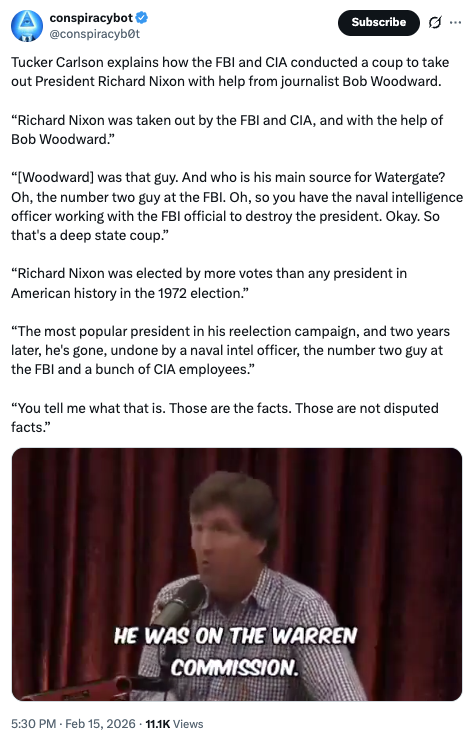
Tucker Carlson explains how the FBI and CIA conducted a coup to take out President Richard Nixon with help from journalist Bob Woodward.

“Richard Nixon was taken out by the FBI and CIA, and with the help of Bob Woodward.”

“[Woodward] was that guy. And who is his main source for Watergate? Oh, the number two guy at the FBI. Oh, so you have the naval intelligence officer working with the FBI official to destroy the president. Okay. So that's a deep state coup.”

“Richard Nixon was elected by more votes than any president in American history in the 1972 election.”

“The most popular president in his reelection campaign, and two years later, he's gone, undone by a naval intel officer, the number two guy at the FBI and a bunch of CIA employees.”

“You tell me what that is. Those are the facts. Those are not disputed facts.”
Continue ReadingWatergate Inverted

Lenin, Unvarnished

Greg Lukianoff is frustrated with the widespread white-washing of Lenin. Excerpt:

Lenin wasn’t “complicated.” He was evil. Full stop. We don’t say that enough in the United States because most people never actually learn what he did and others with “intellectual” mentors, parents or grandparents can’t let themselves admit they had a warm heart for the man who ushered in the new age of true totalitarianism quite intentionally. Instead we get at best a cartoon: czar bad, revolution messy, Stalin later goes too far. Lenin is treated like the grim (or for true elitists, heroic) but necessary prologue. That’s backwards.

This is a man who personally ordered people hanged in public “so that the people will see, tremble, and know.” Not generals on a battlefield—peasants labeled “kulaks,” defined as the wrong class of peasant, you know? Like my family. He didn’t reluctantly authorize force in a crisis. He theorized terror as a positive good. He wanted fear as a permanent feature of the system. If deliberately terrorizing civilians as a category isn’t evil, the word doesn’t mean anything.

And what he built was not run-of-the-mill authoritarianism. A normal dictator mostly wants you to shut up and not plot against him. Lenin’s party claimed a monopoly on TRUTH. Every independent center of life, churches, unions, rival socialist parties, the press, civil associations, had to be destroyed or absorbed. Violence wasn’t a last resort; it was a standing method; it was “cleansing”. Whole groups were pre-classified as enemies to be “liquidated” if necessary. He made the jump from dictatorship to totalitarianism.

Continue ReadingLenin, Unvarnished

Elon Musk Explains the Origin of OpenAI

OpenAI was supposed to be open source and non-profit. That's not how it turned out.

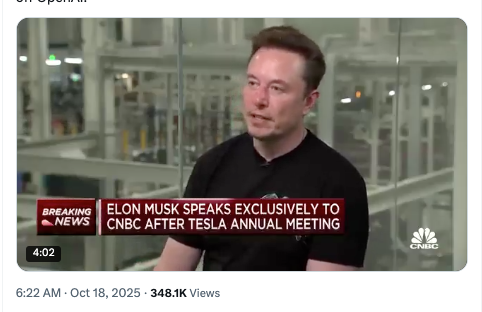
Musk explains the history (transcribed by Eva Fox on X).

“I am the reason OpenAI exists.”

“I used to be a close friend with Larry Page, and I was staying at his house, and we'd have these conversations long into the evening about AI, and I would be constantly urging him to be careful about the danger of AI. And he was really not concerned about the danger of AI and was quite cavalier about it. And at the time, Google, especially after the acquisition of DeepMind, had three-quarters of the world's AI talent; they had a lot of computers, a lot of money, so it was a unipolar world for AI. And we got a unipolar world, but the person who controls that does not, or at least did not seem to be concerned about AI safety. That sounded like a real problem.

The final straw was Larry calling me a speciest for being a pro-human consciousness instead of machine consciousness, and I like, 'Well, yes, I guess I am a speciest.'

I came up with the name [OpenAI], which refers to open source. The intent was to what is the opposite of Google, would be an open source non-profit, because Google is closed source profit, and that profit motivation could be dangerous...

It does seem weird that something can be a nonprofit, open source, and somehow transform itself into a for-profit, closed source. I mean, this would be like, let's say you founded the organization to save the Amazon rainforest, but instead, they became a lumber company and chopped down the forest and sold it for money. And you'd be, therefore, like, 'Wait a second, that's the exact opposite of what I gave the money for. Is that legal?' That doesn't seem legal. And if, in general, it is legal to start a company as a non-profit and then take the IP and transfer it to a for-profit that then makes tons of money, shouldn't everyone start? Shouldn't that be the default?

And I also think it is important to understand, like when push comes to shove, let's say they do create some digital super intelligence, almost Godlike intelligence, well, who is in control, and what is exactly the relationship between OpenAI and Microsoft? And I do worry that Microsoft actually may be more in control than the leadership team at OpenAI realizes. I mean, Microsoft, as part of Microsoft Investment, has rights to all of the software, all of the model weights, and everything necessary to run the inference system. At any point, Microsoft could cut off OpenAI.”

Continue ReadingElon Musk Explains the Origin of OpenAI

Short History of Leftist Violence

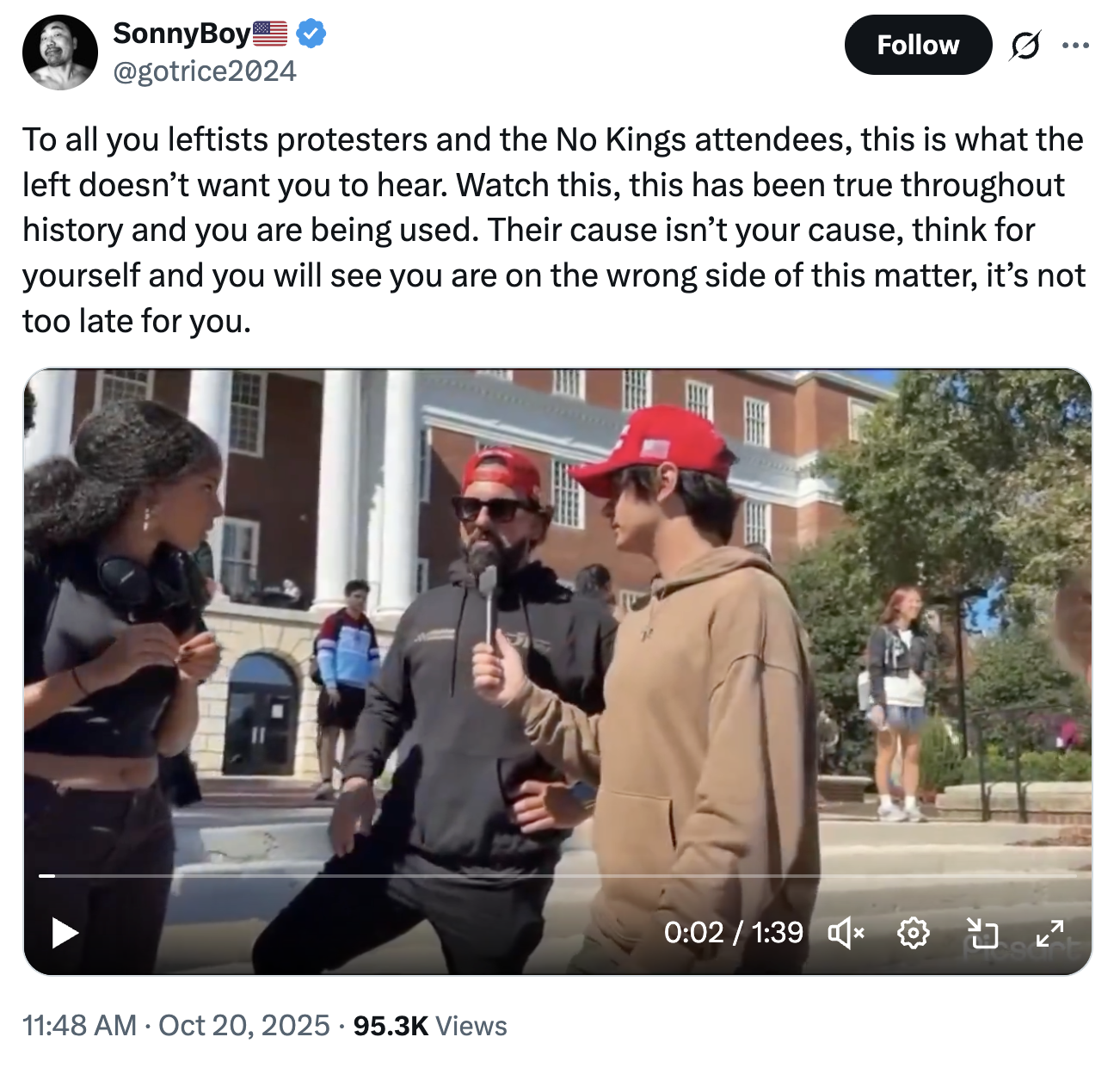
To all you leftists protesters and the No Kings attendees, this is what the left doesn’t want you to hear. Watch this, this has been true throughout history and you are being used. Their cause isn’t your cause, think for yourself and you will see you are on the wrong side of this matter, it’s not too late for you.

Continue ReadingShort History of Leftist Violence

The Complex Story of Slavery and Abolition

Next time someone tells you the simple story of slavery, suggest that they read this article by myth-buster Edward Campbell. The title: "The West Didn’t Invent Slavery: But It Fought to End It: Abolition and the birth of moral restraint."  Here's an excerpt:

Slavery was the norm for over 5,000 years. Abolition was the rupture.

In this essay, I challenge the comforting myth that history bends naturally toward justice. Instead, I trace the global story of slavery and argue that the real anomaly wasn’t oppression—it was restraint. The West didn’t invent slavery, but parts of it did something almost no civilization had done before: use power to end it.

Featuring the West Africa Squadron, the Haitian Revolution, and moral crusaders from Wilberforce to Tubman—this is a story about conscience, power, and the rare moments when they align.

Slavery is as old as civilization—dating back over 5,000 years. It was present in the earliest empires of Mesopotamia, Egypt, and China. For millennia, it was accepted as natural, necessary—even sacred. Every society practiced it; few questioned it. From pharaohs to emperors, slavery was a pillar of power. v Then—within barely a century—it virtually vanished from the earth. This essay is about the exception that proved the rule.

Slavery was the norm. Abolition was the rupture.

Continue ReadingThe Complex Story of Slavery and Abolition