
New Trend in Psychotherapy: Encouraging Learned Helplessness

A New Trend in Psychotherapy: Encouraging Learned Helplessness. In this video by FAIR, Christine Sefein, a professor of clinical psychology discusses her resignation from Antioch College. She could no longer thrive in a department that now seeks to validate its patients' claims of learned helplessness and identitarian blaming. The new approach also intentionally overlooks maladaptive behaviors. According to Sefein, this new approach destructively locks people into a belief that they are powerless. This new approach endangers patients who are feeling desperate.

This new affirmation therapy taught by Antioch is a major change from traditional approaches to psychotherapy, which properly emphasized empowering therapy, adaptive coping skills, strong social support system, exercise, meditation and, when needed, medication.  

Making this situation all-the-worse is the well documented rise in anxiety depression and self-harm among young adults.  

For more on FAIR (Foundation Against Intolerance and Racism) visit FAIR's extensive website and videos. 
Continue ReadingNew Trend in Psychotherapy: Encouraging Learned Helplessness

Beating Type 2 Diabetes Through Restriction of Food

I used to weigh 30 pounds more than I currently weigh. My secret is that I avoided most refined carbs, ate less overall and exercised more. One of the prime reasons I lost the weight was a concern with diabetes. This study should give hope to many other people concerned with diabetes. It was sent to me by a friend who decided to take control of his weight, losing 50 pounds early in the pandemic. The title: "Nutritional basis of type 2 diabetes remission."

Type 2 diabetes mellitus was once thought to be irreversible and progressive, but a series of clinical studies over the past 12 years have clarified the mechanisms that cause the disease. We now know that the processes that cause type 2 diabetes can be returned to normal functioning by restriction of food energy to achieve weight loss of around 15 kg.1 Around half of people who are within the first 10 years of diagnosis and manage to follow food energy restriction can stop all diabetes medication and return to non-diabetic glucose control.23 Remission is achieved when haemoglobin A1c concentrations of 48 mmol/mol are recorded after weight loss and at least six months later without any anti-diabetic medications (box 1).4 Here we summarise the new understanding of type 2 diabetes and consider how different changes to food intake can achieve the necessary weight loss and maintenance required for remission of diabetes.

Continue ReadingBeating Type 2 Diabetes Through Restriction of Food

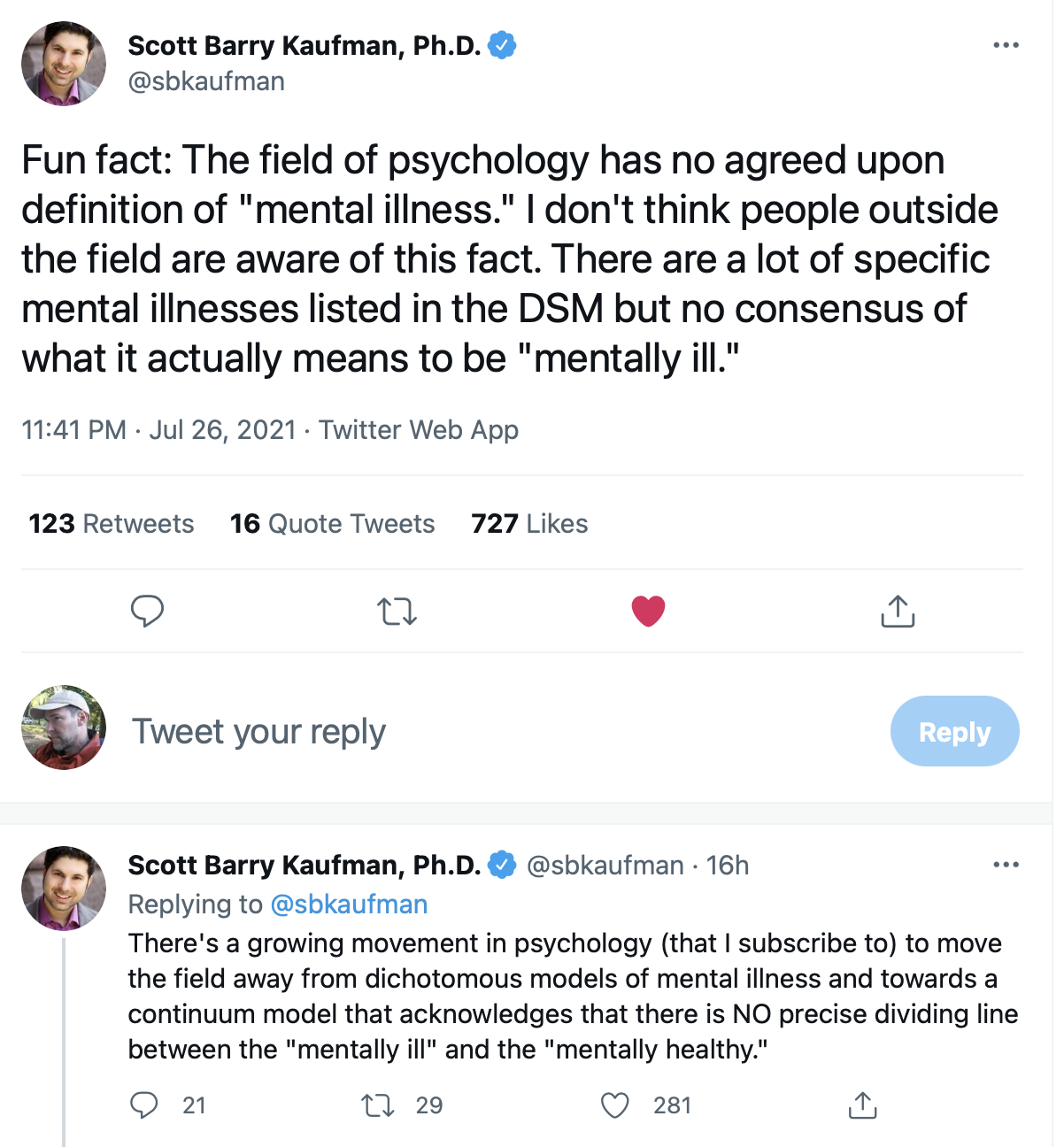
What does it mean to be “mentally ill”?

Fascinating. So what is it, at bottom, to call someone "mentally ill? Is it essentially name calling? We are surrounded highly functional people who periodically and temporarily seem highly dysfunctional in specific ways. We have been cobbled together by natural selection, living Rube Goldberg machines, we are also equipped with sophisticated built-in PR departments that make it seem like we are more purposeful, more functional than we actually are. Further, Randolph Nesse has made a strong case that many "mental illnesses" are adaptive. What does it help use a global stamp of "mentally ill"?

Here's an excerpt from Nesse's 2020 book, Good Reasons for Bad Feelings:

The question “What is a mental disorder? ”has been addressed by Jerome Wakefield, a social worker, clinician, researcher, and philosopher at New York University. His pithy conclusion is that mental disorders are characterized by “harmful dysfunction.”“Dysfunction”means a malfunction in a useful system shaped by natural selection. “Harmful”means that the dysfunction causes suffering or other harm to the individual. Wakefield’s analysis grounds psychiatric diagnosis in an evolutionary understanding of the normal functions of brain/mind, the same way the rest of medicine understands pathology in the context of normal physiology. His cogent analysis has, however, had little influence on how psychiatrists make diagnoses.

Continue ReadingWhat does it mean to be “mentally ill”?

The Problem with the Transgender Affirmative Care Standard

This is an excerpt from a review  of Abigail Shier's book Irreversible Damage by Dr. Harriet Hall, from a section called, "The customer is always right."

A new “affirmative care” standard of mental health care has been adopted by nearly every medical accrediting organization. The American Psychological Association guidelines go much further than respecting and supporting trans identities; they mandate that therapists adopt gender ideology themselves. Therapists must accept and affirm the patient’s self-diagnosis. Shrier likens this to telling an anorexic teen “If you think you are fat, then you are. Let’s talk about liposuction and weight-loss programs”. She asks whether a standard guided less by biology than by political correctness is in the best interests of the patient.

We don’t provide affirmative care for anorexia. We don’t say “Yes, you are fat” and offer to help them reduce their weight even more. Part of a therapist’s role is to question a patient’s self-assessment.

Dr. Hall emphasizes that she is open to current treatments, but only where the patient needs them:
I support hormones and gender surgeries for adults who will benefit from them. I care about the welfare of these adolescent girls and it bothers me that some of them may be unduly influenced and take irreversible steps they will later regret.

Dr. Hall concludes:

[Abigail Shrier's book] will undoubtedly be criticized just as Lisa Littman’s study was. Yes, it’s full of anecdotes and horror stories, and we know the plural of anecdote is not data, but Shrier looked diligently for good scientific studies and didn’t find much. And that’s the problem. We desperately need good science, and it’s not likely to happen in the current political climate. Anyone who addresses this subject can expect to be attacked by activists. Is ROGD a legitimate category? We don’t know, since the necessary controlled studies have not been done. I fully expect Shrier to be called a transphobe and to be vilified for harming transgender people, and I’m sure I will be labeled a transphobe just for reviewing her book.

She brings up some alarming facts that desperately need to be looked into. The incidence of teen gender dysphoria is rising and appears to be linked to internet influences and social peer groups. The number of people identifying as lesbians is dropping. Therapists are accepting patients’ self-diagnoses unquestioningly, and irreversible treatments are being offered without therapist involvement. We know at least some of these patients will desist and detransition, and we have no way to predict which ones. Children are being instructed in how to lie to parents and doctors to coerce them into providing the treatments they want. Families are being destroyed.

Continue ReadingThe Problem with the Transgender Affirmative Care Standard